





- Love & Romance
- Best Sellers
- Lilies
 $69.90








- $49.90



June 1, 2026
Slocomb June Floral Selection
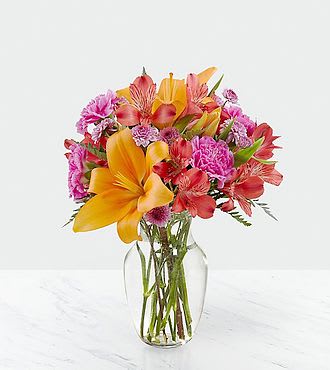
The Bloom Central flower delivery of the month for June in Slocomb is the Birthday Brights Bouquet

The Birthday Brights Bouquet from Bloom Central is a delightful floral arrangement that anyone would adore. With its vibrant colors and cheerful blooms, it's sure to bring a smile to the face of that special someone.
This bouquet features an assortment of beautiful flowers in shades of pink, orange, yellow, and purple. The combination of these bright hues creates a lively display that will add warmth and happiness to any room.
Specifically the Birthday Brights Bouquet is composed of hot pink gerbera daisies and orange roses taking center stage surrounded by purple statice, yellow cushion poms, green button poms, and lush greens to create party perfect birthday display.
To enhance the overall aesthetic appeal, delicate greenery has been added around the blooms. These greens provide texture while giving depth to each individual flower within the bouquet.
With Bloom Central's expert florists crafting every detail with care and precision, you can be confident knowing that your gift will arrive fresh and beautifully arranged at the lucky recipient's doorstep when they least expect it.
If you're looking for something special to help someone celebrate - look no further than Bloom Central's Birthday Brights Bouquet!
Slocomb Alabama Flower Delivery
Slocomb Flower Delivery - Frequently Asked Questions
- Does Bloom Central offer same-day flower delivery in Slocomb?
- Yes. Place your order online before 1:00 PM and a local Slocomb florist will hand-deliver your arrangement the same day. Orders can also be scheduled up to one month in advance.
- Is it safe to order flowers online?
- Absolutely! We utilize a secure, encrypted checkout to protect your personal and payment information. Visa, Mastercard, American Express, Discover, PayPal and Klarna are all accepted.
- What funeral homes does Bloom Central deliver sympathy flowers to in Slocomb?
- We hand-deliver sympathy and memorial floral arrangements to all funeral homes near Slocomb, including: Enterprise City Cemetery, Integrity Funeral Services, Jackson County Vault & Monuments, Searcy Funeral Home & Crematory, Sorrells Funeral Home, Inc., Ward Wilson Memory Hill Cemetary.
- What churches does Bloom Central deliver flowers to in Slocomb?
- We deliver fresh floral arrangements to all churches and places of worship in Slocomb, including: Countyline Missionary Baptist Church, First Baptist Church.
- What nearby cities does Bloom Central also deliver flowers to?
- In addition to Slocomb, we deliver fresh flowers to many nearby cities including: Malvern, Hartford, Taylor, Rehobeth, Dothan, Daleville, Newton, Midland City
- What are the most popular flower arrangements at the Slocomb florist?
- Three of our most popular arrangements at our Slocomb florist are: Color Craze Bouquet ($59.90), Prairie Sunrise Bouquet and Happy Birthday Topper ($64.90), Beautiful Spirit Basket ($79.90). All are available for same-day delivery.
More About Slocomb
Are looking for a Slocomb florist because you are not local to the area? If so, here is a brief travelogue of what Slocomb has to offer. Who knows, perhaps you'll be intrigued enough to come visit soon, partake in some of the fun activities Slocomb has to offer and deliver flowers to your loved one in person!
The sun in Slocomb, Alabama, does not so much rise as press itself against the flatness of the land, a slow suffusion of gold that turns the dew on peanut fields into something like scattered glass. You notice first the quiet, which is not an absence but a presence, a low thrum of tractors idling, screen doors whispering shut, the distant clang of a bell at Slocomb High signaling the start of a day that feels both urgent and unhurried. Here, time moves like syrup. The town’s single traffic light blinks red in all directions, less a regulator than a metronome, a steady reminder that rhythm, not rush, governs what the locals call “The Tomato Capital of Alabama.” The title is earned, not given. Each summer, the soil, a loamy, crimson thing, yields rows of tomatoes so plump and unblemished they seem less grown than curated, as if the earth itself were an artist with a knack for precision.
To drive through Slocomb is to witness a kind of paradox: a place that refuses to vanish. The downtown strip, with its squat brick buildings and fading murals, persists in the manner of old hymns. At the Co-op, farmers in seed caps trade stories over grits, their hands calloused maps of labor. The hardware store still sells single nails, because sometimes you only need one. The volunteer fire department hosts pancake breakfasts where the syrup is poured with a generosity that borders on spiritual. There’s a sense of mutual recognition here, a web of glances and nods that says, I see you, you see me, and that’s enough.

Same day service available. Order your Slocomb floral delivery and surprise someone today!
What outsiders might mistake for inertia is, in fact, a kind of fierce loyalty, to land, to tradition, to each other. Take the Slocomb Tomato Festival, a three-day jubilee where the fruit is celebrated with parades, recipes, and a crowning ceremony for the Tomato Queen. The festival is less about tomatoes than about what tomatoes mean: continuity, care, the pride of tending something fragile until it thrives. Teenagers in 4-H shirts beam as they present blue-ribbon specimens, their faces flushed with a pride that transcends agriculture. Elders, seated in fold-out chairs under the pavilion, speak of rainfall and rot with the gravity of philosophers. Everyone knows heat and blight are inevitable, but so, they insist, is next year’s crop.
The people here wear resilience like a second skin. At the diner on Main Street, the waitress calls you “sugar” and remembers how you take your coffee. The librarian hands a third-grader a book on astronauts and says, “You’ll do big things,” without a trace of irony. In the park, children chase fireflies as fathers swap tools for favors, a lawnmower repaired, a fence post set, deals sealed not with invoices but handshakes. There’s an unspoken pact here: no one gets left behind. When storms tear through, as they often do, barns are rebuilt before insurance adjusters arrive. Casseroles appear on porches without prompting. Grief, like joy, is communal.
It would be easy to frame Slocomb as an artifact, a relic of some mythic “simpler time.” But that’s a disservice. The town pulses with a quiet modernity: broadband lines buried beside cotton fields, students coding in computer labs that smell of fresh paint, a solar farm humming on the outskirts like a hymn to the future. Progress here isn’t an eraser; it’s a bridge. The past isn’t worshipped, it’s used, the way a farmer uses every part of the harvest. History here is both anchor and compass.
To leave Slocomb is to carry its imprint. The way the horizon hugs the earth, the smell of turned soil after rain, the sound of a gospel choir drifting from a church whose doors haven’t locked in 50 years. These details accumulate. They become a kind of compass. The town, in its unassuming way, asks a question: What does it mean to stay? To dig in, to tend, to belong? The answers are written in the gleam of a tomato’s skin, in the hand-painted sign outside the elementary school that reads, “Watch us grow.”