





- Get Well
- Best Sellers
- Carnations
 $54.90
- $54.90
- $79.90
- $54.90
- $49.90
- $49.90






















June 1, 2026
Tuskegee June Floral Selection
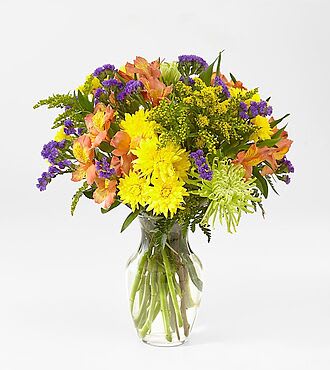
The Bloom Central flower delivery of the month for June in Tuskegee is the All For You Bouquet

The All For You Bouquet from Bloom Central is an absolute delight! Bursting with happiness and vibrant colors, this floral arrangement is sure to bring joy to anyone's day. With its simple yet stunning design, it effortlessly captures the essence of love and celebration.
Featuring a graceful assortment of fresh flowers, including roses, lilies, sunflowers, and carnations, the All For You Bouquet exudes elegance in every petal. The carefully selected blooms come together in perfect harmony to create a truly mesmerizing display. It's like sending a heartfelt message through nature's own language!
Whether you're looking for the perfect gift for your best friend's birthday or want to surprise someone dear on their anniversary, this bouquet is ideal for any occasion. Its versatility allows it to shine as both a centerpiece at gatherings or as an eye-catching accent piece adorning any space.
What makes the All For You Bouquet truly exceptional is not only its beauty but also its longevity. Crafted by skilled florists using top-quality materials ensures that these blossoms will continue spreading cheer long after they arrive at their destination.
So go ahead - treat yourself or make someone feel extra special today! The All For You Bouquet promises nothing less than sheer joy packaged beautifully within radiant petals meant exclusively For You.
Local Flower Delivery in Tuskegee
Tuskegee Flower Delivery - Frequently Asked Questions
- Does Bloom Central offer same-day flower delivery in Tuskegee?
- Yes. Place your order online before 1:00 PM and a local Tuskegee florist will hand-deliver your arrangement the same day. Orders can also be scheduled up to one month in advance.
- Is it safe to order flowers online?
- Absolutely! We utilize a secure, encrypted checkout to protect your personal and payment information. Visa, Mastercard, American Express, Discover, PayPal and Klarna are all accepted.
- What hospitals and care facilities does Bloom Central deliver to in Tuskegee?
- We deliver fresh flower arrangements to all hospitals, nursing homes and care facilities in Tuskegee Alabama, including: Central Alabama Veterans Health Care System East Campus, Magnolia Haven Health And Rehabilitation Center.
- What funeral homes does Bloom Central deliver sympathy flowers to in Tuskegee?
- We hand-deliver sympathy and memorial floral arrangements to all funeral homes near Tuskegee, including: Alabama Heritage Funeral Home, Bass Funeral Home, Brookside Funeral Home Crematorium & Memorial Gardens, Fort Mitchell National Cemetery, Frederick-Dean Funeral Home, Ingram Memorial, Johnson Brown Service Funeral Home, Leak Memory Chapel, McMullen Funeral Home and Crematory, Montgomery Memorial Cemetery, Parkhill Cemetery, Pine Hill Cemetery, Radney Funeral Home, Ross-Clayton Funeral Home, Striffler-Hamby Mortuary, Taylor Funeral Home, Vance Memorial Chapel, Wetumka Memorial Funeral Home.
- What churches does Bloom Central deliver flowers to in Tuskegee?
- We deliver fresh floral arrangements to all churches and places of worship in Tuskegee, including: Bethel Missionary Baptist Church, Butler Chapel African Methodist Episcopal Zion Church, Chehaw African Methodist Episcopal Zion Church, Fort Hull African Methodist Episcopal Zion Church, Greater Friendship Baptist Church, Greater Saint Mark Missionary Baptist Church, Hickory Grove African Methodist Episcopal Zion Church, Liberty Hill African Methodist Episcopal Zion Church, Pine Grove African Methodist Episcopal Zion Church, Saint James African Methodist Episcopal Church, Saint John African Methodist Episcopal Church, Shady Grove Missionary Baptist Church.
- What nearby cities does Bloom Central also deliver flowers to?
- In addition to Tuskegee, we deliver fresh flowers to many nearby cities including: Tallassee, Auburn, Union Springs, Emerald Mountain, Opelika, Eclectic, Pike Road, Camp Hill
- What are the most popular flower arrangements at the Tuskegee florist?
- Three of our most popular arrangements at our Tuskegee florist are: Colorful Visions Bouquet ($54.90), Unity Bouquet ($59.90), Justice Basket ($59.90). All are available for same-day delivery.
More About Tuskegee
Are looking for a Tuskegee florist because you are not local to the area? If so, here is a brief travelogue of what Tuskegee has to offer. Who knows, perhaps you'll be intrigued enough to come visit soon, partake in some of the fun activities Tuskegee has to offer and deliver flowers to your loved one in person!
The sun in Tuskegee is the kind that doesn’t just illuminate but interrogates. It presses down on the red clay roads, the rows of pecan trees, the white-columned buildings of Tuskegee University, asking in its silent thermal way: What are you? What have you been? What will you become? These questions linger here. They hover over the town like the heat, unavoidable, a low hum in the blood. To walk Tuskegee’s streets is to move through a palimpsest of American history, each layer insisting on its relevance. The past here isn’t past. It’s a living thing, breathing through the cracks in the sidewalks, the rustle of oak leaves, the quiet resolve of people who’ve turned legacy into labor.
Start at the university. Booker T. Washington founded it in 1881 with a shoestring budget and a blueprint for Black dignity. The campus today is a sprawl of green and brick where students still plant crops in the same soil George Washington Carver once coaxed into yielding secrets. Carver’s labs, preserved behind glass, feel less like relics than blueprints. You half-expect the man himself to materialize, pocket full of peanuts, muttering about the regenerative properties of sweet potatoes. His ghost would approve of the current projects: sustainable agriculture, aerospace engineering, a nursing program training healers for rural clinics. Tuskegee doesn’t memorialize. It iterates.

Same day service available. Order your Tuskegee floral delivery and surprise someone today!
Drive south on Highway 81. The Moton Field airstrip appears like a mirage, its control tower jutting into the blue. This is where the Tuskegee Airmen learned to fly in a country that often insisted they crawl. Their hangars now house museums where children press hands against P-51 Mustang replicas, tracing the outlines of red tails. The guides here, some descendants of the original pilots, speak in a vernacular of pride and precision. They’ll tell you the airmen’s story isn’t about overcoming. It’s about ascension. Gravity, in all its forms, was just another force to be harnessed.
Downtown’s storefronts wear fresh paint over old bones. The Rooster’s Crow Bookshop shares a block with a family-run soul food spot where collards simmer for hours. Proprietors greet regulars by name and newcomers with a curiosity that’s neither intrusive nor performative. It’s the kind of place where a stranger might hand you a pecan pie recipe unsolicited, saying, “Swap butter for lard if you want it like my grandma’s.” History here is familial, tactile, passed hand to hand.
At the Tuskegee History Center, exhibits chronicle everything from Reconstruction to the civil rights era. The curator, a woman with a laugh like a wind chime, emphasizes not the trauma but the continuity. “Look at these quilts,” she’ll say. “See how the stitches hold? That’s us. Every thread a story. Every knot a choice to stay whole.” The center’s archives brim with letters, photographs, oral histories, each a rebuttal to erasure.
Outside, kids play tag around the Confederate monument relocated here from the town square. Its presence now is pedagogical, flanked by plaques that dissect the mythology of the Lost Cause. Recontextualized, it becomes inert, a stone lesson in how to disarm symbols. Nearby, a community garden thrives. Tomatoes and okra rise in tidy rows. A hand-painted sign says, “Grow where you’re planted.”
There’s a particular light that falls on Tuskegee in late afternoon. It gilds the chapel spire, the fire station, the murals of Harriet Tubman and Rosa Parks that dominate entire building sides. The light feels like an invitation to look closer, to see not just what was done to this place but what it has done, relentlessly, insistently, for itself. Tuskegee’s story is often framed as a series of trials. But spend time here and you notice something else: an arc bending not just toward justice, but toward joy. It’s in the hum of a biology lab, the roar of a vintage plane engine, the chorus of cicadas at dusk. It’s the sound of a town that has learned to turn memory into momentum, one breath at a time.