




- New Baby
- Best Sellers
- Lilies


 $49.90
June 1, 2026
Dillingham June Floral Selection
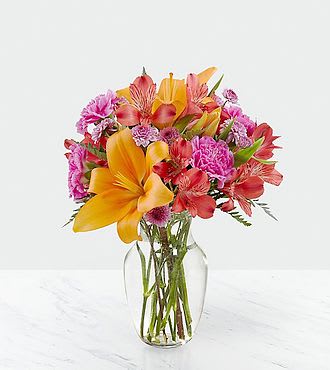
The Bloom Central flower delivery of the month for June in Dillingham is the Hello Gorgeous Bouquet
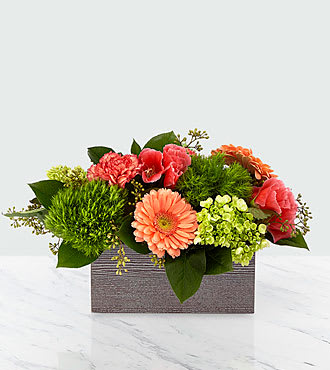
The Hello Gorgeous Bouquet from Bloom Central is a simply breathtaking floral arrangement - like a burst of sunshine and happiness all wrapped up in one beautiful bouquet. Through a unique combination of carnation's love, gerbera's happiness, hydrangea's emotion and alstroemeria's devotion, our florists have crafted a bouquet that blossoms with heartfelt sentiment.
The vibrant colors in this bouquet will surely brighten up any room. With cheerful shades of pink, orange, and peach, the arrangement radiates joy and positivity. The flowers are carefully selected to create a harmonious blend that will instantly put a smile on your face.
Imagine walking into your home and being greeted by the sight of these stunning blooms. In addition to the exciting your visual senses, one thing you'll notice about the Hello Gorgeous Bouquet is its lovely scent. Each flower emits a delightful fragrance that fills the air with pure bliss. It's as if nature itself has created a symphony of scents just for you.
This arrangement is perfect for any occasion - whether it be a birthday celebration, an anniversary surprise or simply just because the versatility of the Hello Gorgeous Bouquet knows no bounds.
Bloom Central takes great pride in delivering only the freshest flowers, so you can rest assured that each stem in this bouquet is handpicked at its peak perfection. These blooms are meant to last long after they arrive at your doorstep and bringing joy day after day.
And let's not forget about how easy it is to care for these blossoms! Simply trim the stems every few days and change out the water regularly. Your gorgeous bouquet will continue blooming beautifully before your eyes.
So why wait? Treat yourself or someone special today with Bloom Central's Hello Gorgeous Bouquet because everyone deserves some floral love in their life!
Dillingham Alaska Flower Delivery
Dillingham Flower Delivery - Frequently Asked Questions
- Does Bloom Central offer same-day flower delivery in Dillingham?
- Yes. Place your order online before 1:00 PM and a local Dillingham florist will hand-deliver your arrangement the same day. Orders can also be scheduled up to one month in advance.
- Is it safe to order flowers online?
- Absolutely! We utilize a secure, encrypted checkout to protect your personal and payment information. Visa, Mastercard, American Express, Discover, PayPal and Klarna are all accepted.
- What hospitals and care facilities does Bloom Central deliver to in Dillingham?
- We deliver fresh flower arrangements to all hospitals, nursing homes and care facilities in Dillingham Alaska, including: Kanakanak Hospital - Bbahc, Marrulut Eniit Assisted Living.
- What churches does Bloom Central deliver flowers to in Dillingham?
- We deliver fresh floral arrangements to all churches and places of worship in Dillingham, including: Community Baptist Church.
- What are the most popular flower arrangements at the Dillingham florist?
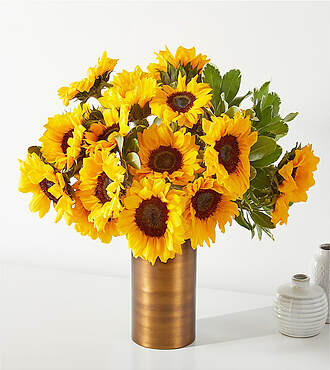
- Three of our most popular arrangements at our Dillingham florist are: High Style Bouquet ($59.90), Sun Salutation Box Bouquet ($64.90), On One Knee Bouquet Set ($135.90). All are available for same-day delivery.
More About Dillingham
Are looking for a Dillingham florist because you are not local to the area? If so, here is a brief travelogue of what Dillingham has to offer. Who knows, perhaps you'll be intrigued enough to come visit soon, partake in some of the fun activities Dillingham has to offer and deliver flowers to your loved one in person!
Dillingham, Alaska, sits at the edge of the world in a way that makes the phrase “middle of nowhere” feel like a cartographer’s inside joke. The town’s 2,300-odd residents occupy a sliver of land between the Nushagak River’s silt-rich currents and the vast, treeless tundra that stretches north toward places with names only geologists and caribou know. To fly into Dillingham in summer is to witness a paradox: a community both dwarfed by and inseparable from the wilderness around it. The plane banks low over Bristol Bay, where the water churns with salmon runs so thick they look like seismic shifts, and you think, if you’re the sort who thinks in metaphors, that the fish are less a resource here than a kind of pulsing, silver bloodstream, keeping everything alive.
The rhythm of Dillingham bends to the will of these fish. In July, the docks hum with a kinetic urgency as commercial fishermen in Grundéns gear ready their gillnets, their voices blending with the cries of gulls and the diesel growl of boats named Arctic Dawn and North Star. Kids pedal bikes past stacks of crab pots, their laughter sharp against the clatter. At the height of the season, the sun lingers past midnight, painting the sky in hues of peach and lavender, and the cannery workers, many of them Yup’ik natives who’ve fished these waters for generations, move with the steady precision of people who understand that time is both elastic and precious. There’s a communion here, an unspoken pact between human and horizon. You feel it in the way a deckhand’s hands split salmon with practiced ease, in the way elders mend nets while sharing stories that twist English and Yup’ik into something melodic.

Same day service available. Order your Dillingham floral delivery and surprise someone today!
Walk past the airstrip, where bush planes come and go like clockwork, and you’ll find a grid of gravel roads leading to a library, a school, a clinic. The homes are a patchwork of clapboard and corrugated metal, their yards dotted with snow machines and dog teams. In winter, when temperatures plunge and daylight shrinks to a slim blue wafer, the town turns inward. Ice clings to everything, fence posts, boat hulls, beards, and the northern lights ripple overhead like celluloid dreams. Neighbors check on neighbors. Potlucks materialize in community halls, steaming with moose stew and fry bread. Teenagers race four-wheelers across frozen lakes, their headlights carving arcs in the dark.
What’s easy to miss, if you’re just passing through, is the quiet calculus of resilience here. Dillingham isn’t a postcard or a frontier fantasy. It’s a place where people fix their own engines, teach their kids to both code and fillet a king salmon, and debate the merits of new hydroelectric projects with the gravity of philosophers. The local radio station broadcasts weather reports, birthday shoutouts, and lost-dog alerts with equal solemnity. At the cultural center, artists carve walrus ivory into intricate shapes, their knives tracing patterns older than the concept of Alaska.
Stand on the bluffs above the Nushagak at dusk, watching the water turn the color of hammered steel, and you might notice how the landscape refuses to be romanticized. The tundra doesn’t care about your awe. The bears padding through the fireweed exist in a different tense. Yet there’s a warmth here, a frayed-at-the-edges generosity that defies the isolation. Maybe it’s the scale of things, the knowledge that you’re small, that the land and sea dictate terms, that survival is a team sport. Or maybe it’s the light, that singular Alaskan light, which in summer has the clarity of a diamond and in winter the softness of a bruise, always reminding you that beauty isn’t a luxury but a condition of existence.
Dillingham doesn’t announce itself. It whispers in the clang of buoys, the creak of dock lines, the static crackle of VHF radios. It asks you to lean in, to listen. And if you do, you’ll hear something rare: a town that isn’t just surviving but measuring life in tides, in fish counts, in the slow unfurling of a place that knows its own worth.