





- Best Value
- Best Sellers
- Under $100
 $49.90













June 1, 2026
Steele Creek June Floral Selection
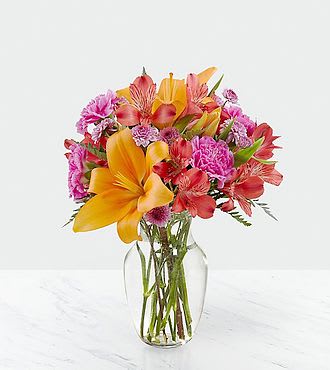
The Bloom Central flower delivery of the month for June in Steele Creek is the Into the Woods Bouquet

The Into the Woods Bouquet floral arrangement from Bloom Central is simply enchanting. The rustic charm and natural beauty will captivate anyone who is lucky enough to receive this bouquet.
The Into the Woods Bouquet consists of hot pink roses, orange spray roses, pink gilly flower, pink Asiatic Lilies and yellow Peruvian Lilies. The combination of vibrant colors and earthy tones create an inviting atmosphere that every can appreciate. And don't worry this dazzling bouquet requires minimal effort to maintain.
Let's also talk about how versatile this bouquet is for various occasions. Whether you're celebrating a birthday, hosting a cozy dinner party with friends or looking for a unique way to say thinking of you or thank you - rest assured that the Into the Woods Bouquet is up to the task.
One thing everyone can appreciate is longevity in flowers so fear not because this stunning arrangement has amazing staying power. It will gracefully hold its own for days on end while still maintaining its fresh-from-the-garden look.
When it comes to convenience, ordering online couldn't be easier thanks to Bloom Central's user-friendly website. In just a few clicks, you'll have your very own woodland wonderland delivered straight to your doorstep!
So treat yourself or someone special to a little piece of nature's serenity. Add a touch of woodland magic to your home with the breathtaking Into the Woods Bouquet. This fantastic selection will undoubtedly bring peace, joy, and a sense of natural beauty that everyone deserves.
Steele Creek Alaska Flower Delivery
Steele Creek Flower Delivery - Frequently Asked Questions
- Does Bloom Central offer same-day flower delivery in Steele Creek?
- Yes. Place your order online before 1:00 PM and a local Steele Creek florist will hand-deliver your arrangement the same day. Orders can also be scheduled up to one month in advance.
- Is it safe to order flowers online?
- Absolutely! We utilize a secure, encrypted checkout to protect your personal and payment information. Visa, Mastercard, American Express, Discover, PayPal and Klarna are all accepted.
- What nearby cities does Bloom Central also deliver flowers to?
- In addition to Steele Creek, we deliver fresh flowers to many nearby cities including: Farmers Loop, Badger, Fairbanks, College, North Pole, Goldstream, Ester, Chena Ridge
- What are the most popular flower arrangements at the Steele Creek florist?
- Three of our most popular arrangements at our Steele Creek florist are: Southwest Sophistication Dishgarden ($89.90), Special Request 90 ($90.00), Chinese Evergreen Plant ($117.90). All are available for same-day delivery.
More About Steele Creek
Are looking for a Steele Creek florist because you are not local to the area? If so, here is a brief travelogue of what Steele Creek has to offer. Who knows, perhaps you'll be intrigued enough to come visit soon, partake in some of the fun activities Steele Creek has to offer and deliver flowers to your loved one in person!
The thing about Steele Creek isn’t that it’s hidden, though it is, tucked into Alaska’s interior like a secret whispered between mountains, but that it insists on being found anyway. You drive north from Fairbanks until the road thins to gravel, then dirt, then something more like a suggestion, and just when the spruce have crowded so close you’re certain civilization has given up, there it is: a scatter of cabins, a general store with a hand-painted sign, a schoolhouse where six kids study fractions under a window that frames a peak locals call “The Old Man’s Chin.” The air smells of thawing permafrost and diesel generators. People here don’t so much live as persist, their lives a daily negotiation with a land that’s equal parts muse and antagonist.
Morning in Steele Creek starts with light, not the timid, apologetic stuff of lower latitudes, but a radiant blaze that crests the Alaska Range and floods the valley in gold. By 7 a.m., Floyd Tobin is already at the airstrip, fueling his Cessna for the day’s mail run. His hands move with the brisk efficiency of someone who’s repaired an engine mid-blizzard. Across town, Janice Cole checks traps along the creek, her breath fogging the air as she kneels to inspect tracks: moose, wolf, the occasional wolverine. She’ll teach a survival workshop later at the community center, demonstrating how to build a fire with damp wood, her voice steady as she says, “The cold isn’t your enemy. Impatience is.”

Same day service available. Order your Steele Creek floral delivery and surprise someone today!
What’s striking isn’t the isolation but the density of connection. At the store, Martha Lee stocks shelves with canned peaches and snowshoes, memorizing orders called in from homesteads 50 miles out. She knows who needs insulin, who’s low on propane, who’d appreciate a tin of shortbread slipped into their parcel. When the northern lights flare, neon green rippling over the tundra, kids pile into pickup beds to watch, mittened hands pointing at the sky, while parents sip coffee and trade stories about the ’92 freeze or the summer the caribou came through. There’s a rhythm here that feels ancient, a choreography of mutual aid and quiet labor.
Technology exists but doesn’t dominate. Satellite internet reaches Steele Creek, but you’ll more often find teenagers learning to tan hides at the library than scrolling TikTok. The lone drone in town belongs to Ben Yazzie, who uses it to track migratory caribou herds, the footage helping elders predict hunting routes. At potlucks, casseroles share table space with jars of cloudberry jam and thumb-drives of aerial maps. Progress here isn’t a replacement; it’s a tool, folded into tradition like a new verse in an old song.
Winter is the great unifier. Temperatures plunge to 40 below, and the community becomes a single organism. Neighbors plow each other’s driveways with ATVs. The school doubles as a storm shelter. When the generator at Ruth Harper’s cabin fails, three men arrive within the hour, their parkas dusted with ice, to jury-rig a fix using parts from a disassembled snowmobile. Later, they’ll joke about it over moose chili at the lodge, their laughter echoing under taxidermied caribou heads. Hardship, here, isn’t romanticized or resented, it’s the thread that weaves them together.
Come summer, Steele Creek softens. The sun lingers past midnight, glazing the tundra in amber. Gardens erupt in riotous spinach and rhubarb. Fishermen cast for grayling in the creek, their lines arcing through light that never quite fades. Tourists trickle in, wide-eyed at the scale of it all, and locals greet them with the gentle humor of people who’ve mastered a life that seems impossible to outsiders. “No, we don’t have Uber,” Martha Lee tells a visitor, grinning as she hands him a map. “But that ridge? Best view you’ll ever hike to. Take a bear bell.”
It would be easy to mythologize Steele Creek as a frontier relic, a holdout against modernity. But that’s not quite right. This isn’t a place frozen in time; it’s a place that moves to a different clock, one paced by seasons and storms and the sound of prop planes buzzing over the Talkeetnas. What binds people here isn’t nostalgia but a shared understanding: that remoteness can be a kind of abundance, that community isn’t just a word but a verb, practiced daily. You don’t escape to Steele Creek. You meet it, again and again, in the crunch of boots on frost, the glow of a woodstove at dusk, the way the horizon stretches wide enough to hold every hope you’ve ever carried.