





- Anniversary
- Best Sellers
- Under $80
 $69.90




- $69.90

June 1, 2026
Loyola June Floral Selection
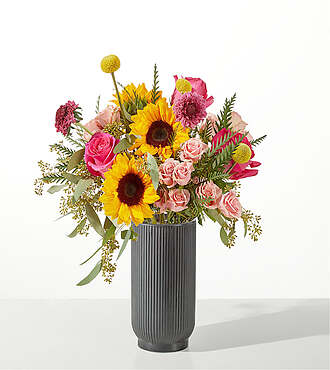
The Bloom Central flower delivery of the month for June in Loyola is the Be Bold Bouquet by Better Homes and Gardens

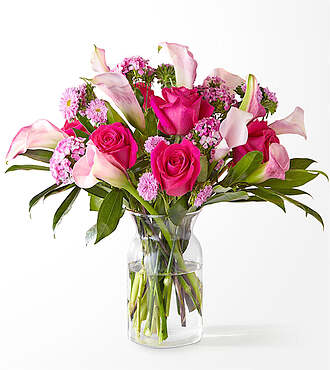
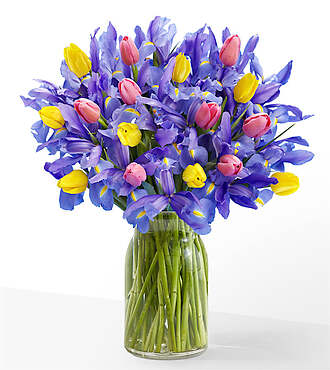
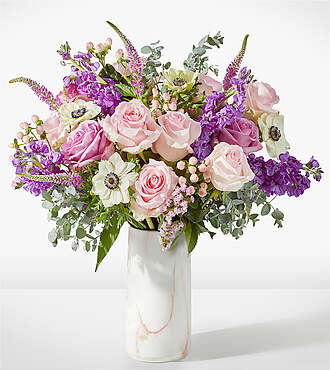
Introducing the Be Bold Bouquet by Better Homes and Gardens floral arrangement! Blooming with bright colors to boldly express your every emotion, this exquisite flower bouquet is set to celebrate. Hot pink roses, purple Peruvian Lilies, lavender mini carnations, green hypericum berries, lily grass blades, and lush greens are brought together to create an incredible flower arrangement.
The flowers are artfully arranged in a clear glass cube vase, allowing their natural beauty to shine through. The lucky recipient will feel like you have just picked the flowers yourself from a beautiful garden!
Whether you're celebrating an anniversary, sending get well wishes or simply saying 'I love you', the Be Bold Bouquet is always appropriate. This floral selection has timeless appeal and will be cherished by anyone who is lucky enough to receive it.
Better Homes and Gardens has truly outdone themselves with this incredible creation. Their attention to detail shines through in every petal and leaf - creating an arrangement that not only looks stunning but also feels incredibly luxurious.
If you're looking for a captivating floral arrangement that brings joy wherever it goes, the Be Bold Bouquet by Better Homes and Gardens is the perfect choice. The stunning colors, long-lasting blooms, delightful fragrance and affordable price make it a true winner in every way. Get ready to add a touch of boldness and beauty to someone's life - you won't regret it!
Loyola Florist
Loyola Flower Delivery - Frequently Asked Questions
- Does Bloom Central offer same-day flower delivery in Loyola?
- Yes. Place your order online before 1:00 PM and a local Loyola florist will hand-deliver your arrangement the same day. Orders can also be scheduled up to one month in advance.
- Is it safe to order flowers online?
- Absolutely! We utilize a secure, encrypted checkout to protect your personal and payment information. Visa, Mastercard, American Express, Discover, PayPal and Klarna are all accepted.
- What funeral homes does Bloom Central deliver sympathy flowers to in Loyola?
- We hand-deliver sympathy and memorial floral arrangements to all funeral homes near Loyola, including: Bubbling Well Pet Memorial Park, Catholic Cemeteries of the Diocese, Crosby-N. Gray & Co. Funeral Home and Cremation Service, Cusimano Family Colonial Mortuary, DC Cemetery, Felix Services Company, Gate of Heaven Cemetery, Mountain View Funeral and Cremation Service - The Casket Store, Spangler Mortuaries, Spangler Mortuaries.
- What nearby cities does Bloom Central also deliver flowers to?
- In addition to Loyola, we deliver fresh flowers to many nearby cities including: Los Altos, Mountain View, Los Altos Hills, Sunnyvale, Cupertino, Stanford, Ladera, Palo Alto
- What are the most popular flower arrangements at the Loyola florist?
- Three of our most popular arrangements at our Loyola florist are: Color of Love Bouquet ($84.90), French Garden ($89.90), Spring Tradition - A Florist Original ($54.90). All are available for same-day delivery.
More About Loyola
Are looking for a Loyola florist because you are not local to the area? If so, here is a brief travelogue of what Loyola has to offer. Who knows, perhaps you'll be intrigued enough to come visit soon, partake in some of the fun activities Loyola has to offer and deliver flowers to your loved one in person!
Loyola, California, sits between a sprawl of coastal hills and a stretch of highway so unassuming you might miss the exit twice. The town is the kind of place where the sun climbs over the ridge each morning like a kid peeking into a cookie jar, spilling light onto streets still damp from the fog that rolls in each night as reliably as the tides. To drive through Loyola is to feel time slow in a way that makes your rental car’s GPS glitch, recalculating not routes but priorities. The air here smells like eucalyptus and espresso, a blend so specific you’ll find yourself unconsciously breathing deeper, as if the act could clear more than just your sinuses.
The locals move with the deliberate calm of people who’ve hacked some code the rest of us are still parsing. At the farmers’ market, Saturdays, 7 a.m. sharp, they linger at stalls selling heirloom tomatoes and raw honey, discussing soil pH and the merits of different compost teas. These conversations aren’t small talk. They’re debates about the metaphysics of growth, the ethics of zucchini. A woman in a sunhat offers a sample of peach. The fruit’s sweetness hits your tongue like a revelation, and suddenly you’re nodding along as she explains how sunlight angles in September affect the sugar content. You didn’t know you cared. You do now.

Same day service available. Order your Loyola floral delivery and surprise someone today!
Downtown Loyola has exactly one traffic light, which the city council votes annually to keep “just to prove we’re not sentimental.” The buildings are low-slung, a mix of midcentury stucco and Victorian-era woodwork maintained with a vigilance that suggests the town collectively agreed aging is optional. Storefronts include a bookstore whose owner handwrites recommendations on index cards (“If you liked The Overstory, try looking at that redwood outside”) and a bakery where the sourdough starter dates back to the Carter administration. The barista at the corner café steams milk in a pitcher painted with daisies, her tattoos sleeves of botanicals that seem to shift as she works, vines curling when she laughs.
What’s strange, or maybe not strange at all, is how the 21st century folds into Loyola without flattening it. Tech workers in Patagonia vests type code at picnic tables outside the library, which offers not just Wi-Fi but a “birdwatching hotspot” map curated by the octogenarian twins who volunteer Thursdays. Kids skateboard past murals depicting Chumash tribal histories, their wheels clacking against seams in the sidewalk. A startup CEO who commutes to Palo Alto in a Tesla retrofitted with solar panels spends weekends building owl boxes with the high school ecology club. The owls, he’ll tell you, are better listeners than his board of directors.
The hiking trails here are the town’s true nervous system, veins of dirt and stone that thread through oaks and manzanitas. On weekends, you’ll find Loyolans of all specs hiking these paths, grandparents in wide-brimmed hats, toddlers strapped to backs, college athletes who pause to let banana slugs cross. The trails crest hillsides where the view unspools all the way to the Pacific, a blue so vast it recalibrates your sense of scale. You’ll notice nobody takes selfies here. They’re too busy pointing out red-tailed hawks to strangers, who within minutes will be offering you trail mix and advice about the best taco truck (it’s the one with the rainbow umbrella, cash only).
It would be easy to mistake Loyola for a postcard, a diorama of coastal quaintness. But spend a day, and you start to sense the quiet choreography beneath. This is a town that chooses, chooses to plant native grasses in the park, chooses to argue at length about zoning laws, chooses to wave at every passing car, even the ones with out-of-state plates. The result feels less like a throwback than a preview: a community that’s cracked how to be a neighbor without first being a network. You leave wondering why more places don’t work like this, then realizing they probably could, if enough people decided to care about peaches and owls and each other in precisely this way.