





- New Baby
- Best Sellers
- Lilies
 $49.90
July 1, 2026
Anahola July Floral Selection
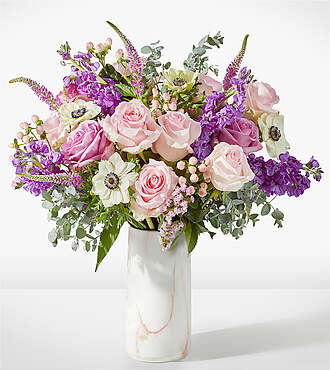
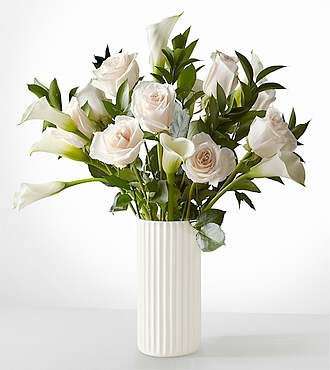
The Bloom Central flower delivery of the month for July in Anahola is the Blooming Masterpiece Rose Bouquet
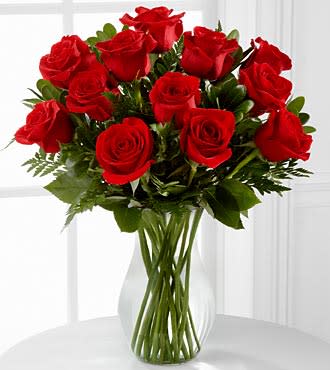
The Blooming Masterpiece Rose Bouquet from Bloom Central is the perfect floral arrangement to brighten up any space in your home. With its vibrant colors and stunning presentation, it will surely catch the eyes of all who see it.
This bouquet features our finest red roses. Each rose is carefully hand-picked by skilled florists to ensure only the freshest blooms make their way into this masterpiece. The petals are velvety smooth to the touch and exude a delightful fragrance that fills the room with warmth and happiness.
What sets this bouquet apart is its exquisite arrangement. The roses are artfully grouped together in a tasteful glass vase, allowing each bloom to stand out on its own while also complementing one another. It's like seeing an artist's canvas come to life!
Whether you place it as a centerpiece on your dining table or use it as an accent piece in your living room, this arrangement instantly adds sophistication and style to any setting. Its timeless beauty is a classic expression of love and sweet affection.
One thing worth mentioning about this gorgeous bouquet is how long-lasting it can be with proper care. By following simple instructions provided by Bloom Central upon delivery, you can enjoy these blossoms for days on end without worry.
With every glance at the Blooming Masterpiece Rose Bouquet from Bloom Central, you'll feel uplifted and inspired by nature's wonders captured so effortlessly within such elegance. This lovely floral arrangement truly deserves its name - a blooming masterpiece indeed!
Anahola Hawaii Flower Delivery
Anahola Flower Delivery - Frequently Asked Questions
- Does Bloom Central offer same-day flower delivery in Anahola?
- Yes. Place your order online before 1:00 PM and a local Anahola florist will hand-deliver your arrangement the same day. Orders can also be scheduled up to one month in advance.
- Is it safe to order flowers online?
- Absolutely! We utilize a secure, encrypted checkout to protect your personal and payment information. Visa, Mastercard, American Express, Discover, PayPal and Klarna are all accepted.
- What funeral homes does Bloom Central deliver sympathy flowers to in Anahola?
- We hand-deliver sympathy and memorial floral arrangements to all funeral homes near Anahola, including: Garden Island Mortuary, Kauai Chinese Cemetery, Koloa Cemetery, Old Cemetery.
- What nearby cities does Bloom Central also deliver flowers to?
- In addition to Anahola, we deliver fresh flowers to many nearby cities including: Kapaa, Wailua, Wailua Homesteads, Kilauea, Hanamaulu, Princeville, Lihue, Puhi
- What are the most popular flower arrangements at the Anahola florist?
- Three of our most popular arrangements at our Anahola florist are: Sunlit Centerpiece ($84.90), Best Day Bouquet with Birthday Balloon ($74.90), Seasons Change Bouquet ($74.90). All are available for same-day delivery.
More About Anahola
Are looking for a Anahola florist because you are not local to the area? If so, here is a brief travelogue of what Anahola has to offer. Who knows, perhaps you'll be intrigued enough to come visit soon, partake in some of the fun activities Anahola has to offer and deliver flowers to your loved one in person!
The sun rises over Anahola like a promise kept. It spills first across the peaks of Kalalea Mountain, whose jagged silhouette, a kind of lithic psalm, anchors the eastern sky, then slips down through the mist-threaded valleys to gild the rooftops of houses nestled in the green. Here, on Kauai’s eastern shore, the day begins not with the honk and snarl of mainland commutes but with the rustle of palm fronds, the distant hiss of surf, the scent of plumeria and salt. Chickens, feral and unbothered, patrol the roadsides with a dignity that suggests they’ve read the same guidebooks as the tourists. Visitors crunch across the coral-strewn shore of Anahola Beach, where toddlers wobble in tide pools and fishermen mend nets with hands that know the weight of generations. This is a place where the word “community” isn’t an abstraction. It’s the grandmother teaching her moʻopuna to weave lauhala mats under the mango tree. It’s the uncle sharing stories of the ʻaumakua while flipping burgers at the annual kanikapila fundraiser. It’s the way the Anahola River, silty and serene, curves toward the sea as if drawn by the moon’s quiet insistence.
To spend time here is to notice how the land itself seems alive. Taro patches, their leaves broad as elephant ears, stretch in emerald grids beneath the highway. These loʻi kalo are more than crops. They’re a covenant, a reminder that the Hawaiians who first settled these shores understood the reciprocity of existence long before it became a hashtag. Water feeds the taro. Taro feeds the people. People care for the water. Up in the hills, where the air thickens with the tang of guava and wild ginger, trails wind through the ruins of ancient heiau. The stones, cool underfoot, hum with a silence that feels less like absence than presence.

Same day service available. Order your Anahola floral delivery and surprise someone today!
Down at the Anahola Marketplace, vendors hawk papayas the size of toddlers and shave ice drenched in lilikoi syrup. A man strums a ukulele near the entrance, his voice as weathered and warm as koa wood. Children sprint between tables, their laughter syncopating with the rhythm of his song. The market isn’t just a place to buy mangoes. It’s where you learn that “local” isn’t a demographic. It’s a verb. It’s the woman who remembers your auntie from Wailua. It’s the farmer who hands you a lychee sample and says, “Tell your boss take the day off, stay a while.”
The beach, though, always the beach. Anahola Bay curves like a comma, inviting pause. Surfers paddle out at dawn, their boards slicing through water so clear it seems to hold the sky in suspension. Later, families spread towels under the ironwoods, their roots clawing at the sand like arthritic fingers. Teenagers dare each other to leap off the pier. Sea turtles glide through the shallows, indifferent to the gasps they inspire. By sunset, the horizon blushes. The mountain darkens. Stars emerge, first as shy pinpricks, then as a riot. It’s easy, in such moments, to feel the thinness of the veil between past and present. To sense the ancestors in the wind’s whisper. To understand why the Hawaiians named this place ʻāina momona, land of plenty.
What Anahola offers isn’t escapism. It’s clarity. A chance to see what happens when people decide that progress doesn’t require erasure. That a place can hold its history in one hand and its future in the other, fingers interlaced. You leave with sand in your shoes and a question in your chest: What if we all tended our roots this deeply? The chickens, of course, don’t answer. They just keep strutting, as if they’ve known the truth all along.