



- Best Value
- Best Sellers
- Lilies
 $49.90
- $49.90
July 1, 2026
Laie July Floral Selection
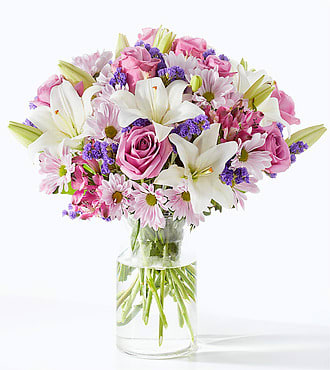
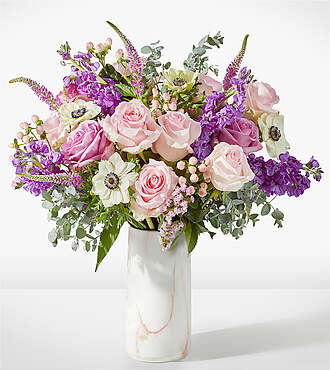
The Bloom Central flower delivery of the month for July in Laie is the Blooming Embrace Bouquet
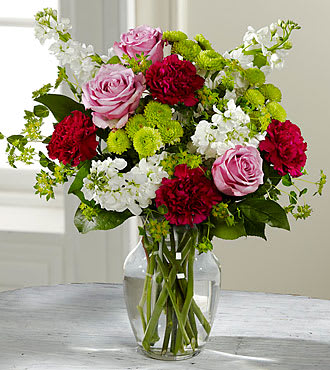
Introducing the beautiful Blooming Embrace Bouquet from Bloom Central! This floral arrangement is a delightful burst of color and charm that will instantly brighten up any room. With its vibrant blooms and exquisite design, it's truly a treat for the eyes.
The bouquet is a hug sent from across the miles wrapped in blooming beauty, this fresh flower arrangement conveys your heartfelt emotions with each astonishing bloom. Lavender roses are sweetly stylish surrounded by purple carnations, frilly and fragrant white gilly flower, and green button poms, accented with lush greens and presented in a classic clear glass vase.
One can't help but feel uplifted by the sight of this bouquet. Its joyful colors evoke feelings of happiness and positivity, making it an ideal gift for any occasion - be it birthdays, anniversaries or simply just because! Whether you're surprising someone special or treating yourself, this bouquet is sure to bring smiles all around.
What makes the Blooming Embrace Bouquet even more impressive is its long-lasting freshness. The high-quality blooms are expertly arranged to ensure maximum longevity. So you can enjoy their beauty day after day without worrying about them wilting away too soon.
Not only is this bouquet visually appealing, but it also fills any space with a delightful fragrance that lingers in the air. Imagine walking into your home and being greeted by such a sweet scent; it's like stepping into your very own garden oasis!
Ordering from Bloom Central guarantees exceptional service and reliability - they take great care in ensuring your order arrives on time and in perfect condition. Plus, their attention to detail shines through in every aspect of creating this marvelous arrangement.
Whether you're looking to surprise someone special or add some beauty to your own life, the Blooming Embrace Bouquet from Bloom Central won't disappoint! Its radiant colors, fresh fragrances and impeccable craftsmanship make it an absolute delight for anyone who receives it. So go ahead , indulge yourself or spread joy with this exquisite bouquet - you won't regret it!
Laie Florist
Laie Flower Delivery - Frequently Asked Questions
- Does Bloom Central offer same-day flower delivery in Laie?
- Yes. Place your order online before 1:00 PM and a local Laie florist will hand-deliver your arrangement the same day. Orders can also be scheduled up to one month in advance.
- Is it safe to order flowers online?
- Absolutely! We utilize a secure, encrypted checkout to protect your personal and payment information. Visa, Mastercard, American Express, Discover, PayPal and Klarna are all accepted.
- What funeral homes does Bloom Central deliver sympathy flowers to in Laie?
- We hand-deliver sympathy and memorial floral arrangements to all funeral homes near Laie, including: Ballard Family Moanalua Mortuary, Borthwick Mortuary, Byodo-In Temple, Diamond Head Mortuary, Flowers by Fletcher, Hawaii State Veterans Cemetery, Hawaiian Memorial Park Cemetery, Hawaiian Memorial Park Mortuary, Hosoi Garden Mortuary, Leeward Funeral Home, Mililani Downtown Mortuary, Mililani Memorial Park & Mortuary, Nuuanu Memorial Park & Mortuary, Oahu Mortuary, Rainbow Pigeons, Ultimate Cremation Services, Valley of the Temples, Woolsey Hosoi Mortuary LLC.
- What nearby cities does Bloom Central also deliver flowers to?
- In addition to Laie, we deliver fresh flowers to many nearby cities including: Kahuku, Hauula, Punaluu, Kaaawa, Pupukea, Whitmore Village, Wahiawa, Haleiwa
- What are the most popular flower arrangements at the Laie florist?
- Three of our most popular arrangements at our Laie florist are: Hayride Bouquet ($59.90), Daydreamer Bouquet ($54.90), Limoncello Bouquet ($54.90). All are available for same-day delivery.
More About Laie
Are looking for a Laie florist because you are not local to the area? If so, here is a brief travelogue of what Laie has to offer. Who knows, perhaps you'll be intrigued enough to come visit soon, partake in some of the fun activities Laie has to offer and deliver flowers to your loved one in person!
Laie sits on Oahu’s northeastern edge like a secret the island keeps from itself, a pocket of stillness where the Pacific’s roar meets the quiet hum of human persistence. To drive here from Honolulu is to watch Hawaii shed its postcard clichés, the high-rises, the traffic, the sulfurous tang of mass tourism, and become something older, softer, a place where the land insists on its own terms. The road narrows. The mountains lean closer. Coconut palms sway with a patience that feels almost pedagogical. You are entering a town where the word “community” isn’t an abstraction but a daily verb, a thing enacted in the slant of afternoon light over sugarcane fields, in the way neighbors wave not with hands but whole arms, as if semaphoring gratitude to the sky.
This is the Hawai’i few visitors imagine: a coastal village where the ocean isn’t a backdrop but a participant. Children bob in turquoise waves at Hukilau Beach, their laughter syncopating with the hiss of retreating foam. Fishermen cast lines with a rhythmic focus that suggests they’re communing as much as harvesting. The shoreline here doesn’t dazzle so much as embrace, its sands littered with the kind of seashells that still smell like salt when you hold them to your ear. It’s easy to forget, amid such unforced beauty, that Laie’s history is one of survival, of Native Hawaiians navigating colonialism’s ruptures, of Mormon pioneers carving a refuge from lava rock and coral, but the evidence lingers in the stoop of a kupuna’s smile, in the way stories are told here twice: once in words, again in the silence between them.

Same day service available. Order your Laie floral delivery and surprise someone today!
At the town’s heart stands the Polynesian Cultural Center, a living museum that resists the inertness of the term. Tourists come expecting luaus and ukulele lessons, then find themselves disarmed by the center’s deeper project: a celebration of Pacific Island cultures that treats tradition not as artifact but bloodstream. Tongan dancers spin in ta’ovala skirts, their stomps sending up red dirt like powdered testimony. Samoan fire-knife performers trace arcs of light that seem to rewrite the air. The Maori haka isn’t performed here, it’s inhabited, a primal dialogue between body and ancestry. What emerges isn’t spectacle but dialogue, a reminder that culture, when tended with reverence, can be both shield and bridge.
A mile inland, the Laie Hawaii Temple rises like a wedding cake left out in the rain, its spires bleached white by decades of sun and salt. Built in 1919 by Mormon settlers, the temple is less a monument than a compass point, its presence a quiet rebuttal to the notion that spirituality and modernity can’t coexist. On weekends, families gather in its shadow, toddlers wobbling across manicured lawns while grandparents murmur in Tagalog, Samoan, Hawaiian. The adjacent BYU-Hawaii campus thrums with a similar polyphony, its students, from Tonga, Fiji, Tahiti, Kansas, carrying the cadences of a dozen homelands into lecture halls and volleyball games. Walk the campus at dusk and you’ll hear a dozen languages, see a hundred shades of skin, all bound by the shared faith that education isn’t extraction but reciprocity, a way to honor roots while reaching.
What defines Laie, finally, isn’t its vistas or even its stories, but the way time moves here. Mornings dilate. Afternoons dissolve. The sun sets not with a bang but a series of whispers, the sky blushing in hues that defy Crayola names, colors you’d have to call mango-silt or post-storm gratitude. Nightfall brings a canopy of stars so dense it’s easy to feel small, but in the way a single thread feels small in a tapestry: essential, connected, thrumming with latent light. To leave is to understand why Hawaiians once believed certain places held mana, a sacred energy. Laie doesn’t just have it. It is it.