





- New Baby
- Best Sellers
- Vased













 $49.90
- $79.90
- $74.90
- $69.90



June 1, 2026
Rigby June Floral Selection
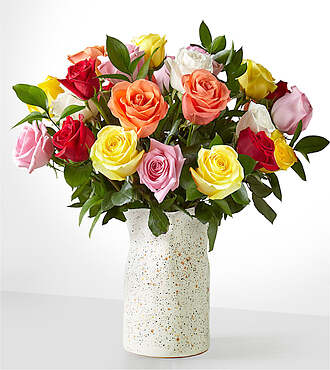
The Bloom Central flower delivery of the month for June in Rigby is the Graceful Grandeur Rose Bouquet

The Graceful Grandeur Rose Bouquet from Bloom Central is simply stunning. With its elegant and sophisticated design, it's sure to make a lasting impression on the lucky recipient.
This exquisite bouquet features a generous arrangement of lush roses in shades of cream, orange, hot pink, coral and light pink. This soft pastel colors create a romantic and feminine feel that is perfect for any occasion.
The roses themselves are nothing short of perfection. Each bloom is carefully selected for its beauty, freshness and delicate fragrance. They are hand-picked by skilled florists who have an eye for detail and a passion for creating breathtaking arrangements.
The combination of different rose varieties adds depth and dimension to the bouquet. The contrasting sizes and shapes create an interesting visual balance that draws the eye in.
What sets this bouquet apart is not only its beauty but also its size. It's generously sized with enough blooms to make a grand statement without overwhelming the recipient or their space. Whether displayed as a centerpiece or placed on a mantelpiece the arrangement will bring joy wherever it goes.
When you send someone this gorgeous floral arrangement, you're not just sending flowers - you're sending love, appreciation and thoughtfulness all bundled up into one beautiful package.
The Graceful Grandeur Rose Bouquet from Bloom Central exudes elegance from every petal. The stunning array of colorful roses combined with expert craftsmanship creates an unforgettable floral masterpiece that will brighten anyone's day with pure delight.
Rigby Idaho Flower Delivery
Rigby Flower Delivery - Frequently Asked Questions
- Does Bloom Central offer same-day flower delivery in Rigby?
- Yes. Place your order online before 1:00 PM and a local Rigby florist will hand-deliver your arrangement the same day. Orders can also be scheduled up to one month in advance.
- Is it safe to order flowers online?
- Absolutely! We utilize a secure, encrypted checkout to protect your personal and payment information. Visa, Mastercard, American Express, Discover, PayPal and Klarna are all accepted.
- What hospitals and care facilities does Bloom Central deliver to in Rigby?
- We deliver fresh flower arrangements to all hospitals, nursing homes and care facilities in Rigby Idaho, including: Gardens Of Rigby, Golden Pines-Rural Assisted Living Facilities, Rigby Country Living-Rural Assisted Living Facilities, Sage Grove Assisted Living.
- What funeral homes does Bloom Central deliver sympathy flowers to in Rigby?
- We hand-deliver sympathy and memorial floral arrangements to all funeral homes near Rigby, including: Coltrin Mortuary & Crematory, Wood Funeral Home.
- What nearby cities does Bloom Central also deliver flowers to?
- In addition to Rigby, we deliver fresh flowers to many nearby cities including: Ucon, Iona, Lincoln, Rexburg, Ammon, Idaho Falls, Sugar City, Shelley
- What are the most popular flower arrangements at the Rigby florist?
- Three of our most popular arrangements at our Rigby florist are: Fall Foliage Bouquet ($54.90), So Beautiful Bouquet ($64.90), Autumn Air Pumpkin Bouquet ($59.90). All are available for same-day delivery.
More About Rigby
Are looking for a Rigby florist because you are not local to the area? If so, here is a brief travelogue of what Rigby has to offer. Who knows, perhaps you'll be intrigued enough to come visit soon, partake in some of the fun activities Rigby has to offer and deliver flowers to your loved one in person!
Rigby, Idaho, sits under a sky so wide and blue it feels less like a dome than a sheet pulled taut by the hands of some cosmic child eager to show off their crayon work. The town announces itself with a modest sign, the kind you might miss if you blink at the wrong moment, but to miss it would be to bypass a place where the American West’s mythologies, self-reliance, neighborliness, the quiet thrill of endurance, still pulse like a heartbeat beneath the asphalt. Drive down Rigby’s main drag, past the squat brick storefronts and the lone traffic light that blinks yellow as if perpetually stuck in a state of polite hesitation, and you’ll notice something odd: the absence of frenzy. People here move with the deliberate calm of those who understand that time is not a foe to wrestle but a companion to walk beside.
The soil here is volcanic, rich and dark, a gift from eruptions millennia past, and it sustains fields of potatoes that stretch to the horizon in rows so straight they seem drawn by a ruler wielded by a particularly fastidious god. This is farmland, yes, but also a cradle of invention. It was in Rigby that a teenage Philo Farnsworth, plowing a field in 1920, looked at the parallel furrows he’d carved and saw something else: electrons streaming across a vacuum tube. The idea for electronic television was born not in a lab coat but in coveralls, dirt under the nails, the smell of turned earth thick in the air. You can still visit the homestead where he worked, now a museum that feels less like a shrine to technology than a testament to the fact that genius often wears the face of the kid next door.

Same day service available. Order your Rigby floral delivery and surprise someone today!
What defines Rigby, though, isn’t just its history or its dirt. It’s the way the present unfolds. At Rigby Lake, on summer evenings, families spread blankets on the grass while children dart into the water, their laughter mixing with the hum of dragonflies. The local high school’s football games draw crowds not because the team is dominant, though they’ve had their moments, but because showing up matters. It’s a ritual of belonging, a way to say, We’re here, together, in this speck on the map, and that’s enough. The bleachers creak under the weight of shared pride.
In winter, the cold arrives like a guest who overstays, frosting windows and stiffening boots. Yet even then, there’s warmth in the way the hardware store clerk knows your name before you say it, in the way the librarian sets aside a new mystery novel because she remembers you like the ones set in coastal towns. The Rigby City Snow Festival turns the season into a celebration: ice sculptures glint under strings of lights, their temporary beauty a reminder that fragility can be magnificent.
Outsiders might wonder how a place so small avoids claustrophobia. The answer hangs in the air, in the scent of sagebrush after rain, in the view of the Tetons looming to the east like frozen waves. Space here isn’t just geographical, it’s psychic. You can breathe. You can think. You can stand on a hill at dusk, watch the sun bleed gold over endless fields, and feel the weird, ancient comfort of knowing you’re a single thread in a tapestry far larger than yourself.
Rigby doesn’t shout. It doesn’t need to. It simply exists, steadfast and unpretentious, a quiet argument for the beauty of staying put. To pass through is to glimpse a paradox: that rootedness, far from being a limitation, can be a kind of freedom. The horizon here isn’t something to chase. It’s something to carry with you.