




- Best Value
- Best Sellers
- Under $60
 $49.90





- $49.90

July 1, 2026
Albion July Floral Selection
The Bloom Central flower delivery of the month for July in Albion is the Love is Grand Bouquet
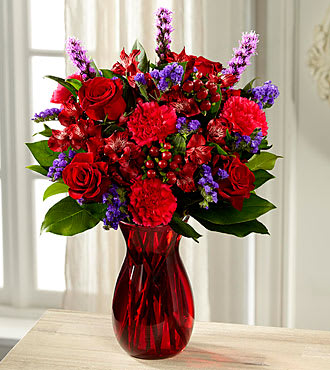
The Love is Grand Bouquet from Bloom Central is an exquisite floral arrangement that will make any recipient feel loved and appreciated. Bursting with vibrant colors and delicate blooms, this bouquet is a true showstopper.
With a combination of beautiful red roses, red Peruvian Lilies, hot pink carnations, purple statice, red hypericum berries and liatris, the Love is Grand Bouquet embodies pure happiness. Bursting with love from every bloom, this bouquet is elegantly arranged in a ruby red glass vase to create an impactive visual affect.
One thing that stands out about this arrangement is the balance. Each flower has been thoughtfully selected to complement one another, creating an aesthetically pleasing harmony of colors and shapes.
Another aspect we can't overlook is the fragrance. The Love is Grand Bouquet emits such a delightful scent that fills up any room it graces with its presence. Imagine walking into your living room after a long day at work and being greeted by this wonderful aroma - instant relaxation!
What really sets this bouquet apart from others are the emotions it evokes. Just looking at it conjures feelings of love, appreciation, and warmth within you.
Not only does this arrangement make an excellent gift for special occasions like birthdays or anniversaries but also serves as a meaningful surprise gift just because Who wouldn't want to receive such beauty unexpectedly?
So go ahead and surprise someone you care about with the Love is Grand Bouquet. This arrangement is a beautiful way to express your emotions and remember, love is grand - so let it bloom!
Albion Illinois Flower Delivery
Albion Flower Delivery - Frequently Asked Questions
- Does Bloom Central offer same-day flower delivery in Albion?
- Yes. Place your order online before 1:00 PM and a local Albion florist will hand-deliver your arrangement the same day. Orders can also be scheduled up to one month in advance.
- Is it safe to order flowers online?
- Absolutely! We utilize a secure, encrypted checkout to protect your personal and payment information. Visa, Mastercard, American Express, Discover, PayPal and Klarna are all accepted.
- What hospitals and care facilities does Bloom Central deliver to in Albion?
- We deliver fresh flower arrangements to all hospitals, nursing homes and care facilities in Albion Illinois, including: Rest Haven Manor.
- What funeral homes does Bloom Central deliver sympathy flowers to in Albion?
- We hand-deliver sympathy and memorial floral arrangements to all funeral homes near Albion, including: Alexander Memorial Park, Benton-Glunt Funeral Home, Boone Funeral Home, Browning Funeral Home, Crest Haven Memorial Park, Glasser Funeral Home, Goodwine Funeral Homes, Kistler-Patterson Funeral Home, Memory Portraits, Oak Hill Cemetery, Stendeback Family Funeral Home, Stodghill Funeral Home, Sunset Funeral Home, Cremation Center & Cemetery, Wade Funeral Home, Werry Funeral Homes, Werry Funeral Homes.
- What nearby cities does Bloom Central also deliver flowers to?
- In addition to Albion, we deliver fresh flowers to many nearby cities including: Grayville, Gray, Grover, Jasper, Phillips, Mount Carmel, Fairfield, Lamard
- What are the most popular flower arrangements at the Albion florist?
- Three of our most popular arrangements at our Albion florist are: Autumn Harmony Centerpiece ($69.90), Spring's Calling Tulip Bouquet ($59.90), Yellow Colors Florist Designed Bouquet ($49.90). All are available for same-day delivery.
More About Albion
Are looking for a Albion florist because you are not local to the area? If so, here is a brief travelogue of what Albion has to offer. Who knows, perhaps you'll be intrigued enough to come visit soon, partake in some of the fun activities Albion has to offer and deliver flowers to your loved one in person!
The town of Albion, Illinois, at dawn is a study in civic geometry. The courthouse anchors the square like a sundial’s gnomon, its shadow sweeping across streets named for presidents and pioneers. Maple trees, over 1,000 of them, planted with the precision of a quilt’s stitching, line every block, their leaves in October a conflagration of amber and scarlet. Residents move through this grid with the ease of electrons in a circuit: retirees in windbreakers circling the square, kids backpedaling toward the schoolyard, farmers in feed caps sipping coffee at the diner where the waitress knows their orders by heart. The air smells of diesel and doughnuts. A banner over Main Street announces the Maple Leaf Festival, though locals need no reminder. They’ve been polishing parade floats and baking pies for weeks.
Albion’s rhythm is syncopated by rituals older than the town itself. At the post office, patrons linger not just for mail but to trade gossip about soybean prices or the high school basketball team’s playoff chances. The library, a redbrick fortress with stained-glass windows depicting Shakespeare and Euclid, hosts toddlers for story hour while teenagers slump at computers, half-researching term papers, half-dreaming of futures elsewhere. Yet even those who leave often boomerang back, drawn by the gravitational pull of a place where the pharmacist remembers your allergies and the barber asks about your mother’s hip.

Same day service available. Order your Albion floral delivery and surprise someone today!
History here isn’t confined to the Edwards County Historical Museum, though that building, a former seminary with creaky floors, does hold relics: arrowheads, quilts, a ledger from the 1850s documenting the sale of a plow for $3.50. No, history breathes in the way the Methodist church’s bell still rings on Sundays, just as it did for the Underground Railroad, or how the same families show up in every census, their names echoing through generations like chords in a hymn. The past isn’t polished or petrified. It’s leaned on, argued with, kept alive.
The surrounding farmland rolls out in all directions, a patchwork of corn and wheat that changes texture with the seasons. Farmers in Albion speak about the land not as a commodity but as a cousin, something to tend, to negotiate with, to respect. Tractors rumble down back roads at dawn, their headlights cutting through mist. At the co-op, men in seed-company caps debate rainfall and crop rotation, their hands calloused from work that predates combines and GPS. The soil here is loamy and stubborn, yielding only to those who understand its secrets.
What defines Albion isn’t just its aesthetics or agrarian pulse but a metaphysics of care. Neighbors shovel each other’s driveways after snowstorms. The Lion’s Club funds scholarships for college-bound teens. When the hardware store nearly closed last year, half the town showed up to a fundraiser, buying hammers they didn’t need and paintbrushes they’d never use, just to keep the shelves stocked. This isn’t nostalgia. It’s a kind of covenant, an unspoken vow to preserve a way of life where front porches face the street, where “How’s your dad?” isn’t small talk but a census, where the definition of community is both elastic and exact.
The courthouse clock chimes noon. Sunlight angles through the maples, dappling the sidewalks. A girl on a bike weaves around fallen leaves, laughing as her dog trots beside her. Somewhere, a teacher grades essays, a mechanic fixes a tractor, a teenager practices clarinet for the fall concert. Albion doesn’t dazzle. It doesn’t need to. It persists, a quiet argument for continuity in a country obsessed with the next big thing. The maple leaves will fall, the parade will march, the soil will rest under winter’s frost. And then, inevitably, the cycle will begin again.