




- New Baby
- Best Sellers
- Sympathy





 $297.90
- $64.90




July 1, 2026
Cahokia July Floral Selection
The Bloom Central flower delivery of the month for July in Cahokia is the Blooming Masterpiece Rose Bouquet
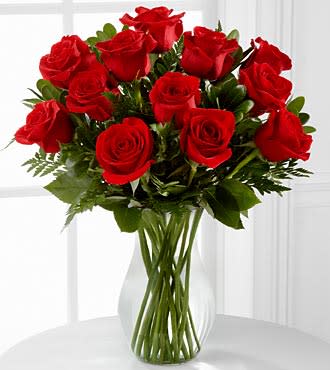
The Blooming Masterpiece Rose Bouquet from Bloom Central is the perfect floral arrangement to brighten up any space in your home. With its vibrant colors and stunning presentation, it will surely catch the eyes of all who see it.
This bouquet features our finest red roses. Each rose is carefully hand-picked by skilled florists to ensure only the freshest blooms make their way into this masterpiece. The petals are velvety smooth to the touch and exude a delightful fragrance that fills the room with warmth and happiness.
What sets this bouquet apart is its exquisite arrangement. The roses are artfully grouped together in a tasteful glass vase, allowing each bloom to stand out on its own while also complementing one another. It's like seeing an artist's canvas come to life!
Whether you place it as a centerpiece on your dining table or use it as an accent piece in your living room, this arrangement instantly adds sophistication and style to any setting. Its timeless beauty is a classic expression of love and sweet affection.
One thing worth mentioning about this gorgeous bouquet is how long-lasting it can be with proper care. By following simple instructions provided by Bloom Central upon delivery, you can enjoy these blossoms for days on end without worry.
With every glance at the Blooming Masterpiece Rose Bouquet from Bloom Central, you'll feel uplifted and inspired by nature's wonders captured so effortlessly within such elegance. This lovely floral arrangement truly deserves its name - a blooming masterpiece indeed!
Cahokia Illinois Flower Delivery
Cahokia Flower Delivery - Frequently Asked Questions
- Does Bloom Central offer same-day flower delivery in Cahokia?
- Yes. Place your order online before 1:00 PM and a local Cahokia florist will hand-deliver your arrangement the same day. Orders can also be scheduled up to one month in advance.
- Is it safe to order flowers online?
- Absolutely! We utilize a secure, encrypted checkout to protect your personal and payment information. Visa, Mastercard, American Express, Discover, PayPal and Klarna are all accepted.
- What hospitals and care facilities does Bloom Central deliver to in Cahokia?
- We deliver fresh flower arrangements to all hospitals, nursing homes and care facilities in Cahokia Illinois, including: Atrium Hc & Rehab Ctr-Cahokia, Cahokia Nursing & Rehab Center.
- What funeral homes does Bloom Central deliver sympathy flowers to in Cahokia?
- We hand-deliver sympathy and memorial floral arrangements to all funeral homes near Cahokia, including: Ambruster Chapel, Austin Layne Mortuary, Braun Colonial Funeral Home, Dashner Leesman Funeral Home, Fey Funeral Home, Granberry Mortuary, Heiligtag-Lang-Fendler Funeral Home, Hoffmeister Colonial Mortuary, Kassly Herbert A Funeral Home, Kutis Funeral Home, Kutis Funeral Home, Lord Funeral Home, McLaughlin Funeral Home, Renner Funeral Home, Shepard Funeral Chapel, St Louis Cremation Services, Valhalla-Gaerdner-Holten Funeral Home, Ziegenhein John L & Sons.
- What churches does Bloom Central deliver flowers to in Cahokia?
- We deliver fresh floral arrangements to all churches and places of worship in Cahokia, including: Gateway Baptist Church Of Greater Saint Louis - West Campus.
- What nearby cities does Bloom Central also deliver flowers to?
- In addition to Cahokia, we deliver fresh flowers to many nearby cities including: Centreville, Sugar Loaf, Alorton, Dupo, East St. Louis, Stookey, Washington Park, Fairmont City
- What are the most popular flower arrangements at the Cahokia florist?
- Three of our most popular arrangements at our Cahokia florist are: Beyond Blue Bouquet ($54.90), Special Request 50 ($50.00), Soft Serenade Rose Bouquet ($82.90). All are available for same-day delivery.
More About Cahokia
Are looking for a Cahokia florist because you are not local to the area? If so, here is a brief travelogue of what Cahokia has to offer. Who knows, perhaps you'll be intrigued enough to come visit soon, partake in some of the fun activities Cahokia has to offer and deliver flowers to your loved one in person!
The thing about Cahokia, Illinois, is how the place doesn’t announce itself so much as hum. You drive past the low-slung warehouses and strip malls of the Metro East, the Mississippi a brown ribbon glimpsed between trees, and then you’re there, except you’re not, not really, because what’s there now is a quiet town of 15,000, all red-brick storefronts and sun-faded flags, while the real Cahokia, the one that matters, the one that hums, is underground. Or not underground, exactly, but beneath the surface in the way great things often are, waiting for you to notice how the grass dips and swells in the empty fields west of Collinsville Road, how the horizon isn’t flat but rippled, like a sheet shaken loose before settling. These are the Cahokia Mounds, and they’re not hills. They’re choices.
Imagine a city larger than London in 1250 AD, a sprawl of thatched roofs and plaza markets, where 20,000 people farmed maize, traded copper and shells from the Great Lakes to the Gulf, watched processions of feather-robed leaders ascend earthen pyramids so vast their shadows could cloak a village. This was the indigenous metropolis now called Cahokia, though no one knows what its builders named it. The largest pyramid, Monks Mound, still stands: 100 feet tall, 14 acres base, a four-tiered colossus hauled into existence basket by basket. To stand atop it today is to feel the vertigo of deep time. The stairs creak. The wind carries diesel fumes from the interstate. But look east, and the skyline of St. Louis mirrors the past, steel Arch instead of timber temples, skyscrapers where longhouses once clustered. The symmetry is accidental, inevitable.

Same day service available. Order your Cahokia floral delivery and surprise someone today!
What’s easy to miss, focusing on scale, is the precision. Cahokians tracked solstices. Their “Woodhenge” posts marked equinoxes with a shiver of aligned shadows. They played a ritual sport called chunkey, rolling stone discs while athletes hurled spears toward the point of stillness, a game of physics and fate. They forged a society without written records or European blueprints, yet their garbage pits reveal neighborhoods divided by craft: potters here, flint-knappers there, shell-bead artisans humming as they drilled. This wasn’t just a city. It was a verb. A doing.
Then, by 1350, it stopped. The why is a Rorschach blot for theorists, climate shifts, resource depletion, the slow unraveling of collective faith. But to fixate on disappearance is to ignore the bloom. For three centuries, Cahokia thrived. It hosted pilgrims. It inspired satellite towns from Wisconsin to Arkansas. It codified a cosmology where upper and lower worlds negotiated through ritual, where death wasn’t an end but a redistricting. In Mound 72, archaeologists found a man buried on a bed of 20,000 shell beads, surrounded by sacrificed retainers, a cosmos in miniature. You can debate the ethics, but not the vision: here was a culture that built its eternity, layer by layer.
Modern Cahokia, the town, knows it sits on someone else’s foundation. The high school mascot is the Warriors; local murals mix 1950s nostalgia with sepia-toned elders. It’s a dissonance familiar to America, the past isn’t past, just ignored until the day some highway crew cuts a trench and unearths a spear point, or a child skidding down Monk’s Mound on a cardboard sled scuffs up a potsherd. History isn’t a ledger. It’s the dirt under your nails.
Maybe that’s the lesson. Cahokia’s pyramids weren’t monuments to immortality but to collaboration. No pharaohs with whips, just people deciding, for a time, to bend toward a shared horizon. Today, the mounds endure as public parkland. Visitors picnic on the grass where priests once chanted. Kids roll down slopes that took 300 years to build. The site’s UNESCO plaque calls it a “reminder of the sacredness of man’s relationship with nature,” which is true, if incomplete. Better to say Cahokia reminds us that grandeur isn’t about lasting forever. It’s about meaning enough, for long enough, to leave a mark that someone, someday, will feel beneath their feet.