





- New Baby
- Best Sellers
- Under $60









 $49.90

July 1, 2026
Divernon July Floral Selection
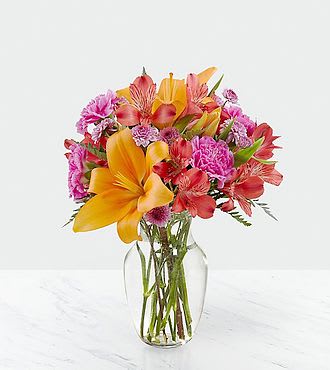
The Bloom Central flower delivery of the month for July in Divernon is the Love is Grand Bouquet
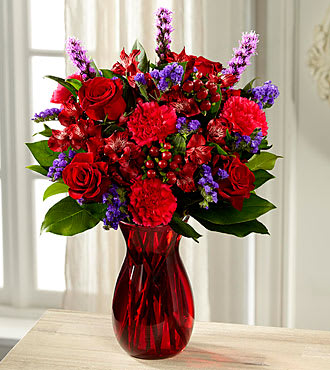
The Love is Grand Bouquet from Bloom Central is an exquisite floral arrangement that will make any recipient feel loved and appreciated. Bursting with vibrant colors and delicate blooms, this bouquet is a true showstopper.
With a combination of beautiful red roses, red Peruvian Lilies, hot pink carnations, purple statice, red hypericum berries and liatris, the Love is Grand Bouquet embodies pure happiness. Bursting with love from every bloom, this bouquet is elegantly arranged in a ruby red glass vase to create an impactive visual affect.
One thing that stands out about this arrangement is the balance. Each flower has been thoughtfully selected to complement one another, creating an aesthetically pleasing harmony of colors and shapes.
Another aspect we can't overlook is the fragrance. The Love is Grand Bouquet emits such a delightful scent that fills up any room it graces with its presence. Imagine walking into your living room after a long day at work and being greeted by this wonderful aroma - instant relaxation!
What really sets this bouquet apart from others are the emotions it evokes. Just looking at it conjures feelings of love, appreciation, and warmth within you.
Not only does this arrangement make an excellent gift for special occasions like birthdays or anniversaries but also serves as a meaningful surprise gift just because Who wouldn't want to receive such beauty unexpectedly?
So go ahead and surprise someone you care about with the Love is Grand Bouquet. This arrangement is a beautiful way to express your emotions and remember, love is grand - so let it bloom!
Divernon Florist
Divernon Flower Delivery - Frequently Asked Questions
- Does Bloom Central offer same-day flower delivery in Divernon?
- Yes. Place your order online before 1:00 PM and a local Divernon florist will hand-deliver your arrangement the same day. Orders can also be scheduled up to one month in advance.
- Is it safe to order flowers online?
- Absolutely! We utilize a secure, encrypted checkout to protect your personal and payment information. Visa, Mastercard, American Express, Discover, PayPal and Klarna are all accepted.
- What funeral homes does Bloom Central deliver sympathy flowers to in Divernon?
- We hand-deliver sympathy and memorial floral arrangements to all funeral homes near Divernon, including: Arnold Monument, Ellinger-Kunz & Park Funeral Home & Cremation Service, Oak Hill Cemetery, Oak Hill Cemetery, Oak Ridge Cemetery, Springfield Monument, Staab Funeral Homes, Stiehl-Dawson Funeral Home, Vancil Memorial Funeral Chapel.
- What churches does Bloom Central deliver flowers to in Divernon?
- We deliver fresh floral arrangements to all churches and places of worship in Divernon, including: First Baptist Church.
- What nearby cities does Bloom Central also deliver flowers to?
- In addition to Divernon, we deliver fresh flowers to many nearby cities including: Pawnee, Auburn, Bois D'Arc, Ball, Virden, Chatham, Girard, Capital
- What are the most popular flower arrangements at the Divernon florist?
- Three of our most popular arrangements at our Divernon florist are: April Showers Bouquet ($49.90), Sun Salutation Bouquet ($69.90), At First Sight Bouquet and Candle Set ($114.90). All are available for same-day delivery.
More About Divernon
Are looking for a Divernon florist because you are not local to the area? If so, here is a brief travelogue of what Divernon has to offer. Who knows, perhaps you'll be intrigued enough to come visit soon, partake in some of the fun activities Divernon has to offer and deliver flowers to your loved one in person!
Divernon, Illinois, population 1,176, sits in a part of the Midwest where the land flattens into a grid of soy and corn so precise it feels less like geography than a proof of some cosmic theorem. The town’s name, a portmanteau of a railroad official’s nickname and a forgotten “Vernon,” hints at its origin story: a place born of trains and toil, where the Chicago & Alton Railroad once carved its steel will into the prairie. Today, the tracks still bisect the town, their rusted seams humming under summer heat, a reminder that Divernon, like so many small towns, exists in a tense ballet of motion and stillness, a place you pass through but also a place people stay, for reasons opaque to the coastal imagination. To drive here from Springfield is to watch the strip malls dissolve into fields, the sky widen, the mind’s aperture adjust. You notice things. A red tractor idling outside the Dollar General. A teenager pedaling a bike with a fishing pole slung over his shoulder. The way the noon light hits the grain elevator’s aluminum siding, turning it into a beacon.
The town’s heart is a four-block lattice of brick storefronts that seem both weathered and eternal. At the Divernon Hardware Store, founded 1932, the floorboards creak a welcome. The owner knows your name before you speak. He asks about your mother’s knee. You leave with a gallon of paint and a story about his grandson’s T-ball game. Down the street, the library occupies a former bank vault, its thick walls now guarding paperbacks and a collection of local yearbooks. The librarian waves to a woman pushing a stroller. The woman waves to a man adjusting the flag outside the VFW. The flag snaps in a breeze that carries the scent of cut grass. There’s a rhythm here, a choreography of small gestures that accumulate into something like belonging.

Same day service available. Order your Divernon floral delivery and surprise someone today!
History here isn’t archived so much as worn. The old railroad depot, now a museum, displays sepia photos of men in handlebar mustaches posing beside steam engines. Their descendants still gather at the diner on Sundays after church, swapping gossip over pie. The diner’s coffee tastes like it did in 1957. The waitress calls you “hon.” You don’t mind. Outside, kids chase fireflies in the park, their laughter threading through oak branches. Parents lean against pickup trucks, trading stories about harvests and highway construction. The conversations are familiar but never stale. There’s comfort in repetition, in knowing the script.
Seasons dictate the town’s pulse. Spring arrives as a riot of peonies in front yards. Summer bakes the asphalt soft. Fall turns the timberline into a kaleidoscope. Winter muffles everything in snow so pure it hurts to look at. Through it all, the people here persist with a quiet pragmatism. They fix fences. They volunteer at the food pantry. They host pancake breakfasts to fund new swingsets. They show up.
What’s easy to miss, if you’re just passing through, is how much this place resists the clichés of rural America. Divernon isn’t a relic. It’s not a postcard. It’s a living argument for the idea that community can be both a safety net and a springboard, a thing you lean on and a thing you build, daily, through acts of mundane care. The woman who organizes the town’s fall festival also runs the STEM club at the elementary school. The man who repairs tractors coaches the volleyball team. The kid who mows your lawn will someday inherit the farm, or leave for college, or both.
To understand Divernon is to stand at the railroad crossing at dusk, watching the signal lights blink red as a freight train barrels past. You wait. You feel the ground tremble. You count the cars. And then it’s gone, and the silence rushes back, deeper now, a reminder that some things endure not by shouting but by standing still, by holding space in a world that’s always rushing elsewhere.