




- Birthday
- Best Sellers
- Thank You


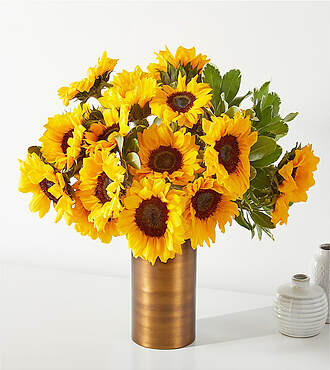
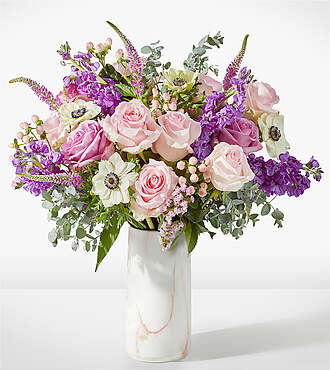
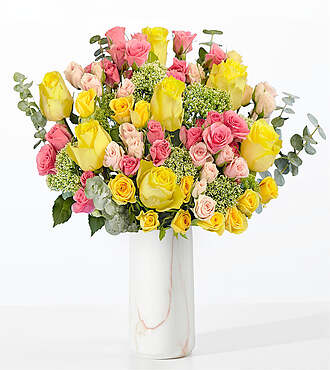
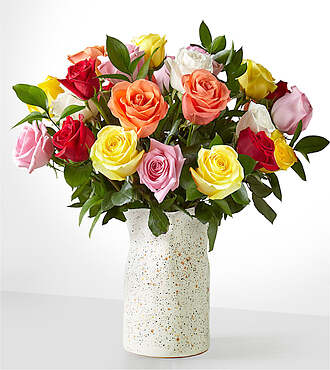
 $49.90
- $79.90
July 1, 2026
Fairmont July Floral Selection
The Bloom Central flower delivery of the month for July in Fairmont is the Blooming Masterpiece Rose Bouquet
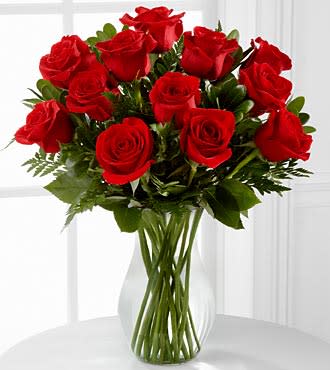
The Blooming Masterpiece Rose Bouquet from Bloom Central is the perfect floral arrangement to brighten up any space in your home. With its vibrant colors and stunning presentation, it will surely catch the eyes of all who see it.
This bouquet features our finest red roses. Each rose is carefully hand-picked by skilled florists to ensure only the freshest blooms make their way into this masterpiece. The petals are velvety smooth to the touch and exude a delightful fragrance that fills the room with warmth and happiness.
What sets this bouquet apart is its exquisite arrangement. The roses are artfully grouped together in a tasteful glass vase, allowing each bloom to stand out on its own while also complementing one another. It's like seeing an artist's canvas come to life!
Whether you place it as a centerpiece on your dining table or use it as an accent piece in your living room, this arrangement instantly adds sophistication and style to any setting. Its timeless beauty is a classic expression of love and sweet affection.
One thing worth mentioning about this gorgeous bouquet is how long-lasting it can be with proper care. By following simple instructions provided by Bloom Central upon delivery, you can enjoy these blossoms for days on end without worry.
With every glance at the Blooming Masterpiece Rose Bouquet from Bloom Central, you'll feel uplifted and inspired by nature's wonders captured so effortlessly within such elegance. This lovely floral arrangement truly deserves its name - a blooming masterpiece indeed!
Fairmont Illinois Flower Delivery
Fairmont Flower Delivery - Frequently Asked Questions
- Does Bloom Central offer same-day flower delivery in Fairmont?
- Yes. Place your order online before 1:00 PM and a local Fairmont florist will hand-deliver your arrangement the same day. Orders can also be scheduled up to one month in advance.
- Is it safe to order flowers online?
- Absolutely! We utilize a secure, encrypted checkout to protect your personal and payment information. Visa, Mastercard, American Express, Discover, PayPal and Klarna are all accepted.
- What funeral homes does Bloom Central deliver sympathy flowers to in Fairmont?
- We hand-deliver sympathy and memorial floral arrangements to all funeral homes near Fairmont, including: Adams-Winterfield & Sullivan Funeral Home & Cremation Services, Anderson Memorial Chapel, Anderson Memorial Home, Beidelman-Kunsch Funeral Homes & Crematory, Bolingbrook McCauley Funeral Chapel, Carlson Holmquist Sayles Funeral Home & Crematory, Fred C Dames Funeral Home and Crematory, Goodale Memorial Chapel, Markiewicz Funeral Home, Minor-Morris Funeral Home, ONeil Funeral Home and Heritage Crematory, Orland Funeral Home, Overman Jones Funeral Home, Precious Pets Crematory & Funeral Home, Richard J Modell Funeral Home & Cremation Services, Sullivan Funeral Home & Cremation Services, Tezaks Home to Celebrate LIfe, The Maple Funeral Home & Crematory.
- What nearby cities does Bloom Central also deliver flowers to?
- In addition to Fairmont, we deliver fresh flowers to many nearby cities including: Crest Hill, Ingalls Park, Lockport, Rockdale, Preston Heights, Crystal Lawns, Joliet, Homer
- What are the most popular flower arrangements at the Fairmont florist?
- Three of our most popular arrangements at our Fairmont florist are: Apple Picking Bouquet ($44.90), Musings Luxury Calla Lily Bouquet by Vera Wang ($397.90), Hope and Serenity Bouquet ($79.90). All are available for same-day delivery.
More About Fairmont
Are looking for a Fairmont florist because you are not local to the area? If so, here is a brief travelogue of what Fairmont has to offer. Who knows, perhaps you'll be intrigued enough to come visit soon, partake in some of the fun activities Fairmont has to offer and deliver flowers to your loved one in person!
In the soft dawn light, Fairmont, Illinois, hums with a quiet insistence, its streets stretching awake beneath a sky streaked with contrails from planes bound for Chicago or St. Louis. The town sits snug along the Sangamon River, a place where the scent of freshly turned earth mingles with the faint tang of diesel from passing freight trains. Residents here move with the deliberate pace of people who know their neighbors, who wave at passing cars without needing to see the driver’s face, who measure time not in minutes but in seasons: corn rising, leaves falling, snow settling like a held breath. There’s a rhythm here, a pulse beneath the asphalt, that defies the easy categorizations of “small town” or “flyover.” Fairmont isn’t a relic. It’s alive.
Walk down First Street on a Saturday morning and you’ll see it. The diner’s griddle hisses under pancakes, its vinyl booths crowded with farmers in seed-company caps and teenagers sneaking glances at their phones. At the hardware store, a clerk patiently explains the difference between Phillips and flathead screws to a kid repairing his bike. The post office, a squat brick relic from the 1930s, still bears the faint ghost of a sign advertising “Telegrams” on its side, a reminder that progress here isn’t about erasure but accretion. Layers accumulate. History isn’t displayed behind glass. It’s in the way the librarian remembers your middle name, or how the barber asks about your mother’s hip replacement without needing a prompt.

Same day service available. Order your Fairmont floral delivery and surprise someone today!
The railroad tracks bisect Fairmont like a spine, and it’s here you feel the town’s duality. To the east, the old depot, now a museum, holds sepia-toned photos of men in bowlers steering horse-drawn plows. To the west, a new community garden sprouts tomatoes and zinnias, tended by retirees and third-graders alike. The trains themselves, though, are constant. They barrel through day and night, their horns echoing off grain silos, a sound so familiar locals can sleep through it but visitors lie awake, pulse quickening, as if the noise carries some encrypted message. It does, in a way. The message is: This is a place things pass through, but also a place people stay.
Summers here shimmer with a kind of collective improvisation. Kids pedal bikes to the public pool, towels flapping behind them like capes. Families gather in Fairmont Park for concerts where the band plays Creedence covers slightly off-key, and no one minds. The Fourth of July parade features tractors draped in bunting, Little Leaguers chucking candy to spectators, and a fire truck polished to a comical shine. You get the sense that everyone, somehow, is both participant and audience, a blurring of roles that feels increasingly rare in a world of curated personas.
Autumn sharpens the air, and the high school football field becomes a beacon. On Friday nights, the crowd’s roar blends with the crunch of leaves underfoot, and for a few hours, the entire town seems to orbit around the stubborn dream of a touchdown. The players, helmets glinting, are sons of sons of sons of men who once scored on this same field. There’s a continuity here that doesn’t feel stifling but grounding, a sense that every life here, every victory, every loss, adds another thread to a tapestry that’s still being woven.
Fairmont’s winters are hushed and patient, the streets glazed with ice that sparkles under sodium lamps. People check on each other. They shovel driveways for those who can’t. They bring casseroles without being asked. Spring returns with a riot of dogwoods and a floodplain bursting into green, the river swelling until it’s fat and slow, reminding everyone that renewal isn’t a metaphor here. It’s a fact.
What lingers, though, isn’t the scenery or the rituals. It’s the quiet understanding that in Fairmont, life’s volume is turned just low enough to hear the things that matter: a friend’s laugh, the creak of a porch swing, the sound of your own breath as you stand under a sky so vast it humbles you. You realize, eventually, that the town’s true rhythm isn’t in its trains or seasons or Friday night lights. It’s in the steady, unremarkable, beautiful act of tending, to land, to community, to the fragile hope that here, in this specific here, people still look out for one another. And maybe that’s enough.