





- Best Value
- Best Sellers
- Under $80
 $49.90




- $69.90


July 1, 2026
Harrison July Floral Selection
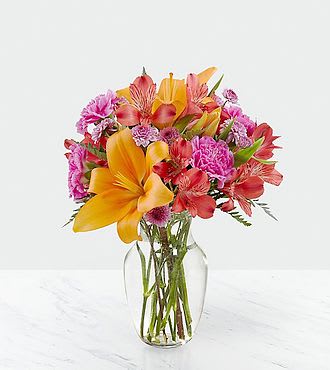
The Bloom Central flower delivery of the month for July in Harrison is the Light and Lovely Bouquet
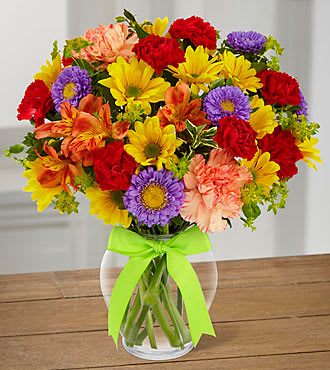
Introducing the Light and Lovely Bouquet, a floral arrangement that will brighten up any space with its delicate beauty. This charming bouquet, available at Bloom Central, exudes a sense of freshness and joy that will make you smile from ear to ear.
The Light and Lovely Bouquet features an enchanting combination of yellow daisies, orange Peruvian Lilies, lavender matsumoto asters, orange carnations and red mini carnations. These lovely blooms are carefully arranged in a clear glass vase with a touch of greenery for added elegance.
This delightful floral bouquet is perfect for all occasions be it welcoming a new baby into the world or expressing heartfelt gratitude to someone special. The simplicity and pops of color make this arrangement suitable for anyone who appreciates beauty in its purest form.
What is truly remarkable about the Light and Lovely Bouquet is how effortlessly it brings warmth into any room. It adds just the right amount of charm without overwhelming the senses.
The Light and Lovely Bouquet also comes arranged beautifully in a clear glass vase tied with a lime green ribbon at the neck - making it an ideal gift option when you want to convey your love or appreciation.
Another wonderful aspect worth mentioning is how long-lasting these blooms can be if properly cared for. With regular watering and trimming stems every few days along with fresh water changes every other day; this bouquet can continue bringing cheerfulness for up to two weeks.
There is simply no denying the sheer loveliness radiating from within this exquisite floral arrangement offered by the Light and Lovely Bouquet. The gentle colors combined with thoughtful design make it an absolute must-have addition to any home or a delightful gift to brighten someone's day. Order yours today and experience the joy it brings firsthand.
Harrison Illinois Flower Delivery
Harrison Flower Delivery - Frequently Asked Questions
- Does Bloom Central offer same-day flower delivery in Harrison?
- Yes. Place your order online before 1:00 PM and a local Harrison florist will hand-deliver your arrangement the same day. Orders can also be scheduled up to one month in advance.
- Is it safe to order flowers online?
- Absolutely! We utilize a secure, encrypted checkout to protect your personal and payment information. Visa, Mastercard, American Express, Discover, PayPal and Klarna are all accepted.
- What funeral homes does Bloom Central deliver sympathy flowers to in Harrison?
- We hand-deliver sympathy and memorial floral arrangements to all funeral homes near Harrison, including: Chicago Pastor, Daley Murphy Wisch & Associates Funeral Home and Crematorium, Delehanty Funeral Home, Honquest Family Funeral Home, Honquest Funeral Home, McCorkle Funeral Home, Olson Funeral & Creamation Services.
- What nearby cities does Bloom Central also deliver flowers to?
- In addition to Harrison, we deliver fresh flowers to many nearby cities including: Somerset, Murphysboro, De Soto, Carbondale, Elk, Cambria, Makanda, Royalton
- What are the most popular flower arrangements at the Harrison florist?
- Three of our most popular arrangements at our Harrison florist are: Pop of Whimsy Bouquet ($64.90), Here's Looking at You Bouquet and Bear Set ($124.90), Piece of Cake Bouquet ($49.90). All are available for same-day delivery.
More About Harrison
Are looking for a Harrison florist because you are not local to the area? If so, here is a brief travelogue of what Harrison has to offer. Who knows, perhaps you'll be intrigued enough to come visit soon, partake in some of the fun activities Harrison has to offer and deliver flowers to your loved one in person!
Harrison, Illinois, sits under a sky so wide and blue it seems to mock the very idea of elsewhere. The town announces itself first with a water tower, its silver curves bulging like a punctuation mark, an exclamation point or maybe a comma, depending on how the light hits. You drive in past fields that roll out in quilted greens and yellows, farms where generations have coaxed life from black soil, and suddenly there’s Harrison: a grid of streets where stop signs function less as traffic directives than gentle suggestions to pause, look twice, notice the old man on the bench feeding sparrows from his palm. The air smells of cut grass and diesel and the faint tang of distant rain.
Main Street’s brick facades wear their history without ostentation. A hardware store’s screen door slaps shut in a rhythm so constant it becomes a kind of heartbeat. Inside, clerks who know every nail and hinge by touch direct teenagers repairing tractors and widows replanting geraniums. Next door, a diner’s windows steam up by 6 a.m., its booths crammed with farmers debating crop prices over pancakes that stretch plate-edge to plate-edge. The waitress calls everyone “sugar,” not in the ironic way of city diners but with a warmth that makes you feel, briefly, like family.

Same day service available. Order your Harrison floral delivery and surprise someone today!
At the town’s lone intersection, a barbershop’s striped pole spins eternally. The barber, a man whose hands have shaped the haircuts of three generations, tells stories that loop and digress and always end with a punchline that creases his face into a map of laugh lines. Boys fidget in his chair, legs dangling, as he trps their cowlicks into submission. Across the street, a librarian tapes handmade posters to the window, urging readers to join the summer book club. Her selections, Melville, Morrison, a paperback thriller with a dog-eared spine, sit stacked in hopeful towers.
Harrison’s park sprawls at the town’s edge, its oak trees shading picnic tables where mothers sip lemonade and trade casserole recipes. Kids cannonball into the public pool, their shrieks bouncing off the concrete. An old tennis court, its net sagging like a tired smile, hosts pickup games where the rules bend to accommodate laughter. On weekends, the pavilion fills with potluck dishes: Jell-O salads shimmering like edible stained glass, pies with crusts flaky enough to dissolve on the tongue. Someone always brings a fiddle.
The school’s redbrick tower chimes the hours, a sound that carries clear to the edge of town. In fall, Friday nights glow under stadium lights as the high school football team, the Harrison Harvesters, their jerseys streaked with dirt and pride, charges down the field. Cheers rise in waves, not just for touchdowns but for the band’s off-key anthem, the sophomore who spills hot chocolate down his shirt, the way the crowd hushes when a player stumbles and rises, always rises.
Beyond the railroad tracks, a community garden blooms in defiant color. Retirees weed tomato plants beside teenagers snapping selfies with sunflowers. A sign hammered into the soil reads “Take What You Need, Leave What You Can,” and the baskets at its base brim with zucchini and mutual regard. At dusk, fireflies pulse over the fields, their lights mapping a Morse code only the land understands.
To call Harrison quaint feels like missing the point. It is alive, relentlessly so, in the way a well-tended garden thrives, not by accident but through daily, deliberate care. The woman who collects mail for her vacationing neighbor, the mechanic who fixes a single mother’s car for free, the kids who ride bikes past the war memorial, their wheels tracing figure eights around the names etched there: these are not relics of some bygone era but proof that certain rhythms endure.
Stand on Harrison’s main drag at sunset, and the water tower casts a long shadow. Breathe in the scent of fried chicken and impending storm. Listen to the murmur of a town that knows its worth. You’ll feel it then, a quiet thrum beneath your feet, the pulse of a place that insists on being more than a dot on a map. It is, in its unassuming way, a rebuttal to the notion that small means lesser. Come hungry. Leave full.