





- Anniversary
- Best Sellers
- Sympathy
 $69.90





- $297.90
- $64.90



June 1, 2026
LaSalle June Floral Selection
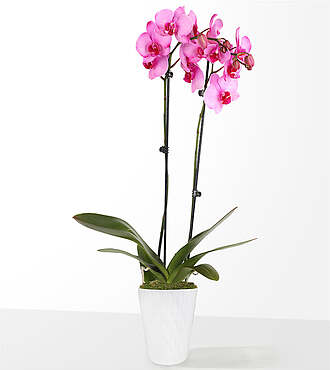
The Bloom Central flower delivery of the month for June in LaSalle is the Fuchsia Phalaenopsis Orchid
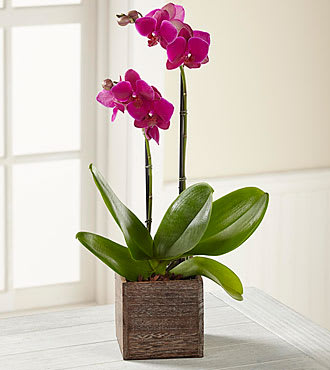
The Fuchsia Phalaenopsis Orchid floral arrangement from Bloom Central is a stunning addition to any home decor. This beautiful orchid arrangement features vibrant violet blooms that are sure to catch the eye of anyone who enters the room.
This stunning double phalaenopsis orchid displays vibrant violet blooms along each stem with gorgeous green tropical foliage at the base. The lively color adds a pop of boldness and liveliness, making it perfect for brightening up a living room or adding some flair to an entryway.
One of the best things about this floral arrangement is its longevity. Unlike other flowers that wither away after just a few days, these phalaenopsis orchids can last for many seasons if properly cared for.
Not only are these flowers long-lasting, but they also require minimal maintenance. With just a little bit of water every week and proper lighting conditions your Fuchsia Phalaenopsis Orchids will thrive and continue to bloom beautifully.
Another great feature is that this arrangement comes in an attractive, modern square wooden planter. This planter adds an extra element of style and charm to the overall look.
Whether you're looking for something to add life to your kitchen counter or wanting to surprise someone special with a unique gift, this Fuchsia Phalaenopsis Orchid floral arrangement from Bloom Central is sure not disappoint. The simplicity combined with its striking color makes it stand out among other flower arrangements.
The Fuchsia Phalaenopsis Orchid floral arrangement brings joy wherever it goes. Its vibrant blooms capture attention while its low-maintenance nature ensures continuous enjoyment without much effort required on the part of the recipient. So go ahead and treat yourself or someone you love today - you won't regret adding such elegance into your life!
LaSalle Florist
LaSalle Flower Delivery - Frequently Asked Questions
- Does Bloom Central offer same-day flower delivery in LaSalle?
- Yes. Place your order online before 1:00 PM and a local LaSalle florist will hand-deliver your arrangement the same day. Orders can also be scheduled up to one month in advance.
- Is it safe to order flowers online?
- Absolutely! We utilize a secure, encrypted checkout to protect your personal and payment information. Visa, Mastercard, American Express, Discover, PayPal and Klarna are all accepted.
- What hospitals and care facilities does Bloom Central deliver to in LaSalle?
- We deliver fresh flower arrangements to all hospitals, nursing homes and care facilities in LaSalle Illinois, including: Heritage Health-Lasalle, Il Veterans Home At Lasalle.
- What funeral homes does Bloom Central deliver sympathy flowers to in LaSalle?
- We hand-deliver sympathy and memorial floral arrangements to all funeral homes near LaSalle, including: Anderson Funeral Home & Crematory, Conley Funeral Home, Dieterle Memorial Home & Cremation Ceremonies, Dunn Family Funeral Home with Crematory, Healy Chapel, Malone Funeral Home, McKeown-Dunn Funeral Home & Cremation Services, Merritt Funeral Home, Moss Family Funeral Homes, Moss-Norris Funeral Home, Norberg Memorial Home, Inc. & Monuments, Schilling-Preston Funeral Home, Seals-Campbell Funeral Home, The Daleiden Mortuary, The Healy Chapel - Sugar Grove, Turner-Eighner Funeral Home, Weber-Hurd Funeral Home, Yurs Funeral Home.
- What nearby cities does Bloom Central also deliver flowers to?
- In addition to LaSalle, we deliver fresh flowers to many nearby cities including: Oglesby, Peru, North Utica, Utica, Eden, Spring Valley, Hall, Granville
- What are the most popular flower arrangements at the LaSalle florist?
- Three of our most popular arrangements at our LaSalle florist are: Ever After Rose Bouquet ($84.90), American Glory Bouquet ($59.90), Red Hot Bouquet ($49.90). All are available for same-day delivery.
More About LaSalle
Are looking for a LaSalle florist because you are not local to the area? If so, here is a brief travelogue of what LaSalle has to offer. Who knows, perhaps you'll be intrigued enough to come visit soon, partake in some of the fun activities LaSalle has to offer and deliver flowers to your loved one in person!
LaSalle, Illinois, sits along the Illinois River like a quiet guest at a party who, once engaged, reveals stories so vivid they recalibrate your sense of time. The river itself is a liquid spine, brown-green and patient, sliding past with the weight of a thousand upstate rains. On its banks, the town hums, not with the frenzy of coastal cities or the drowsy resignation of forgotten Midwest enclaves, but with a rhythm that suggests it knows something you don’t. Here, the past isn’t preserved behind glass. It lingers in the bricks of downtown storefronts, in the creak of a porch swing on North Second Street, in the way the light slants through autumn maples to gild the sidewalks gold.
The Illinois & Michigan Canal, now a relic of 19th-century ambition, once turned LaSalle into a nexus of sweat and steam. Imagine Irish laborers, sleeves rolled to elbows, digging trenches where water would someday carry grain and coal east to Chicago, west to St. Louis. Their ghosts persist in the towpaths, now trails where joggers pulse past historical markers, and in the canal’s still surface, which mirrors the sky with a clarity that feels like forgiveness. The canal’s old locks are inert, yes, but stand close: you can almost hear the echo of foremen’s shouts, the groan of barges, the metallic churn of an era when progress was measured in cubic feet of mud displaced.

Same day service available. Order your LaSalle floral delivery and surprise someone today!
Downtown LaSalle defies the cliché of hollowed-out Main Streets. Family-owned shops huddle beneath ornate cornices, a bakery where the scent of cardamom rolls blooms at dawn, a bookstore whose owner recommends Faulkner with the intensity of a priest offering benediction. The U.S.S. Cold War Submarine Memorial, a hulking silhouette near the river, draws veterans who stand a little straighter as they trace the names of lost comrades. The Hegeler Carus Mansion, a Gilded Age labyrinth of turrets and stained glass, anchors the residential streets with the gravitas of a castle, its halls whispering of philosophy, publishing, and a time when parlor conversations turned on Hegel and Whitman.
What’s striking is how the town’s ethos bends not on nostalgia but continuity. Teenagers cluster at Joe’s Pizza, devouring slices under neon signs that have outlasted half the national franchises on I-80. Retirees play chess in Washington Park, where the cannon from the Spanish-American War points toward a playground full of laughing children. The library, a sandstone fortress, hosts toddlers for story hour and octogenarians learning to email grandchildren. This isn’t a place frozen in amber; it’s a place that decided to carry its history forward, like a family heirloom reupholstered to fit a modern couch.
Nature here refuses to be a backdrop. At Starved Rock State Park, just north, trails wind through canyons where waterfalls freeze mid-plunge in winter, creating cathedrals of ice. But even in LaSalle proper, the wild nudges in, great blue herons stalking the river’s edge, foxes slipping through backyards at dusk, the way a summer storm can flood the air with the scent of wet soil until you swear you’re breathing the earth itself. The Hennepin Canal Parkway threads through town, a linear sanctuary where cyclists glide beneath arches of oak, and the only sounds are the crunch of gravel and the distant cry of a red-tailed hawk.
There’s a particular grace to cities that endure without pretense. LaSalle doesn’t dazzle; it compels. It asks you to slow down, to notice the way the barista remembers a customer’s order, the way the frost etches fractals on the pharmacy window, the way the sunset turns the grain elevators into rusted monoliths. This is a town that understands scale. Its triumphs are human-sized: a high school soccer team’s undefeated season, a diner’s pie winning a county fair ribbon, a neighbor shoveling another’s driveway after a blizzard. To visit is to glimpse a paradox, a community both unassuming and vital, where the American experiment grinds on, not with a roar, but the quiet persistence of a river carving its path.