





- Love & Romance
- Best Sellers
- Under $100
 $69.90






July 1, 2026
Romeoville July Floral Selection
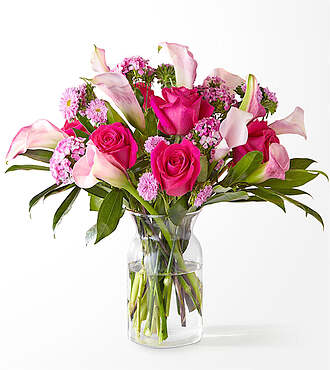
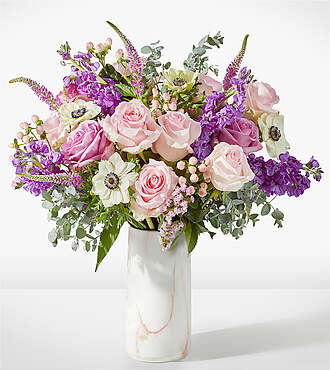
The Bloom Central flower delivery of the month for July in Romeoville is the Blooming Visions Bouquet
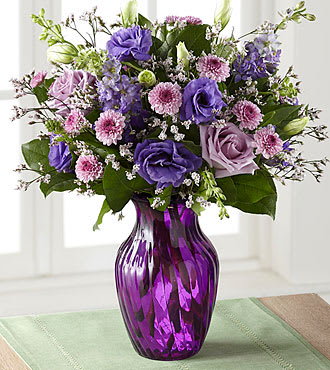
The Blooming Visions Bouquet from Bloom Central is just what every mom needs to brighten up her day! Bursting with an array of vibrant flowers, this bouquet is sure to put a smile on anyone's face.
With its cheerful mix of lavender roses and purple double lisianthus, the Blooming Visions Bouquet creates a picture-perfect arrangement that anyone would love. Its soft hues and delicate petals exude elegance and grace.
The lovely purple button poms add a touch of freshness to the bouquet, creating a harmonious balance between the pops of pink and the lush greens. It's like bringing nature's beauty right into your home!
One thing anyone will appreciate about this floral arrangement is how long-lasting it can be. The blooms are carefully selected for their high quality, ensuring they stay fresh for days on end. This means you can enjoy their beauty each time you walk by.
Not only does the Blooming Visions Bouquet look stunning, but it also has a wonderful fragrance that fills the room with sweetness. This delightful aroma adds an extra layer of sensory pleasure to your daily routine.
What sets this bouquet apart from others is its simplicity - sometimes less truly is more! The sleek glass vase allows all eyes to focus solely on the gorgeous blossoms inside without any distractions.
No matter who you are looking to surprise or help celebrate a special day there's no doubt that gifting them with Bloom Central's Blooming Visions Bouquet will make their heart skip a beat (or two!). So why wait? Treat someone special today and bring some joy into their world with this enchanting floral masterpiece!
Romeoville Illinois Flower Delivery
Romeoville Flower Delivery - Frequently Asked Questions
- Does Bloom Central offer same-day flower delivery in Romeoville?
- Yes. Place your order online before 1:00 PM and a local Romeoville florist will hand-deliver your arrangement the same day. Orders can also be scheduled up to one month in advance.
- Is it safe to order flowers online?
- Absolutely! We utilize a secure, encrypted checkout to protect your personal and payment information. Visa, Mastercard, American Express, Discover, PayPal and Klarna are all accepted.
- What hospitals and care facilities does Bloom Central deliver to in Romeoville?
- We deliver fresh flower arrangements to all hospitals, nursing homes and care facilities in Romeoville Illinois, including: Senior Star At Weber Place, Weber Place Assisted Living.
- What funeral homes does Bloom Central deliver sympathy flowers to in Romeoville?
- We hand-deliver sympathy and memorial floral arrangements to all funeral homes near Romeoville, including: ABC Monuments, Adams-Winterfield & Sullivan Funeral Home & Cremation Services, Anderson Memorial Chapel, Anderson Memorial Home, Beidelman-Kunsch Funeral Homes & Crematory, Bolingbrook McCauley Funeral Chapel, Care Memorial Cremation Center, Cherished Pets Remembered, Goodale Memorial Chapel, ONeil Funeral Home and Heritage Crematory, Overman Jones Funeral Home, Precious Pets Crematory & Funeral Home, Sullivan Funeral Home & Cremation Services.
- What churches does Bloom Central deliver flowers to in Romeoville?
- We deliver fresh floral arrangements to all churches and places of worship in Romeoville, including: Community Christian Church.
- What nearby cities does Bloom Central also deliver flowers to?
- In addition to Romeoville, we deliver fresh flowers to many nearby cities including: Du Page, Bolingbrook, Lockport, Wheatland, Crystal Lawns, Crest Hill, Fairmont, Woodridge
- What are the most popular flower arrangements at the Romeoville florist?
- Three of our most popular arrangements at our Romeoville florist are: Quality Time Bouquet ($54.90), Bright Lights Bouquet with Lavender Basket ($54.90), Golden Gourd Pumpkin Bouquet ($59.90). All are available for same-day delivery.
More About Romeoville
Are looking for a Romeoville florist because you are not local to the area? If so, here is a brief travelogue of what Romeoville has to offer. Who knows, perhaps you'll be intrigued enough to come visit soon, partake in some of the fun activities Romeoville has to offer and deliver flowers to your loved one in person!
Romeoville, Illinois, sits like a quiet promise just southwest of Chicago’s gravitational roar, a place where the Prairie State’s vast flatness seems to exhale. To drive here is to pass through a mosaic of contradictions: fields of soybeans surrendering to subdivisions, century-old farmhouses flanked by big-box stores, the scent of turned earth mingling with fry oil from fast-food vents. But to reduce Romeoville to mere transition, a rest stop between corn and concrete, is to miss the quiet pulse of a community built on the stubborn belief that roots can grow anywhere. Mornings here begin with the hiss of sprinklers on Little League diamonds, the clatter of dumpsters behind a diner where retirees dissect yesterday’s high school football game, the whir of bikes carrying kids toward the labyrinth of trails that stitch together parks named for trees no longer there. The Des Plaines River curls around the town’s edges like a question mark, its banks laced with the footprints of fishermen and the tire tracks of mountain bikers who treat the terrain as both adversary and ally. History here is not a museum but a neighbor. The Romeo Road Historic District wears its 19th-century homes like elders at a family reunion, their porches sagging under the weight of potted geraniums and gossip. Residents speak of “progress” without irony, pointing to the new library’s solar panels or the high school’s hydroponic lab, where students grow lettuce under LED lights, a feat that would’ve made the town’s first settlers, who broke prairie sod with oxen, either chuckle or genuflect. What’s striking is the absence of pretense. There are no artisanal pickle shops here, no self-conscious murals. Instead, there’s a hardware store that has hung the same “Let’s Fix Something” sign since the Nixon administration, its aisles a taxonomy of nails and optimism. There’s the community center where Zumba classes collide with quilt auctions, the recitals where third graders massacre Beethoven on plastic recorders as parents film vertically, grinning like hostages. The town’s rhythm syncs to the Metra trains that slice through twice daily, their horns echoing off water towers painted to look like basketballs or eagles, depending on who’s winning. Summer transforms Central Park into a carnival of inflatable slides and snow cone-stained shirts, while winter turns the same space into a tableau of scarved statues cheering for peewee hockey. The people here, teachers, pipefitters, nurses, mechanics, wear their vocations like surnames. They coach each other’s kids, plow each other’s driveways, argue over zoning laws at meetings where everyone knows the microphones don’t work. It’s a place where you can still find a handwritten note taped to a lamppost announcing a lost Labradoodle, where the phrase “block party” requires no explanation, where the sky at dusk stretches uninterrupted, a canvas for thunderstorms that roll in like freight trains. Romeoville doesn’t dazzle. It persists. Its charm lies in the uncelebrated details: the way the UPS driver knows which dogs bite, the librarian who stockpiles Westerns for the retired farmer with cataracts, the diner booth where the same men have debated the merits of diesel versus unleaded since the Carter era. To call it “quaint” would insult its resilience. This is a town that has swallowed tornadoes and recessions and emerged with its sidewalks intact, its flagpole straight, its Fourth of July parade route still tracing the same six blocks. In an age of curated identities, Romeoville remains unapologetically specific, a pocket of the Midwest where the American experiment continues, quietly, unremarkably, one casserole at a time.