




- Best Value
- Best Sellers
- Under $100
 $49.90
July 1, 2026
Wabash July Floral Selection
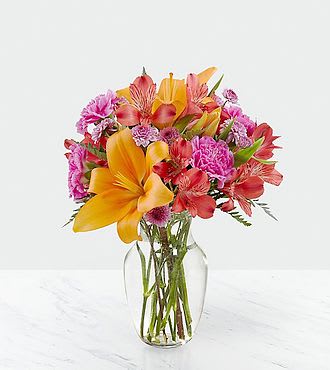
The Bloom Central flower delivery of the month for July in Wabash is the Light and Lovely Bouquet
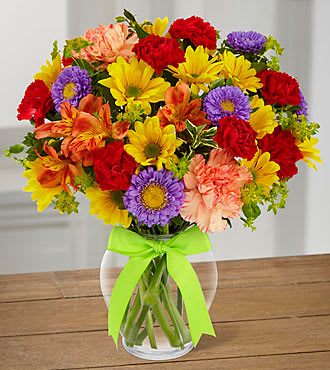
Introducing the Light and Lovely Bouquet, a floral arrangement that will brighten up any space with its delicate beauty. This charming bouquet, available at Bloom Central, exudes a sense of freshness and joy that will make you smile from ear to ear.
The Light and Lovely Bouquet features an enchanting combination of yellow daisies, orange Peruvian Lilies, lavender matsumoto asters, orange carnations and red mini carnations. These lovely blooms are carefully arranged in a clear glass vase with a touch of greenery for added elegance.
This delightful floral bouquet is perfect for all occasions be it welcoming a new baby into the world or expressing heartfelt gratitude to someone special. The simplicity and pops of color make this arrangement suitable for anyone who appreciates beauty in its purest form.
What is truly remarkable about the Light and Lovely Bouquet is how effortlessly it brings warmth into any room. It adds just the right amount of charm without overwhelming the senses.
The Light and Lovely Bouquet also comes arranged beautifully in a clear glass vase tied with a lime green ribbon at the neck - making it an ideal gift option when you want to convey your love or appreciation.
Another wonderful aspect worth mentioning is how long-lasting these blooms can be if properly cared for. With regular watering and trimming stems every few days along with fresh water changes every other day; this bouquet can continue bringing cheerfulness for up to two weeks.
There is simply no denying the sheer loveliness radiating from within this exquisite floral arrangement offered by the Light and Lovely Bouquet. The gentle colors combined with thoughtful design make it an absolute must-have addition to any home or a delightful gift to brighten someone's day. Order yours today and experience the joy it brings firsthand.
Wabash Florist
Wabash Flower Delivery - Frequently Asked Questions
- Does Bloom Central offer same-day flower delivery in Wabash?
- Yes. Place your order online before 1:00 PM and a local Wabash florist will hand-deliver your arrangement the same day. Orders can also be scheduled up to one month in advance.
- Is it safe to order flowers online?
- Absolutely! We utilize a secure, encrypted checkout to protect your personal and payment information. Visa, Mastercard, American Express, Discover, PayPal and Klarna are all accepted.
- What funeral homes does Bloom Central deliver sympathy flowers to in Wabash?
- We hand-deliver sympathy and memorial floral arrangements to all funeral homes near Wabash, including: Alexander Memorial Park, Anderson-Poindexter Funeral Home, Benton-Glunt Funeral Home, Boone Funeral Home, Browning Funeral Home, Crest Haven Memorial Park, Glasser Funeral Home, Glenn Funeral Home and Crematory, Goodwine Funeral Homes, Haley-McGinnis Funeral Home & Crematory, Kistler-Patterson Funeral Home, Oak Hill Cemetery, Stendeback Family Funeral Home, Stodghill Funeral Home, Sunset Funeral Home, Cremation Center & Cemetery, Wade Funeral Home, Werry Funeral Homes, Werry Funeral Homes.
- What nearby cities does Bloom Central also deliver flowers to?
- In addition to Wabash, we deliver fresh flowers to many nearby cities including: Marshall, Symmes, Martinsville, Paris, Kansas, Casey, Hutsonville, Ashmore
- What are the most popular flower arrangements at the Wabash florist?
- Three of our most popular arrangements at our Wabash florist are: Tranquil Bouquet ($59.90), Special Request 100 ($100.00), Soft Persuasion Bouquet ($54.90). All are available for same-day delivery.
More About Wabash
Are looking for a Wabash florist because you are not local to the area? If so, here is a brief travelogue of what Wabash has to offer. Who knows, perhaps you'll be intrigued enough to come visit soon, partake in some of the fun activities Wabash has to offer and deliver flowers to your loved one in person!
The thing about Wabash, Illinois, is how the place insists on itself. You’re driving through the flatness of the Midwest, past cornfields that stretch like an argument for infinity, and then, suddenly, there’s a river, a cluster of red brick, a courthouse dome that catches the sun like a wink. The town doesn’t announce itself with billboards or neon. It just appears, quiet and unapologetic, as if it’s been waiting for you to notice it all along. People here still wave at strangers. They still plant flowers in tires. They still trust the weatherman. There’s a rhythm to the streets, a pulse you can feel in the creak of porch swings and the clatter of a distant train crossing the Wabash River, which curls around the town like a question mark someone forgot to finish.
The river is the kind of old that makes you want to sit still. Its surface wrinkles with the wind, flickering between silver and mud-brown, and on its banks, kids cast lines for catfish while their parents swap stories about the one that got away in ’92. The water doesn’t hurry. It knows where it’s going. You get the sense that if you listened close enough, it might tell you secrets about steamboats and ice harvests, about floods that receded and left the soil richer. But the river keeps its counsel, and the town respects that. People here understand that some things don’t need explaining.

Same day service available. Order your Wabash floral delivery and surprise someone today!
Downtown, the buildings wear their history like a favorite coat. The marquee of the Eagles Theatre still promises magic on Friday nights. At the Five & Dime, a bell jingles when you open the door, and the floorboards groan underfoot as if sharing gossip. The woman behind the counter knows everyone’s name and the correct way to fix a leaky faucet. At the coffee shop on Market Street, the regulars argue about high school football and the best route to avoid harvest traffic. The air smells like burnt beans and sincerity. You can’t buy a latte here, but you can get a cup of coffee that tastes like someone’s grandmother made it, and that’s better.
What’s strange is how the ordinary becomes extraordinary when you look closely. Take the courthouse lawn. On Tuesday afternoons, retirees play chess under the shade of oaks planted before their grandparents were born. The pieces click against marble tables, and the men laugh like they’ve already won, even when they haven’t. Across the street, a mural spans the side of the hardware store, a patchwork of faces and tractors and sunsets, the kind of art that doesn’t care if you call it folk or naïve. It’s just there, humming with color, because someone decided the wall needed to mean something.
The park by the river hosts a concert series every summer. Families spread blankets on the grass. Kids chase fireflies. A local band covers Johnny Cash, and the drummer’s mom mouths the lyrics from the front row. Nobody’s a star here, but everyone’s invited. When the sun dips low, the streetlights flicker on, and this is the part that gets you: Wabash was the first city in the world to be entirely lit by electricity. They turned the switch in 1880, and the town glowed like a jar of lightning bugs. You can still feel that shock of possibility, that pride in a light that says, Here we are.
It’s easy to romanticize small towns. To mistake quiet for simplicity, or kindness for naivete. But Wabash resists the binary. It’s a place where the past isn’t preserved behind glass, it’s alive, tangled in the present, feeding the roots of what’s next. The farmer selling tomatoes at the market learned to garden from his father, who learned from his. The librarian who recommends mystery novels remembers when your mother checked out Anne of Green Gables. The high school quarterback mows Mrs. Henley’s lawn every Saturday.
You leave thinking about how some places refuse to disappear. How they persist, not in spite of their smallness, but because of it. Wabash doesn’t shout. It doesn’t have to. It’s enough to sit by the river, to watch the water hold the sky, and to realize that sometimes, the best things don’t need to be bigger. They just need to be.