





- Anniversary
- Best Sellers
- Under $100
 $69.90




July 1, 2026
Calmar July Floral Selection
The Bloom Central flower delivery of the month for July in Calmar is the Happy Day Bouquet
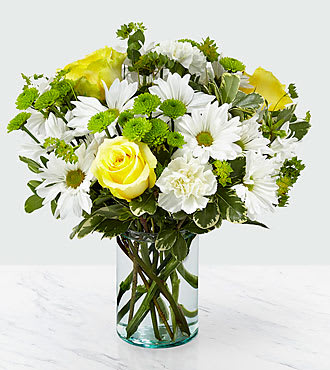
The Happy Day Bouquet from Bloom Central is simply adorable. This charming floral arrangement is perfect for brightening up any room in your home. It features a delightful mix of vibrant flowers that will instantly bring joy to anyone who sees them.
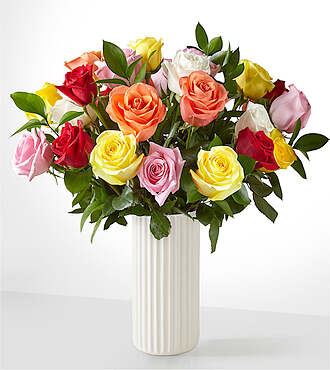
With cheery colors and a playful design the Happy Day Bouquet is sure to put a smile on anyone's face. The bouquet includes a collection of yellow roses and luminous bupleurum plus white daisy pompon and green button pompon. These blooms are expertly arranged in a clear cylindrical glass vase with green foliage accents.
The size of this bouquet is just right - not too big and not too small. It is the perfect centerpiece for your dining table or coffee table, adding a pop of color without overwhelming the space. Plus, it's so easy to care for! Simply add water every few days and enjoy the beauty it brings to your home.
What makes this arrangement truly special is its versatility. Whether you're celebrating a birthday, anniversary, or simply want to brighten someone's day, the Happy Day Bouquet fits the bill perfectly. With timeless appeal makes this arrangement is suitable for recipients of all ages.
If you're looking for an affordable yet stunning gift option look no further than the Happy Day Bouquet from Bloom Central. As one of our lowest priced arrangements, the budget-friendly price allows you to spread happiness without breaking the bank.
Ordering this beautiful bouquet couldn't be easier either. With Bloom Central's convenient online ordering system you can have it delivered straight to your doorstep or directly to someone special in just a few clicks.
So why wait? Treat yourself or surprise someone dear with this delightful floral arrangement today! The Happy Day Bouquet will undoubtedly uplift spirits and create lasting memories filled with joy and love.
Calmar Iowa Flower Delivery
Calmar Flower Delivery - Frequently Asked Questions
- Does Bloom Central offer same-day flower delivery in Calmar?
- Yes. Place your order online before 1:00 PM and a local Calmar florist will hand-deliver your arrangement the same day. Orders can also be scheduled up to one month in advance.
- Is it safe to order flowers online?
- Absolutely! We utilize a secure, encrypted checkout to protect your personal and payment information. Visa, Mastercard, American Express, Discover, PayPal and Klarna are all accepted.
- What funeral homes does Bloom Central deliver sympathy flowers to in Calmar?
- We hand-deliver sympathy and memorial floral arrangements to all funeral homes near Calmar, including: Garrity Funeral Home, Jamison-Schmitz Funeral Homes, Mentor Fay Cemetery, Redman-Schwartz Funeral Homes.
- What nearby cities does Bloom Central also deliver flowers to?
- In addition to Calmar, we deliver fresh flowers to many nearby cities including: Decorah, West Union, Postville, Cresco, Waukon, Fredericksburg, Fayette, New Hampton
- What are the most popular flower arrangements at the Calmar florist?
- Three of our most popular arrangements at our Calmar florist are: Party Starter Bouquet ($59.90), Be Happy Bouquet ($49.90), Garden Glam Bouquet ($64.90). All are available for same-day delivery.
More About Calmar
Are looking for a Calmar florist because you are not local to the area? If so, here is a brief travelogue of what Calmar has to offer. Who knows, perhaps you'll be intrigued enough to come visit soon, partake in some of the fun activities Calmar has to offer and deliver flowers to your loved one in person!
Calmar, Iowa, exists in that rare American space where the sky feels both endless and intimate, a paradox of plains geography that makes the horizon seem like something you could reach out and adjust with your hands. The town sits quietly in Winneshiek County, population 978 at last count, a number that feels both precise and fluid, as if the act of counting itself might disrupt the equilibrium of a place so consciously unconcerned with scale. Drive through on Highway 150 and you’ll see the usual markers: a post office, a bank, a diner with checkered curtains, a single traffic light that blinks yellow after 8 p.m. as though politely reminding the night to take its time. What you won’t see, at least not immediately, is the quiet thrum of a community that has mastered the art of sustaining itself without announcing it.
The soil here is the kind of black gold that makes farmers from less blessed regions sigh with a mix of envy and reverence. Fields stretch in quilted perfection, each row of corn or soybeans standing at attention like disciplined sentinels. But to focus only on the agrarian would be to miss the town’s quieter marvels. Take, for instance, the Seed Savers Exchange, a nonprofit tucked into 890 acres of rolling hills just north of town. Here, heirloom vegetables and heritage crops, tomatoes that predate the Great Depression, beans carried in the pockets of immigrants, are cultivated with the care of archivists. Volunteers and staff move through the gardens with an almost monastic dedication, their hands cradling the future of flavors nearly erased by industrial agriculture. It feels less like a farm and more like a living library, each plant a volume in a epic about survival.

Same day service available. Order your Calmar floral delivery and surprise someone today!
Main Street wears its humility like a badge. The storefronts, a hardware store, a café serving pie with crusts so flaky they seem to defy physics, a pharmacy where the pharmacist knows your name before you say it, exude a warmth that doesn’t require nostalgia to appreciate. On summer evenings, families gather in Veterans Memorial Park, kids darting between oak trees while parents trade updates on rain forecasts and the high school football team’s prospects. The park’s gazebo hosts everything from polka festivals to quilting circles, the kind of events where attendance is both a choice and a reflex.
What’s striking about Calmar isn’t just its resilience but its refusal to conflate resilience with stasis. The town’s school system, a single K-12 building with a enrollment smaller than some city kindergarten classes, produces students who routinely outperform state averages. Teachers here double as coaches, mentors, and de facto community historians, their classrooms buzzing with a sense of possibility that feels both quaint and radical. The same kids who rebuild tractors in vocational classes debate climate science in AP courses, their hands stained with engine grease and their minds parsing data sets.
There’s a particular light that falls over Calmar in late afternoon, slanting through the steeples of St. Aloysius Catholic Church and the Lutheran chapel a block east, painting the streets in long, golden strokes. It’s the kind of light that makes you notice how clean the sidewalks are, how the flower boxes on the library’s windowsills burst with blooms that seem to have been chosen for maximal joy-per-petal. You might catch an old-timer on a bench, nodding at passersby with the serene authority of someone who has earned the right to take his time.
To call Calmar “quaint” would miss the point. Quaintness implies a performance, a self-awareness that this town pointedly lacks. Life here moves at the pace of trust, trust that the crops will grow, that the neighbor will wave, that the postmaster will hold your mail if you’re out of town. It’s a place that quietly insists there’s still room for a certain kind of American life, one where the word “community” isn’t an abstraction but a daily practice. You don’t visit Calmar so much as let it settle into you, like the steady turning of the seasons, reliable and unpretentious and alive.