




- Love & Romance
- Best Sellers
- Sympathy
 $69.90


- $297.90
- $64.90




July 1, 2026
Lyman July Floral Selection
The Bloom Central flower delivery of the month for July in Lyman is the Be Bold Bouquet by Better Homes and Gardens
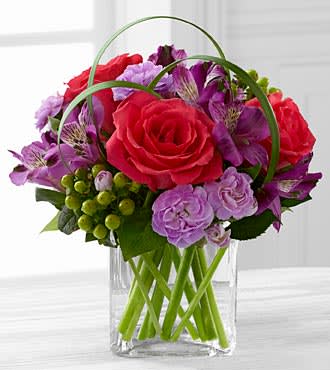
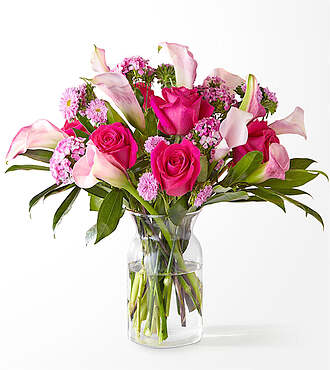
Introducing the Be Bold Bouquet by Better Homes and Gardens floral arrangement! Blooming with bright colors to boldly express your every emotion, this exquisite flower bouquet is set to celebrate. Hot pink roses, purple Peruvian Lilies, lavender mini carnations, green hypericum berries, lily grass blades, and lush greens are brought together to create an incredible flower arrangement.
The flowers are artfully arranged in a clear glass cube vase, allowing their natural beauty to shine through. The lucky recipient will feel like you have just picked the flowers yourself from a beautiful garden!
Whether you're celebrating an anniversary, sending get well wishes or simply saying 'I love you', the Be Bold Bouquet is always appropriate. This floral selection has timeless appeal and will be cherished by anyone who is lucky enough to receive it.
Better Homes and Gardens has truly outdone themselves with this incredible creation. Their attention to detail shines through in every petal and leaf - creating an arrangement that not only looks stunning but also feels incredibly luxurious.
If you're looking for a captivating floral arrangement that brings joy wherever it goes, the Be Bold Bouquet by Better Homes and Gardens is the perfect choice. The stunning colors, long-lasting blooms, delightful fragrance and affordable price make it a true winner in every way. Get ready to add a touch of boldness and beauty to someone's life - you won't regret it!
Local Flower Delivery in Lyman
Lyman Flower Delivery - Frequently Asked Questions
- Does Bloom Central offer same-day flower delivery in Lyman?
- Yes. Place your order online before 1:00 PM and a local Lyman florist will hand-deliver your arrangement the same day. Orders can also be scheduled up to one month in advance.
- Is it safe to order flowers online?
- Absolutely! We utilize a secure, encrypted checkout to protect your personal and payment information. Visa, Mastercard, American Express, Discover, PayPal and Klarna are all accepted.
- What funeral homes does Bloom Central deliver sympathy flowers to in Lyman?
- We hand-deliver sympathy and memorial floral arrangements to all funeral homes near Lyman, including: A.T. Hutchins,LLC, Bibber Memorial Chapel Funeral Home, Brooklawn Memorial Park, Calvary Cemetery, Conroy-Tully Walker Funeral Homes - Portland, Dennett-Craig & Pate Funeral Home, Eastern Cemetery, Edgerly Funeral Home, Evergreen Cemetery, Forest City Cemetery, Hope Memorial Chapel, Jones, Rich & Barnes Funeral Home, Laurel Hill Cemetery Assoc, Locust Grove Cemetery, Maine Memorial Company, Ocean View Cemetery, St Hyacinths Cemetary, Western Cemetery.
- What nearby cities does Bloom Central also deliver flowers to?
- In addition to Lyman, we deliver fresh flowers to many nearby cities including: Alfred, Dayton, West Kennebunk, Arundel, Sanford, Waterboro, Hollis, Kennebunk
- What are the most popular flower arrangements at the Lyman florist?
- Three of our most popular arrangements at our Lyman florist are: Outdoors Bouquet ($54.90), True Charm Bouquet ($49.90), Loving Light Dishgarden ($69.90). All are available for same-day delivery.
More About Lyman
Are looking for a Lyman florist because you are not local to the area? If so, here is a brief travelogue of what Lyman has to offer. Who knows, perhaps you'll be intrigued enough to come visit soon, partake in some of the fun activities Lyman has to offer and deliver flowers to your loved one in person!
Lyman, Maine, sits like a quiet guest at the edge of York County, a place where the land itself seems to exhale. To drive through is to witness an unspoken agreement between people and geography, fields roll into stands of pine, stone walls stitch together properties older than the idea of zoning laws, and the sky hangs low enough to touch if you stand on the right hill. There is a rhythm here, not the frenetic thrum of progress but something slower, deeper, a pulse measured in seasons and sunsets. The town’s name, Lyman, comes from some ancestral figure lost to time, but the place feels less named than simply endured, as if the soil itself shrugged and said fine, call it this.
Mornings start with mist. Fog pools in the hollows, and by seven, pickup trucks idle outside the general store, their drivers swapping stories over coffee in Styrofoam cups. The store’s screen door slaps shut like a metronome. Inside, shelves hold motor oil and local honey, and the cashier knows everyone’s usual. Conversations here orbit the weather, the price of hay, the high school soccer team’s latest win. The talk is practical but not unkind. When someone asks how’s your mother, they mean it.

Same day service available. Order your Lyman floral delivery and surprise someone today!
The heart of Lyman isn’t a downtown, it’s the roads between. Route 111 cuts through, straight and unpretentious, flanked by farmstands where handwritten signs advertise tomatoes or firewood. Turn onto a side street, and the pavement narrows, giving way to dirt lanes that ribbon past barns wearing their age like pride. These roads go nowhere fast, which is the point. Children pedal bikes with streamers on the handles. Dogs trot loose, sniffing mailboxes. At dusk, porch lights flicker on, each house a beacon saying here, we’re here.
Autumn sharpens the air, and the town becomes a canvas of red and gold. Farmers haul pumpkins; tractors kick up dust. At the elementary school, kids press leaves into wax paper while teachers explain photosynthesis in a way that makes the whole room smell like crayons. There’s a harvest festival every October, craft tables, apple cider, a scarecrow contest judged by the fire chief. The event lacks spectacle, unless you count the way a toddler’s face lights up when they win a cupcake by guessing its weight.
Winter quiets everything. Snow muffles sound, and woodsmoke tangles with the cold. Neighbors shovel each other’s driveways without asking. The community center hosts potlucks where casseroles outnumber people, and someone always brings a crockpot of baked beans. Teenagers drag sleds to the hill behind the old church, laughing as they tumble into drifts. You learn here that silence isn’t empty. It’s full of things too ordinary to name: the creak of a frozen branch, the distant hum of plows, the way your breath hangs visible, proof you’re alive.
Spring arrives shyly, tentative green shoots poking through mud. The river swells, and kids dare each other to skip stones on water still icy at the edges. Gardens get tilled, and hardware stores sell out of seeds by May. There’s a sense of reset, of starting over, but without the pressure to reinvent. Growth here isn’t a slogan. It’s just what happens when you plant something and wait.
Summer is Lyman’s exhalation. Days stretch long and honeyed. The library runs a reading program where kids earn stickers for every book finished, and the parking lot becomes a stage for minivans and bicycles. At dusk, fireflies blink Morse code over lawns. Families eat ice cream on picnic tables, and the local dairy’s vanilla tastes like childhood. You can stand in the middle of a field and hear nothing but wind and your own heartbeat. It’s easy, in moments like these, to forget the world beyond the tree line. Easy to believe that smallness isn’t a limitation but a gift.
What Lyman lacks in grandeur it makes up in texture. This isn’t a town for postcards. It’s a place where life happens in the cracks, the shared nod at the post office, the way the sunset turns the feed mill golden, the collective memory of which barn burned down in which decade. To call it quaint would miss the point. Quaintness is for tourists, and Lyman, steadfast and unassuming, seems content to just be. There’s a lesson in that, maybe. A reminder that some places, and people, thrive not by shouting but by staying, by tending to the fragile, vital work of continuity.