





- Get Well
- Best Sellers
- Under $100
 $54.90
- $54.90
- $79.90
- $54.90
- $49.90
- $49.90



July 1, 2026
Whitefield July Floral Selection
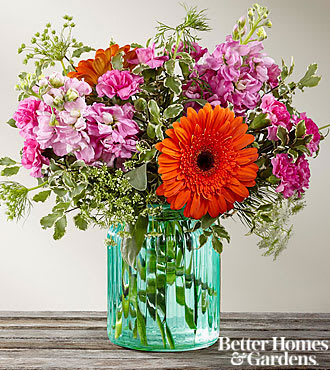
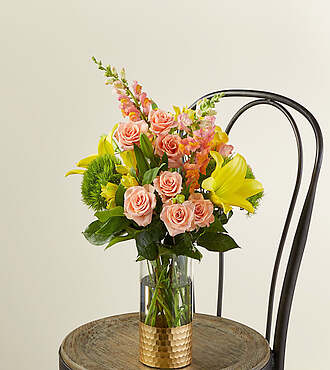
The Bloom Central flower delivery of the month for July in Whitefield is the Into the Woods Bouquet
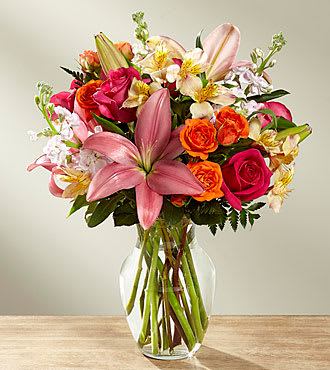
The Into the Woods Bouquet floral arrangement from Bloom Central is simply enchanting. The rustic charm and natural beauty will captivate anyone who is lucky enough to receive this bouquet.
The Into the Woods Bouquet consists of hot pink roses, orange spray roses, pink gilly flower, pink Asiatic Lilies and yellow Peruvian Lilies. The combination of vibrant colors and earthy tones create an inviting atmosphere that every can appreciate. And don't worry this dazzling bouquet requires minimal effort to maintain.
Let's also talk about how versatile this bouquet is for various occasions. Whether you're celebrating a birthday, hosting a cozy dinner party with friends or looking for a unique way to say thinking of you or thank you - rest assured that the Into the Woods Bouquet is up to the task.
One thing everyone can appreciate is longevity in flowers so fear not because this stunning arrangement has amazing staying power. It will gracefully hold its own for days on end while still maintaining its fresh-from-the-garden look.
When it comes to convenience, ordering online couldn't be easier thanks to Bloom Central's user-friendly website. In just a few clicks, you'll have your very own woodland wonderland delivered straight to your doorstep!
So treat yourself or someone special to a little piece of nature's serenity. Add a touch of woodland magic to your home with the breathtaking Into the Woods Bouquet. This fantastic selection will undoubtedly bring peace, joy, and a sense of natural beauty that everyone deserves.
Whitefield Florist
Whitefield Flower Delivery - Frequently Asked Questions
- Does Bloom Central offer same-day flower delivery in Whitefield?
- Yes. Place your order online before 1:00 PM and a local Whitefield florist will hand-deliver your arrangement the same day. Orders can also be scheduled up to one month in advance.
- Is it safe to order flowers online?
- Absolutely! We utilize a secure, encrypted checkout to protect your personal and payment information. Visa, Mastercard, American Express, Discover, PayPal and Klarna are all accepted.
- What funeral homes does Bloom Central deliver sympathy flowers to in Whitefield?
- We hand-deliver sympathy and memorial floral arrangements to all funeral homes near Whitefield, including: A.T. Hutchins,LLC, Boothbay Harbor Town of, Brackett Funeral Home, Calvary Cemetery, Conroy-Tully Walker Funeral Homes - Portland, Dan & Scott Adams Cremation & Funeral Service, Dan & Scotts Cremation & Funeral Service, Direct Cremation Of Maine, Eastern Cemetery, Evergreen Cemetery, Funeral Alternatives, Jones, Rich & Barnes Funeral Home, Kenniston Cemetery, Lewis Cemetery, Maine Memorial Company, Maine Veterans Memorial Cemetery, Pear Street Cemetery, Riverview Cemetery.
- What nearby cities does Bloom Central also deliver flowers to?
- In addition to Whitefield, we deliver fresh flowers to many nearby cities including: Pittston, Jefferson, Chelsea, Randolph, Gardiner, Windsor, Nobleboro, Dresden
- What are the most popular flower arrangements at the Whitefield florist?
- Three of our most popular arrangements at our Whitefield florist are: A Splendid Day Bouquet ($64.90), Crimson Leaves Bouquet ($54.90), Independence Bouquet ($49.90). All are available for same-day delivery.
More About Whitefield
Are looking for a Whitefield florist because you are not local to the area? If so, here is a brief travelogue of what Whitefield has to offer. Who knows, perhaps you'll be intrigued enough to come visit soon, partake in some of the fun activities Whitefield has to offer and deliver flowers to your loved one in person!
Whitefield, Maine, sits in the kind of rural quiet that hums. The town’s two-lane roads curve like afterthoughts around hills dense with pine, past barns whose red paint has faded to something closer to memory. Mornings here begin with mist lifting off the Sheepscot River, the kind of mist that seems less weather than a held breath, and by 7 a.m. the diner on Route 218 is already clattering with locals leaning into mugs of coffee, their voices tangling over the hiss of the grill. The waitress knows everyone’s order, which is to say she knows everyone. This is not the sort of place you pass through. You arrive.
Driving north from the coast, the landscape sheds lobster traps and gift shops for fields striped with cornrows and the slow ballet of dairy cows. Whitefield’s soil is stubborn, glacial till that demands hands willing to coax it into yielding. Those hands belong to people who can fix a tractor with a paperclip and a prayer, who measure time not in meetings but in seasons, planting, haying, harvest. Their faces, creased as the fields they work, appear in town only for hardware store runs or the Friday farmers market, where tables groan under heirloom tomatoes and jars of honey so raw they still hum with summer.

Same day service available. Order your Whitefield floral delivery and surprise someone today!
The town center is a comma of civilization: a post office, a library housed in a 19th-century church, a general store where the screen door slaps shut like a punchline. Kids pedal bikes past Victorian homes with porch swings that sway empty until dusk, when neighbors materialize to dissect the day’s non-events. Conversations here are recursive, layered with decades of context. A remark about the weather (“Think it’ll rain?”) is both meteorology and metaphysics, a cipher for everything unsaid.
Whitefield’s heart beats in its contradictions. It is a place where solitude and community orbit each other, gravitational. Walk the back roads and you’ll pass a farmstand unmanned but for a cigar box of cash and a sign urging honesty. Five miles down, a sculptor’s studio, all jagged steel and neon, juts from a meadow, proof that even here, the avant-garde can take root. The town hall hosts potlucks where casseroles compete with quinoa salads, where teenagers in Carhartts debate TikTok trends beside octogenarians who still call the internet “the email.”
What binds them is land. The woods here are thick with trails that dissolve into moss, with streams that flicker silver under ferns. In autumn, maples ignite in hues that make tourists brake too suddenly, but locals know the real spectacle is November, when the leaves fall and the sky opens like a vault, endless and cold. Winter brings a silence so total it rings. Snow muffles the world until all that’s left is woodsmoke and the scrape of shovels, the occasional bark of a dog chasing nothing. By March, when mud season turns roads into slurries, everyone pretends to hate it here. Then April arrives, and the first crocuses punch through frost, and the cycle begins again.
To call Whitefield “quaint” misses the point. Quaint is static; Whitefield persists. It persists in the way the librarian organizes not just books but grief after a loss, in the way the fire department’s pancake breakfast doubles as a town census, in the way the river keeps carving its path regardless of what’s built beside it. There’s a resilience here that doesn’t announce itself, a rhythm older than nostalgia. You see it in the teenager teaching her sister to parallel park in the IGA lot, in the retired teacher who still drops zucchinis on doorsteps each August, in the way the fog returns each dawn, faithful, softening the edges of everything.
Come evening, the diner’s neon sign buzzes on, a beacon against the gathering dark. Inside, the coffee keeps coming. The talk turns to tomorrow’s weather, always tomorrow’s. Someone laughs. The grill sizzles. You could call it simple. You’d be wrong.