





- Anniversary
- Best Sellers
- Carnations
 $69.90


















July 1, 2026
Arbutus July Floral Selection
The Bloom Central flower delivery of the month for July in Arbutus is the Into the Woods Bouquet
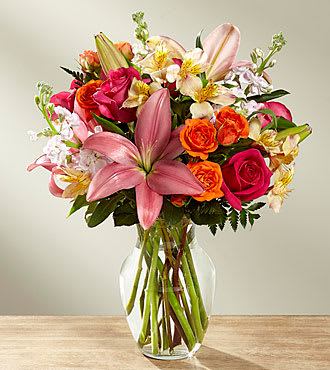
The Into the Woods Bouquet floral arrangement from Bloom Central is simply enchanting. The rustic charm and natural beauty will captivate anyone who is lucky enough to receive this bouquet.
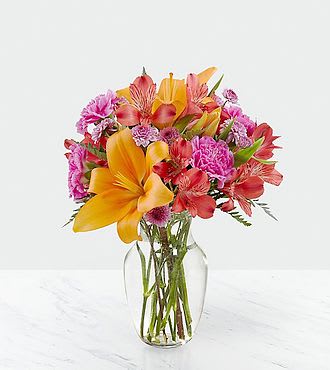
The Into the Woods Bouquet consists of hot pink roses, orange spray roses, pink gilly flower, pink Asiatic Lilies and yellow Peruvian Lilies. The combination of vibrant colors and earthy tones create an inviting atmosphere that every can appreciate. And don't worry this dazzling bouquet requires minimal effort to maintain.
Let's also talk about how versatile this bouquet is for various occasions. Whether you're celebrating a birthday, hosting a cozy dinner party with friends or looking for a unique way to say thinking of you or thank you - rest assured that the Into the Woods Bouquet is up to the task.
One thing everyone can appreciate is longevity in flowers so fear not because this stunning arrangement has amazing staying power. It will gracefully hold its own for days on end while still maintaining its fresh-from-the-garden look.
When it comes to convenience, ordering online couldn't be easier thanks to Bloom Central's user-friendly website. In just a few clicks, you'll have your very own woodland wonderland delivered straight to your doorstep!
So treat yourself or someone special to a little piece of nature's serenity. Add a touch of woodland magic to your home with the breathtaking Into the Woods Bouquet. This fantastic selection will undoubtedly bring peace, joy, and a sense of natural beauty that everyone deserves.
Arbutus Maryland Flower Delivery
Arbutus Flower Delivery - Frequently Asked Questions
- Does Bloom Central offer same-day flower delivery in Arbutus?
- Yes. Place your order online before 1:00 PM and a local Arbutus florist will hand-deliver your arrangement the same day. Orders can also be scheduled up to one month in advance.
- Is it safe to order flowers online?
- Absolutely! We utilize a secure, encrypted checkout to protect your personal and payment information. Visa, Mastercard, American Express, Discover, PayPal and Klarna are all accepted.
- What funeral homes does Bloom Central deliver sympathy flowers to in Arbutus?
- We hand-deliver sympathy and memorial floral arrangements to all funeral homes near Arbutus, including: Charm City Pet Crematory, Cremation Society of Maryland, Greene Funeral Home, Hubbard Funeral Home, Loudon Park Cemetery, Loudon Park Funeral Home, MacNabb Funeral Home, Mt. Zion Cemetery, Weber David J Funeral Homes PA.
- What churches does Bloom Central deliver flowers to in Arbutus?
- We deliver fresh floral arrangements to all churches and places of worship in Arbutus, including: Nichiren Buddhism Soka Gakkai International.
- What nearby cities does Bloom Central also deliver flowers to?
- In addition to Arbutus, we deliver fresh flowers to many nearby cities including: Catonsville, Lansdowne, Elkridge, Ilchester, Baltimore Highlands, Linthicum, Brooklyn Park, Woodlawn
- What are the most popular flower arrangements at the Arbutus florist?
- Three of our most popular arrangements at our Arbutus florist are: Piece of Cake Bouquet ($49.90), Pop of Whimsy Bouquet ($64.90), Here's Looking at You Bouquet and Bear Set ($124.90). All are available for same-day delivery.
More About Arbutus
Are looking for a Arbutus florist because you are not local to the area? If so, here is a brief travelogue of what Arbutus has to offer. Who knows, perhaps you'll be intrigued enough to come visit soon, partake in some of the fun activities Arbutus has to offer and deliver flowers to your loved one in person!
Arbutus, Maryland, sits just southwest of Baltimore like a quiet cousin at a family reunion, content to observe the bustle from a distance. The town’s identity is a lattice of contradictions, a place where commuter trains slice through neighborhoods stacked with century-old homes, where the scent of autumn bonfires mingles with the diesel breath of freight trucks idling on East Drive. To call it a suburb feels reductive, a term too flimsy to contain the particular gravity of a community bound not by proximity to a city but by something harder to name. Drive down Oregon Avenue on a Tuesday morning. Notice the way sunlight slants through oaks whose roots buckle the sidewalks into geologic maps. Here, the past isn’t archived. It lingers. The Arbutus Library, a low-slung brick building with windows like drowsy eyes, has shelves that remember every child who ever raced through the summer reading program. The fire station on Linden Avenue still hosts pancake breakfasts where volunteers flip batter with the solemnity of priests, syrup dripping like liquid nostalgia onto paper plates. There’s a rhythm here, a pulse beneath the asphalt. It’s in the way neighbors pause midwalk to discuss hydrangeas or the sudden reappearance of rabbits in Carriage Hill Park. It’s in the Friday night lights at Arbutus Middle School, where the football field becomes a stage for teenagers sprinting toward futures they can’t yet imagine. The town’s heart beats loudest during the Fourth of July parade, when fire trucks decked in crepe paper roll past crowds waving miniature flags. Children dart for candy tossed by men in Rotary Club polos, their laughter weaving into the brass notes of high school marching bands. You can’t help but feel you’re witnessing a ritual older than any of its participants, a thread tying generations. Commerce here is personal. The Arbutus Diner, with its vinyl booths and checkered floors, serves milkshakes in steel tumblers so cold they fog in your hand. At Ma’s Kettle, the omelets arrive with gossip from the next table, offered freely, like condiments. Even the CVS on Sulphur Spring Road feels somehow smaller, softer at the edges, as if the building itself knows it’s intruding on a patch of town that still prefers hardware stores with creaky screen doors. Walk the Trolley Trail at dusk, where the asphalt path follows the ghost of a railway that once ferried streetcars to Baltimore. Now it’s a vein for joggers and dog walkers, flanked by maples that blaze in October. Listen. The rustle of leaves syncs with the distant hum of I-695, a reminder that Arbutus exists in the tense space between stillness and motion. The University of Maryland Baltimore County perches on the town’s eastern edge, its concrete campus a stark contrast to Arbutus’ clapboard homes. Students spill into local cafes, laptops open, their conversations layering over the clatter of espresso machines. It’s here that the town’s duality sharpens, the collision of academic ambition with the stubborn persistence of tradition. Yet somehow, it coheres. Arbutus doesn’t beg for attention. It lacks the self-conscious charm of a tourist trap. Its beauty is unadorned, folded into the ordinary: a grandmother planting tulips along her driveway, the way the setting sun turns the Arbutus Town Hall’s clock tower gold, the collective sigh of relief when spring finally thaws the last gray slush of winter. To live here is to understand that belonging isn’t about grandeur. It’s about knowing the name of the librarian who checks out your novels, the barber who remembers your high school graduation year, the waitress who refills your coffee without asking. In a world obsessed with scale, Arbutus insists on intimacy. Its legacy isn’t etched in monuments but in the quiet accretion of shared mornings, of sidewalks swept, of waves exchanged from porches. It is, in its unassuming way, a rebuttal to the idea that smallness is a flaw.