





- Love & Romance
- Best Sellers
- Under $60
 $69.90





- $49.90

July 1, 2026
Amherst Center July Floral Selection
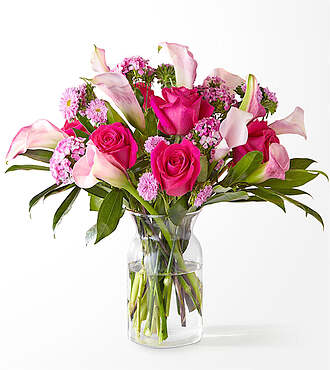
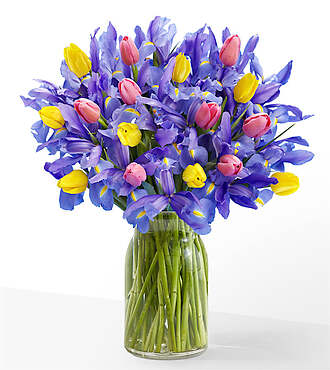
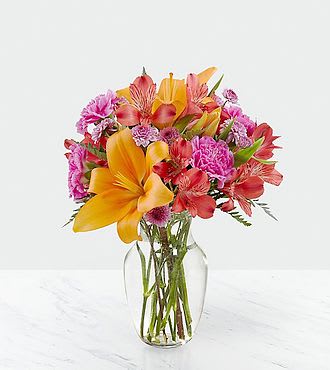
The Bloom Central flower delivery of the month for July in Amherst Center is the Beyond Blue Bouquet
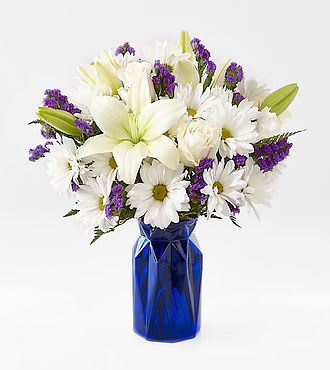
The Beyond Blue Bouquet from Bloom Central is the perfect floral arrangement to brighten up any room in your home. This bouquet features a stunning combination of lilies, roses and statice, creating a soothing and calming vibe.
The soft pastel colors of the Beyond Blue Bouquet make it versatile for any occasion - whether you want to celebrate a birthday or just show someone that you care. Its peaceful aura also makes it an ideal gift for those going through tough times or needing some emotional support.
What sets this arrangement apart is not only its beauty but also its longevity. The flowers are hand-selected with great care so they last longer than average bouquets. You can enjoy their vibrant colors and sweet fragrance for days on end!
One thing worth mentioning about the Beyond Blue Bouquet is how easy it is to maintain. All you need to do is trim the stems every few days and change out the water regularly to ensure maximum freshness.
If you're searching for something special yet affordable, look no further than this lovely floral creation from Bloom Central! Not only will it bring joy into your own life, but it's also sure to put a smile on anyone else's face.
So go ahead and treat yourself or surprise someone dear with the delightful Beyond Blue Bouquet today! With its simplicity, elegance, long-lasting blooms, and effortless maintenance - what more could one ask for?
Amherst Center Florist
Amherst Center Flower Delivery - Frequently Asked Questions
- Does Bloom Central offer same-day flower delivery in Amherst Center?
- Yes. Place your order online before 1:00 PM and a local Amherst Center florist will hand-deliver your arrangement the same day. Orders can also be scheduled up to one month in advance.
- Is it safe to order flowers online?
- Absolutely! We utilize a secure, encrypted checkout to protect your personal and payment information. Visa, Mastercard, American Express, Discover, PayPal and Klarna are all accepted.
- What funeral homes does Bloom Central deliver sympathy flowers to in Amherst Center?
- We hand-deliver sympathy and memorial floral arrangements to all funeral homes near Amherst Center, including: Affordable Caskets and Urns, Ahearn Funeral Home, BNai Jacob Cemetery, Brookfield Cemetery, Cierpial Memorial Funeral Homes, Douglass Funeral Service, Firtion Adams Funeral Service, Hafey Funeral Service & Cremation, Hillcrest Park Cemetery, New England Funeral & Cremation Center, Oak Grove Cemetery of Springfield, Obrien Funeral Home, Pease and Gay Funeral Home, Quabbin Park Cemetery, Ratell Funeral Home, Sampsons Chapel of the Acres, Tylunas Funeral Home.
- What nearby cities does Bloom Central also deliver flowers to?
- In addition to Amherst Center, we deliver fresh flowers to many nearby cities including: Amherst, North Amherst, South Amherst, Hadley, Hatfield, Pelham, Sunderland, Leverett
- What are the most popular flower arrangements at the Amherst Center florist?
- Three of our most popular arrangements at our Amherst Center florist are: Special Request 150 ($150.00), Yellow Brick Road Bouquet ($54.90), Birthday Surprise Bouquet ($54.90). All are available for same-day delivery.
More About Amherst Center
Are looking for a Amherst Center florist because you are not local to the area? If so, here is a brief travelogue of what Amherst Center has to offer. Who knows, perhaps you'll be intrigued enough to come visit soon, partake in some of the fun activities Amherst Center has to offer and deliver flowers to your loved one in person!
Amherst Center, Massachusetts, in the slanting light of a late September afternoon, is the kind of place where the air itself seems to hum with the low-grade static of human curiosity. The town’s central green, a quilt of grass and cobblestone, pulses with students and professors and retirees and toddlers, all orbiting the same few blocks with the quiet urgency of people who believe, deeply, that ideas matter. There’s a bookstore here whose windows display Kierkegaard and Octavia Butler with equal prominence, and a café where undergrads argue about poststructuralism over chai lattes while the barista, a poet with a PhD in comp lit, nods along like a benched player eavesdropping on the game. The whole scene feels less like a New England college town than a collaborative performance art piece about what a New England college town should be, a meta-Amherst, earnest and self-aware and unapologetically cerebral.
Walk east past the white-steepled church, past the co-op where shoppers debate the ethics of almond milk, and you’ll find the Emily Dickinson Museum. The Homestead’s yellow facade glows like a lantern in the haze, its rooms preserved with the fastidiousness of people determined to keep the poet’s ghost on retainer. Visitors speak in whispers here, as if afraid to disrupt the silence Dickinson spent a lifetime curating. A docent mentions that the poet’s herbarium contained over 400 species, pressed and labeled in a folio the size of a tombstone. You imagine her bent over those fragile pages, parsing the veins of a fern like it was a line of verse, and suddenly Amherst’s obsession with minutiae makes a new kind of sense.

Same day service available. Order your Amherst Center floral delivery and surprise someone today!
Back on Main Street, the rhythm shifts. A professor in rumpled khakis waves to a student across the street, their mutual grin telegraphing the thrill of some shared, esoteric joke. Two middle-aged women debate municipal composting policy outside a gallery selling avant-garde pottery. A toddler in a dinosaur hoodie presses her face to the glass of a toy store, mesmerized by a windup robot marching in place. The town’s ethos, part scholarly enclave, part village utopia, feels both fragile and resilient, like a spiderweb after rain.
What’s easy to miss, though, is how the place metabolizes contradiction. The same streets that host lectures on quantum thermodynamics also host Friday night contra dances where fiddlers and accordionists play reels so old they sound invented on the spot. The same people who spend mornings parsing Kantian ethics in seminar rooms spend afternoons tending community gardens, fingers deep in soil that’s been worked since the 1700s. Even the landscape colludes in this duality: the sharp angles of collegiate Gothic buttresses softened by the undulating hills of the Pioneer Valley, the reds and oranges of autumn foliage blazing against the stern gray of library stone.
By dusk, the light turns honeyed, and the town’s edges blur. Joggers loop the common, their breath visible in the cooling air. A grad student on a bench annotates a paperback, her highlighter squeaking like a small, insistent bird. In the window of a Thai restaurant, a couple shares a plate of pad see ew, steam fogging the glass between them and the world. There’s a sense here that life’s deepest questions aren’t academic exercises but daily practices, as routine as tying your shoes or stirring soup. Amherst doesn’t shout its virtues. It murmurs them, confident you’ll lean in to listen.
To leave is to feel the weight of its absence. You check your pockets for some artifact, a receipt from the used bookstore, a maple leaf snagged in your sleeve, and find nothing but the faint scent of fallen leaves and ink. It occurs to you that the town’s real magic lies not in its landmarks or its legends, but in its ability to make the life of the mind feel as immediate as a handshake, as tangible as a stone warmed by the sun.