





- Best Value
- Best Sellers
- Thank You
 $49.90




- $49.90
- $79.90

July 1, 2026
Charlemont July Floral Selection
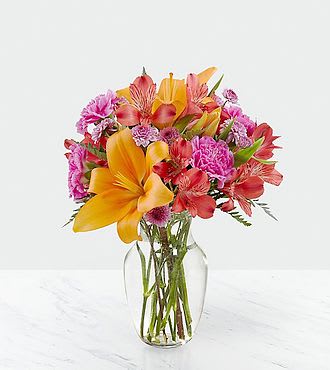
The Bloom Central flower delivery of the month for July in Charlemont is the Light and Lovely Bouquet
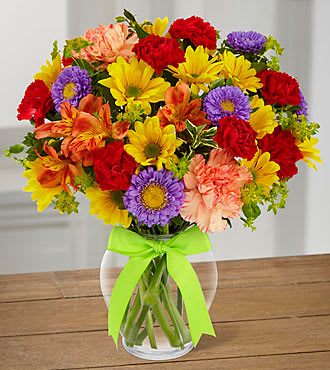
Introducing the Light and Lovely Bouquet, a floral arrangement that will brighten up any space with its delicate beauty. This charming bouquet, available at Bloom Central, exudes a sense of freshness and joy that will make you smile from ear to ear.
The Light and Lovely Bouquet features an enchanting combination of yellow daisies, orange Peruvian Lilies, lavender matsumoto asters, orange carnations and red mini carnations. These lovely blooms are carefully arranged in a clear glass vase with a touch of greenery for added elegance.
This delightful floral bouquet is perfect for all occasions be it welcoming a new baby into the world or expressing heartfelt gratitude to someone special. The simplicity and pops of color make this arrangement suitable for anyone who appreciates beauty in its purest form.
What is truly remarkable about the Light and Lovely Bouquet is how effortlessly it brings warmth into any room. It adds just the right amount of charm without overwhelming the senses.
The Light and Lovely Bouquet also comes arranged beautifully in a clear glass vase tied with a lime green ribbon at the neck - making it an ideal gift option when you want to convey your love or appreciation.
Another wonderful aspect worth mentioning is how long-lasting these blooms can be if properly cared for. With regular watering and trimming stems every few days along with fresh water changes every other day; this bouquet can continue bringing cheerfulness for up to two weeks.
There is simply no denying the sheer loveliness radiating from within this exquisite floral arrangement offered by the Light and Lovely Bouquet. The gentle colors combined with thoughtful design make it an absolute must-have addition to any home or a delightful gift to brighten someone's day. Order yours today and experience the joy it brings firsthand.
Charlemont Massachusetts Flower Delivery
Charlemont Flower Delivery - Frequently Asked Questions
- Does Bloom Central offer same-day flower delivery in Charlemont?
- Yes. Place your order online before 1:00 PM and a local Charlemont florist will hand-deliver your arrangement the same day. Orders can also be scheduled up to one month in advance.
- Is it safe to order flowers online?
- Absolutely! We utilize a secure, encrypted checkout to protect your personal and payment information. Visa, Mastercard, American Express, Discover, PayPal and Klarna are all accepted.
- What funeral homes does Bloom Central deliver sympathy flowers to in Charlemont?
- We hand-deliver sympathy and memorial floral arrangements to all funeral homes near Charlemont, including: Affordable Caskets and Urns, Ahearn Funeral Home, Birches-Roy Funeral Home, Cierpial Memorial Funeral Homes, Diluzio Foley And Fletcher Funeral Homes, Douglass Funeral Service, E P Mahar and Son Funeral Home, Finnerty & Stevens Funeral Home, Firtion Adams Funeral Service, Hafey Funeral Service & Cremation, Hanson-Walbridge & Shea Funeral Home, Infinity Pet Services, Obrien Funeral Home, Old Bennington Cemetery, Parisi Designs & Company, Pease and Gay Funeral Home, Ratell Funeral Home, Tylunas Funeral Home.
- What churches does Bloom Central deliver flowers to in Charlemont?
- We deliver fresh floral arrangements to all churches and places of worship in Charlemont, including: Charlemont Federated Church, Valley Zendo.
- What nearby cities does Bloom Central also deliver flowers to?
- In addition to Charlemont, we deliver fresh flowers to many nearby cities including: Buckland, Shelburne Falls, Ashfield, Colrain, Shelburne, Conway, Greenfield Town, Adams
- What are the most popular flower arrangements at the Charlemont florist?
- Three of our most popular arrangements at our Charlemont florist are: Sun Salutation Bouquet ($69.90), At First Sight Bouquet and Candle Set ($114.90), April Showers Bouquet ($49.90). All are available for same-day delivery.
More About Charlemont
Are looking for a Charlemont florist because you are not local to the area? If so, here is a brief travelogue of what Charlemont has to offer. Who knows, perhaps you'll be intrigued enough to come visit soon, partake in some of the fun activities Charlemont has to offer and deliver flowers to your loved one in person!
In Charlemont, Massachusetts, a town so small the word “town” feels almost performative, the Deerfield River does not so much flow as splay itself across the valley floor like a carelessly dropped quilt. The water here is not the color of nature but of motion, a shimmering, mineral gray that seems to vibrate in the sunlight. You notice things like this in Charlemont. You notice the way the old iron bridge groans when trucks pass, the way the mist clings to the hills until noon as if embarrassed by its own persistence, the way the locals say “good morning” without irony to strangers, their voices carrying the faintest trace of a question mark, as though the greeting were both an offering and a request.
The Mohawk Trail, which ribbons through the town, is less a road than a living exhibit of New England’s capacity for contradiction. In autumn, maple canopies blaze so violently tourists pull over just to stare, mouths slightly open, as if witnessing a magic trick. By winter, those same trees stand bare and monastic, their branches sketching delicate calligraphy against the sky. Locals navigate this seasonal whiplash with a pragmatism that borders on grace. They till rocky soil in spring, sell zucchini and sunflowers at roadside stands in summer, split firewood in fall, and by winter, they wait, not idly, but with the focused patience of people who understand that stillness is its own kind of labor.

Same day service available. Order your Charlemont floral delivery and surprise someone today!
What’s striking about Charlemont isn’t its quaintness, though it has that in spades, but its refusal to perform quaintness. The general store’s screen door slams with the same fervor it did in 1952. The postmaster knows your name before you introduce yourself. At the diner, the coffee tastes like coffee, and the eggs taste like eggs, and the conversation at the counter orbits predictably around weather, the high school basketball team, and the peculiarities of the local wildlife. A black bear once sauntered into someone’s garage, eyed a lawnmower with what witnesses described as “mild existential concern,” then left. This is the kind of story people tell here, not to amaze you, but to include you.
The town’s children grow up amphibious, half in the river, half on land. They leap from boulders into swimming holes with names like “The Screaming Pit,” their shouts echoing off the gorge walls. Later, sunburned and snack-drunk from the concession stand, they sprawl on picnic tables and debate whether the Milky Way is actually visible at night or if they’re just imagining it. (It’s visible.) Their parents, meanwhile, gather at town meetings in the clapboard schoolhouse, where decisions about road repairs and library hours are made with a civility that feels either archaic or revolutionary, depending on your proximity to a metropolitan area.
There’s a rhythm here, a syncopation of tradition and adaptation. The farm that once raised sheep now hosts yoga retreats. The retired teacher who used to grade essays on Thoreau runs a kayak rental shop. The old church, its steeple slightly crooked, doubles as a concert hall for fiddle players and folk singers. None of this feels like a compromise. It feels like a conversation, a long, meandering talk between the past and present, with the future listening in, sipping its tea.
To visit Charlemont is to feel time slow without stalling. The river keeps moving, the hills hold their ground, and the people, in their unshowy way, keep tending to both. You leave wondering why “ordinary” ever became a pejorative. You leave thinking that maybe the real secret to life isn’t about finding hidden wonders but learning to see the ones already there, humming softly in plain sight.