




- New Baby
- Best Sellers
- Under $80


 $69.90

July 1, 2026
Hopedale July Floral Selection
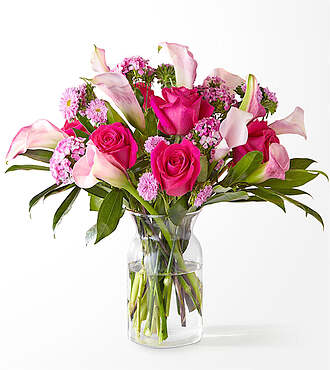
The Bloom Central flower delivery of the month for July in Hopedale is the Blushing Bouquet
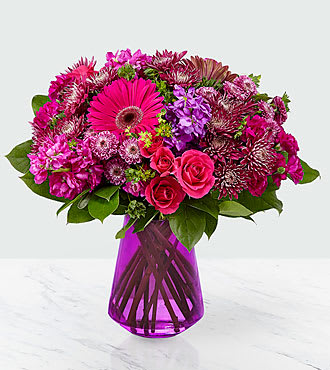
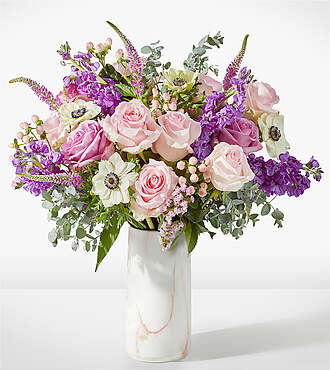
The Blushing Bouquet floral arrangement from Bloom Central is simply delightful. It exudes a sense of elegance and grace that anyone would appreciate. The pink hues and delicate blooms make it the perfect gift for any occasion.
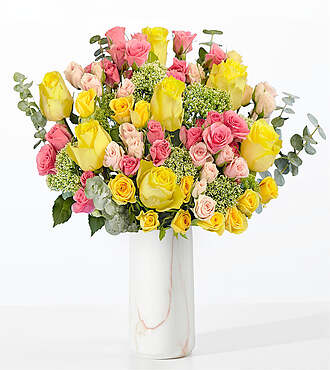
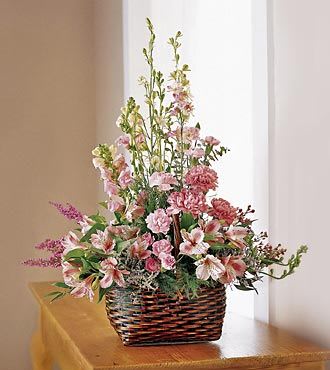
With its stunning array of gerberas, mini carnations, spray roses and button poms, this bouquet captures the essence of beauty in every petal. Each flower is carefully hand-picked to create a harmonious blend of colors that will surely brighten up any room.
The recipient will swoon over the lovely fragrance that fills the air when they receive this stunning arrangement. Its gentle scent brings back memories of blooming gardens on warm summer days, creating an atmosphere of tranquility and serenity.
The Blushing Bouquet's design is both modern and classic at once. The expert florists at Bloom Central have skillfully arranged each stem to create a balanced composition that is pleasing to the eye. Every detail has been meticulously considered, resulting in a masterpiece fit for display in any home or office.
Not only does this elegant bouquet bring joy through its visual appeal, but it also serves as a reminder of love and appreciation whenever seen or admired throughout the day - bringing smiles even during those hectic moments.
Furthermore, ordering from Bloom Central guarantees top-notch quality - ensuring every stem remains fresh upon arrival! What better way to spoil someone than with flowers that are guaranteed to stay vibrant for days?
The Blushing Bouquet from Bloom Central encompasses everything one could desire - beauty, elegance and simplicity.
Hopedale Massachusetts Flower Delivery
Hopedale Flower Delivery - Frequently Asked Questions
- Does Bloom Central offer same-day flower delivery in Hopedale?
- Yes. Place your order online before 1:00 PM and a local Hopedale florist will hand-deliver your arrangement the same day. Orders can also be scheduled up to one month in advance.
- Is it safe to order flowers online?
- Absolutely! We utilize a secure, encrypted checkout to protect your personal and payment information. Visa, Mastercard, American Express, Discover, PayPal and Klarna are all accepted.
- What hospitals and care facilities does Bloom Central deliver to in Hopedale?
- We deliver fresh flower arrangements to all hospitals, nursing homes and care facilities in Hopedale Massachusetts, including: Atria Draper Place.
- What funeral homes does Bloom Central deliver sympathy flowers to in Hopedale?
- We hand-deliver sympathy and memorial floral arrangements to all funeral homes near Hopedale, including: Ackerman Monument, Buma Funeral Home, Buma-Sargeant Funeral Home, Chesmore Funeral Home, Curtis J Holts Sons, Douglas Center Cemetery, Edwards Memorial Funeral Home, Ginley-Crowley Funeral Home, Hamel Lydon Chapel & Cremation Service Of Massachusetts, Kubaska Funeral Home, Menard-Lacouture Funeral Home, Menard-Lacouture Funeral Home, Oteri Funeral Home, Precious Blood Cemetery, Roney Funeral Home, St Denis Cemetery, St Pauls Cemetery, Tancrell-Jackman Funeral Home.
- What nearby cities does Bloom Central also deliver flowers to?
- In addition to Hopedale, we deliver fresh flowers to many nearby cities including: Mendon, Milford, Bellingham, Upton, Medway, Blackstone, Northbridge, Holliston
- What are the most popular flower arrangements at the Hopedale florist?
- Three of our most popular arrangements at our Hopedale florist are: Sweet Nothings Bouquet ($59.90), Sugarplum Bouquet with Chocolates ($74.90), Sunlit Meadows Bouquet ($49.90). All are available for same-day delivery.
More About Hopedale
Are looking for a Hopedale florist because you are not local to the area? If so, here is a brief travelogue of what Hopedale has to offer. Who knows, perhaps you'll be intrigued enough to come visit soon, partake in some of the fun activities Hopedale has to offer and deliver flowers to your loved one in person!
Hopedale, Massachusetts, sits in the eastern part of the state like a small, stubborn stone smoothed by centuries of New England rivers. The town’s name itself, Hopedale, evokes a certain earnestness, a belief in better things that feels both quaint and quietly radical in an era of jadedness. To drive through Hopedale is to pass through a living diorama of American persistence. The streets are lined with clapboard houses painted in colors so muted they seem to have absorbed the gray of the sky, their porches crowned with pumpkins in October and wreaths in December, as if the residents have collectively agreed to perform optimism with straight faces.
The town’s history hums beneath its sidewalks. In the mid-1800s, Hopedale began as a utopian commune, the Hopedale Community, where idealists gathered to reject the era’s industrial brutalities and build a society rooted in equality and temperance. The commune dissolved, as communes do, but its DNA lingers. You can feel it in the way neighbors still nod to one another at the post office, in the Little Red Shop Museum where the town’s founders once plotted brotherhood over handcrafted plows, in the cemetery where their headstones stand shoulder-to-shoulder, egalitarian even in death. The past here isn’t preserved behind glass. It seeps into the soil, feeding the oaks that shade Hopedale Pond.

Same day service available. Order your Hopedale floral delivery and surprise someone today!
That pond, a mirror-flat oval at the town’s center, serves as both compass and calendar. In summer, kids cannonball off the dock while retirees cast lines for bass they’ll release without fanfare. Autumn turns the water into a kaleidoscope of red and gold, and by winter, it’s a frozen plain where toddlers wobble in snowsuits, their laughter echoing like small bells. The pond doesn’t dazzle. It doesn’t need to. It simply exists, a liquid anchor for the town’s rhythms.
Hopedale’s architecture tells its own story. The Draper Corporation, which once dominated the global textile machinery market, planted its headquarters here in the early 20th century, and the factory complex still looms at the edge of town. Its brick walls, streaked with decades of rain, now house small businesses and tech startups, a metaphor so tidy it feels almost unfair. The old mill’s clock tower still chimes the hour, a sound that slips into the background like a heartbeat. Progress here isn’t a bulldozer. It’s a tenant moving into a room someone else vacated, dusting the shelves, and leaving the walls intact.
What defines Hopedale, though, isn’t its history or its scenery. It’s the texture of daily life. The way the librarian knows your name after two visits. The diner that serves pancakes shaped like states because the owner’s kid thought it’d be fun. The high school football games where half the crowd doesn’t care about the score but shows up anyway, folding chairs in hand, because Friday nights are for belonging to something. There’s a particular grace in these routines, a sense that community isn’t an abstract ideal but a verb, something you do by showing up, again and again, in the same places.
To call Hopedale charming risks underselling it. Charm suggests a performance, a veneer. Hopedale is something rarer: a town that quietly insists on its own worth without demanding you notice. It doesn’t beg for postcards or tourists. It simply persists, a pocket of unironic sincerity in a world that often rewards the opposite. You leave wondering why more places aren’t like this, then realize the answer is obvious: Building a future this unassuming requires a kind of courage most of us forgot how to muster. Hopedale didn’t.