




- Best Value
- Best Sellers
- Sympathy
 $49.90
- $297.90
- $64.90


July 1, 2026
Sunderland July Floral Selection
The Bloom Central flower delivery of the month for July in Sunderland is the Classic Beauty Bouquet
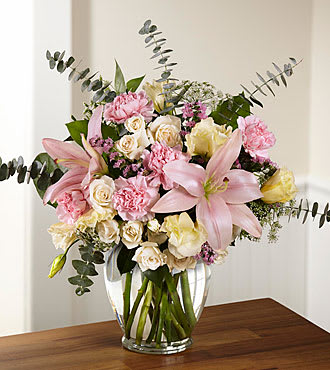
The breathtaking Classic Beauty Bouquet is a floral arrangement that will surely steal your heart! Bursting with elegance and charm, this bouquet is perfect for adding a touch of beauty to any space.
Imagine walking into a room and being greeted by the sweet scent and vibrant colors of these beautiful blooms. The Classic Beauty Bouquet features an exquisite combination of roses, lilies, and carnations - truly a classic trio that never fails to impress.
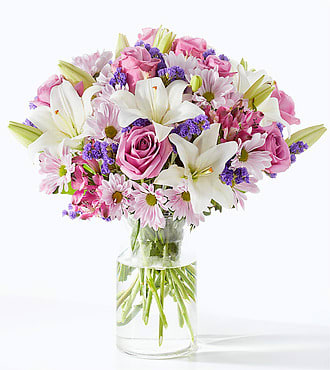
Soft, feminine, and blooming with a flowering finesse at every turn, this gorgeous fresh flower arrangement has a classic elegance to it that simply never goes out of style. Pink Asiatic Lilies serve as a focal point to this flower bouquet surrounded by cream double lisianthus, pink carnations, white spray roses, pink statice, and pink roses, lovingly accented with fronds of Queen Annes Lace, stems of baby blue eucalyptus, and lush greens. Presented in a classic clear glass vase, this gorgeous gift of flowers is arranged just for you to create a treasured moment in honor of your recipients birthday, an anniversary, or to celebrate the birth of a new baby girl.
Whether placed on a coffee table or adorning your dining room centerpiece during special gatherings with loved ones this floral bouquet is sure to be noticed.
What makes the Classic Beauty Bouquet even more special is its ability to evoke emotions without saying a word. It speaks volumes about timeless beauty while effortlessly brightening up any space it graces.
So treat yourself or surprise someone you adore today with Bloom Central's Classic Beauty Bouquet because every day deserves some extra sparkle!
Sunderland Florist
Sunderland Flower Delivery - Frequently Asked Questions
- Does Bloom Central offer same-day flower delivery in Sunderland?
- Yes. Place your order online before 1:00 PM and a local Sunderland florist will hand-deliver your arrangement the same day. Orders can also be scheduled up to one month in advance.
- Is it safe to order flowers online?
- Absolutely! We utilize a secure, encrypted checkout to protect your personal and payment information. Visa, Mastercard, American Express, Discover, PayPal and Klarna are all accepted.
- What hospitals and care facilities does Bloom Central deliver to in Sunderland?
- We deliver fresh flower arrangements to all hospitals, nursing homes and care facilities in Sunderland Massachusetts, including: New England Health Center.
- What funeral homes does Bloom Central deliver sympathy flowers to in Sunderland?
- We hand-deliver sympathy and memorial floral arrangements to all funeral homes near Sunderland, including: Affordable Caskets and Urns, Ahearn Funeral Home, Brandon Funeral Home, Carmon Community Funeral Homes, Carmon Funeral Home, Daniel T. Morrill Funeral Home, Diluzio Foley And Fletcher Funeral Homes, Douglass Funeral Service, E P Mahar and Son Funeral Home, Firtion Adams Funeral Service, Hafey Funeral Service & Cremation, Hanson-Walbridge & Shea Funeral Home, Introvigne Funeral Home, Ladd-Turkington & Carmon Funeral Home, Miles Funeral Home, Obrien Funeral Home, Pease and Gay Funeral Home, Ratell Funeral Home.
- What nearby cities does Bloom Central also deliver flowers to?
- In addition to Sunderland, we deliver fresh flowers to many nearby cities including: Leverett, South Deerfield, North Amherst, Deerfield, Whately, Montague, Hatfield, Amherst Center
- What are the most popular flower arrangements at the Sunderland florist?
- Three of our most popular arrangements at our Sunderland florist are: Golden Gourd Pumpkin Bouquet ($59.90), Quality Time Bouquet ($54.90), Bright Lights Bouquet with Lavender Basket ($54.90). All are available for same-day delivery.
More About Sunderland
Are looking for a Sunderland florist because you are not local to the area? If so, here is a brief travelogue of what Sunderland has to offer. Who knows, perhaps you'll be intrigued enough to come visit soon, partake in some of the fun activities Sunderland has to offer and deliver flowers to your loved one in person!
Sunderland, Massachusetts, sits quietly along the Connecticut River, a town whose name sounds like a whispered secret between the water and the hills. To drive through it is to pass through a kind of liminal space, a place that resists the frantic grammar of modern life. The air here carries the faint musk of turned earth, a scent that clings to the roadsides where farm stands bloom each morning like ephemeral art installations. The town’s identity is bound to the land, not in the abstract, Hallmark-card way, but in the calloused hands of those who still plant asparagus crowns by the acre, who rise before dawn to coax food from soil that has been tended for generations. This is a place where the word “community” isn’t a civic abstraction but a lived verb.
Mount Toby looms to the northeast, its slopes a mosaic of maple and birch that erupts each autumn into a riot of color so intense it feels almost confrontational. Hikers on the Robert Frost Trail pause here, not just to catch their breath but to recalibrate their sense of scale. The mountain doesn’t care about your deadlines. It insists, gently, that you remember how sunlight filters through leaves, how a stone wall crumbles gracefully into history. Down in the valley, the Connecticut River moves with a quiet urgency, its surface dappled with the reflections of herons and the occasional kayaker. The river is both boundary and connective tissue, a liquid spine that links Sunderland to a broader ecosystem of towns and tides.

Same day service available. Order your Sunderland floral delivery and surprise someone today!
The heart of Sunderland beats in its contradictions. A single traffic light governs the main intersection, yet the town’s annual Agricultural Fair transforms its fields into a temporary metropolis of Ferris wheels, pie contests, and children’s laughter tangled with the bleating of prize-winning goats. The fair’s paradox is Sunderland’s paradox: a celebration of the ephemeral within the eternal. You can taste it in the cider doughnuts, hot and granular with sugar, or in the way teenagers cluster near the livestock pens, their phones forgotten as they marvel at a newborn lamb’s wobbly first steps.
History here isn’t confined to plaques or museums. It’s in the floorboards of the 18th-century homes that still stand along Route 47, their wide-plank floors groaning under the weight of centuries. It’s in the Old Sunderland Cemetery, where weathered headstones tell stories in fragments, a mother lost in childbirth, a soldier whose name is now just a rumor in the granite. But this isn’t a town fossilized by its past. The same fields that once fed colonial settlers now host solar panels that hum with quiet industry, a reminder that sustainability isn’t a buzzword here but a lineage.
What lingers, though, isn’t just the landscape or the history. It’s the people, the woman who runs the used bookstore and can recite the provenance of every novel on her shelves, the high school coach who spends weekends repairing bikes for kids who can’t afford them, the retired teacher who plants daffodils along the library walkway each fall, a gift to strangers. Sunderland’s magic is in its insistence that smallness isn’t a limitation but a form of intimacy. The post office clerk knows your name. The barista remembers your order. The guy at the hardware store will spend 20 minutes explaining how to fix a leaky faucet, then throw in a washer for free.
To leave Sunderland is to carry its quiet with you, the sense that somewhere, a river bends without apology, a bridge arches gracefully toward the next town, and a community thrives not in spite of its simplicity but because of it. This is a place that asks you to slow down, to notice, to understand that progress and preservation can share the same soil. The world could use more Sunderlands. Or maybe it just needs to pay better attention to the ones it already has.