





- New Baby
- Best Sellers
- Under $80









 $69.90



July 1, 2026
Corwith July Floral Selection
The Bloom Central flower delivery of the month for July in Corwith is the Bountiful Garden Bouquet
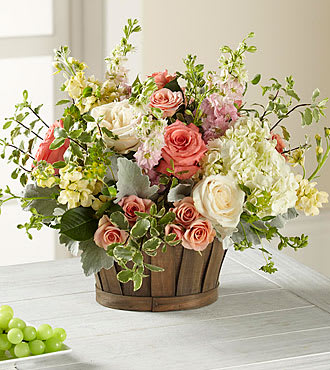
Introducing the delightful Bountiful Garden Bouquet from Bloom Central! This floral arrangement is simply perfect for adding a touch of natural beauty to any space. Bursting with vibrant colors and unique greenery, it's bound to bring smiles all around!
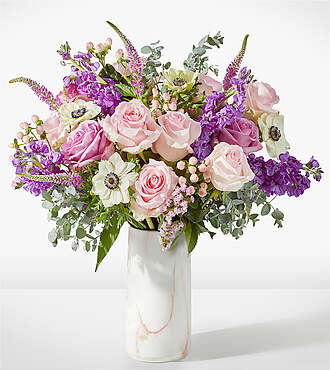
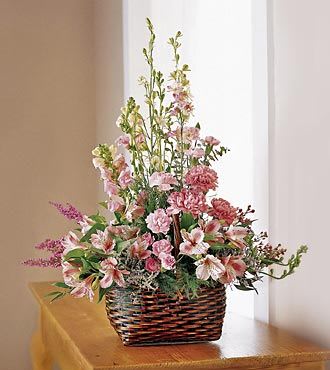
Inspired by French country gardens, this captivating flower bouquet has a Victorian styling your recipient will adore. White and salmon roses made the eyes dance while surrounded by pink larkspur, cream gilly flower, peach spray roses, clouds of white hydrangea, dusty miller stems, and lush greens, arranged to perfection.
Featuring hues ranging from rich peach to soft creams and delicate pinks, this bouquet embodies the warmth of nature's embrace. Whether you're looking for a centerpiece at your next family gathering or want to surprise someone special on their birthday, this arrangement is sure to make hearts skip a beat!
Not only does the Bountiful Garden Bouquet look amazing but it also smells wonderful too! As soon as you approach this beautiful arrangement you'll be greeted by its intoxicating fragrance that fills the air with pure delight.
Thanks to Bloom Central's dedication to quality craftsmanship and attention to detail, these blooms last longer than ever before. You can enjoy their beauty day after day without worrying about them wilting too soon.
This exquisite arrangement comes elegantly presented in an oval stained woodchip basket that helps to blend soft sophistication with raw, rustic appeal. It perfectly complements any decor style; whether your home boasts modern minimalism or cozy farmhouse vibes.
The simplicity in both design and care makes this bouquet ideal even for those who consider themselves less-than-green-thumbs when it comes to plants. With just a little bit of water daily and a touch of love, your Bountiful Garden Bouquet will continue to flourish for days on end.
So why not bring the beauty of nature indoors with the captivating Bountiful Garden Bouquet from Bloom Central? Its rich colors, enchanting fragrance, and effortless charm are sure to brighten up any space and put a smile on everyone's face. Treat yourself or surprise someone you care about - this bouquet is truly a gift that keeps on giving!
Local Flower Delivery in Corwith
Corwith Flower Delivery - Frequently Asked Questions
- Does Bloom Central offer same-day flower delivery in Corwith?
- Yes. Place your order online before 1:00 PM and a local Corwith florist will hand-deliver your arrangement the same day. Orders can also be scheduled up to one month in advance.
- Is it safe to order flowers online?
- Absolutely! We utilize a secure, encrypted checkout to protect your personal and payment information. Visa, Mastercard, American Express, Discover, PayPal and Klarna are all accepted.
- What funeral homes does Bloom Central deliver sympathy flowers to in Corwith?
- We hand-deliver sympathy and memorial floral arrangements to all funeral homes near Corwith, including: Green Funeral Home.
- What nearby cities does Bloom Central also deliver flowers to?
- In addition to Corwith, we deliver fresh flowers to many nearby cities including: Nunda, Livingston, Gaylord, Bagley, Elmira, Charlton, Boyne Valley, Springvale
- What are the most popular flower arrangements at the Corwith florist?
- Three of our most popular arrangements at our Corwith florist are: Happy Blooms Basket ($59.90), Grateful Centerpiece ($59.90), One and Only Bouquet ($49.90). All are available for same-day delivery.
More About Corwith
Are looking for a Corwith florist because you are not local to the area? If so, here is a brief travelogue of what Corwith has to offer. Who knows, perhaps you'll be intrigued enough to come visit soon, partake in some of the fun activities Corwith has to offer and deliver flowers to your loved one in person!
Morning in Corwith, Michigan arrives like a slow exhalation. The sun crests pine-stubbled ridges, spilling light over tin roofs and gravel roads still holding the night’s chill. A lone pickup idles outside the post office, its driver trading jokes with the clerk through an open window. Somewhere beyond the rail tracks, a creek chatters over rocks, and the air smells of damp earth and cut grass. This is a town where the pace feels less like inertia than intention, a collective agreement to let the world turn without rushing to meet it. Corwith is not so much forgotten as deliberately small, a parenthesis in the clamor of modern America. Its population, a figure locals cite with neither pride nor shame, hovers just above 200, a number that seems to shift with the seasons, as if the land itself breathes people in and out. The streets curve around hillsides like afterthoughts, lined with clapboard houses whose porches sag under the weight of geraniums and generations. Here, time isn’t money. It’s conversation. It’s the rustle of maple leaves in October, the creak of a swing set behind the shuttered schoolhouse, the way the diner’s coffee tastes better because the mug fits your hand just so. The past isn’t archived but lived: The general store’s ledger still records tabs in pencil; the library’s oak shelves hold mysteries alongside dog-eared copies of Field & Stream. At the edge of town, a weathered sign marks the site of a 19th-century iron mine, its shafts long flooded, its stories now folded into potlucks and high school football lore. What outsiders might mistake for stasis is a kind of endurance. Winters here are brutal, a months-long siege of snow that drifts to second-story windows. Come February, neighbors dig each other out not out of obligation but reflex, their shovels scraping a rhythm against the silence. Spring thaw brings mud, then trilliums, then the sudden frenzy of gardens planted in narrow strips between sidewalks and fences. Summer is all screen doors and fireflies, kids racing bikes down Main Street while retirees gossip in lawn chairs. Autumn strips the hardwoods bare, and the cycle starts again. The people of Corwith speak in understatement, their laughter easy, their help unasked. Need a carburetor fixed? Someone’s cousin has a barn full of parts. Wedding canceled? The church ladies will fill your freezer with casseroles. There’s a communion in this, a recognition that survival here depends on the habit of care. The wilderness presses close, a green tumult of wolves and whitetail, rivers that vanish into fog. Trails wind through stands of birch, their trunks glowing like pillars in some half-remembered cathedral. To walk these woods is to feel the thinness of the boundary between human and wild, to grasp, briefly, that you are both observer and observed. Yet Corwith never feels besieged. Instead, it hums with the quiet assurance of a place that knows its worth. The annual Harvest Fest draws crowds from three counties for pie contests and tractor pulls. The Fourth of July parade features a kazoo band and a Labradoodle dressed as Uncle Sam. At dusk, everyone gathers at the ballfield to watch fireworks reflect off the lake, their bursts echoing like distant applause. You could call it simple. You’d be wrong. What thrives here isn’t mere quaintness but a stubborn, radiant particularity, the sense that in a world of algorithms and ephemera, Corwith remains irreducible. It is a town that asks nothing of you but attention, that rewards the patient eye with the glint of mica in gravel, the flash of a kingfisher over water, the way a shared glance at the grocery store can feel like a covenant. To leave is to carry its quiet with you, a reminder that some places still choose to be small, and in their smallness, become immense.