





- Get Well
- Best Sellers
- Vased
 $54.90
- $54.90
- $79.90
- $54.90
- $49.90
- $49.90



- $49.90
- $79.90
- $74.90
- $69.90


July 1, 2026
Rome July Floral Selection
The Bloom Central flower delivery of the month for July in Rome is the Graceful Grandeur Rose Bouquet
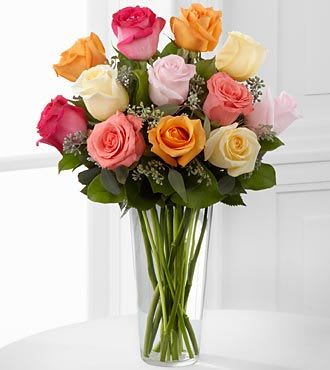
The Graceful Grandeur Rose Bouquet from Bloom Central is simply stunning. With its elegant and sophisticated design, it's sure to make a lasting impression on the lucky recipient.
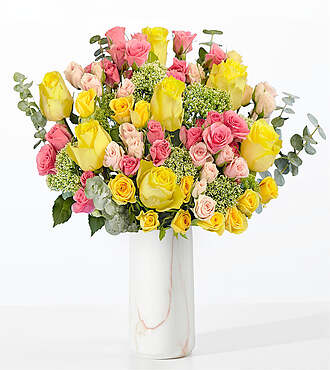
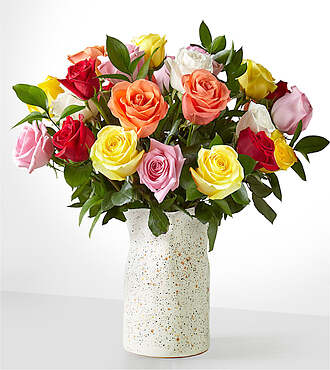
This exquisite bouquet features a generous arrangement of lush roses in shades of cream, orange, hot pink, coral and light pink. This soft pastel colors create a romantic and feminine feel that is perfect for any occasion.
The roses themselves are nothing short of perfection. Each bloom is carefully selected for its beauty, freshness and delicate fragrance. They are hand-picked by skilled florists who have an eye for detail and a passion for creating breathtaking arrangements.
The combination of different rose varieties adds depth and dimension to the bouquet. The contrasting sizes and shapes create an interesting visual balance that draws the eye in.
What sets this bouquet apart is not only its beauty but also its size. It's generously sized with enough blooms to make a grand statement without overwhelming the recipient or their space. Whether displayed as a centerpiece or placed on a mantelpiece the arrangement will bring joy wherever it goes.
When you send someone this gorgeous floral arrangement, you're not just sending flowers - you're sending love, appreciation and thoughtfulness all bundled up into one beautiful package.
The Graceful Grandeur Rose Bouquet from Bloom Central exudes elegance from every petal. The stunning array of colorful roses combined with expert craftsmanship creates an unforgettable floral masterpiece that will brighten anyone's day with pure delight.
Rome Michigan Flower Delivery
Rome Flower Delivery - Frequently Asked Questions
- Does Bloom Central offer same-day flower delivery in Rome?
- Yes. Place your order online before 1:00 PM and a local Rome florist will hand-deliver your arrangement the same day. Orders can also be scheduled up to one month in advance.
- Is it safe to order flowers online?
- Absolutely! We utilize a secure, encrypted checkout to protect your personal and payment information. Visa, Mastercard, American Express, Discover, PayPal and Klarna are all accepted.
- What funeral homes does Bloom Central deliver sympathy flowers to in Rome?
- We hand-deliver sympathy and memorial floral arrangements to all funeral homes near Rome, including: Borek Jennings Funeral Home & Cremation Services, Desnoyer Funeral Home, Eagle Funeral Home, Geer-Logan Chapel Janowiak Funeral Home, Generations Funeral & Cremation Services, Grisier Funeral Home, Heavens Maid, J. Gilbert Purse Funeral Home, Merkle Funeral Service, Inc, Muehlig Funeral Chapel, Newcomer Funeral Home, Southwest Chapel, Nie Funeral Home, Phillips Funeral Home & Cremation, Rupp Funeral Home, Shelters Funeral Home-Swarthout Chapel, Stark Funeral Service - Moore Memorial Chapel, Vermeulen-Sajewski Funeral Home, Walker Funeral Home.
- What nearby cities does Bloom Central also deliver flowers to?
- In addition to Rome, we deliver fresh flowers to many nearby cities including: Cambridge, Manitou Beach-Devils Lake, Rollin, Dover, Adrian, Madison, Woodstock, Hudson
- What are the most popular flower arrangements at the Rome florist?
- Three of our most popular arrangements at our Rome florist are: Cheerleader Bouquet ($54.90), Genuine Gestures Bouquet ($54.90), Light and Lovely Bouquet ($54.90). All are available for same-day delivery.
More About Rome
Are looking for a Rome florist because you are not local to the area? If so, here is a brief travelogue of what Rome has to offer. Who knows, perhaps you'll be intrigued enough to come visit soon, partake in some of the fun activities Rome has to offer and deliver flowers to your loved one in person!
Rome, Michigan, exists in the kind of quiet Midwestern way that resists easy summary, a place where the hum of lawnmowers on Saturday mornings blends with the distant whistle of freight trains, where the sky hangs wide and uncomplicated above fields of soybeans and corn. To call it “quaint” would be to misunderstand it. Quaintness implies a performance, a self-conscious curation of charm. Rome does not perform. It simply is. Drive through its center, past the redbrick storefronts, the post office with its faded flag, the single traffic light that blinks yellow after 8 p.m., and you feel the gravitational pull of a community that has decided, collectively, to persist. Not in spite of modernity, but adjacent to it, like a tree growing sideways around a fence.
The town’s history is written in its sidewalks. Literally. Etched into concrete slabs along Main Street are names and dates from the 1940s, back when residents pressed palms into wet cement like cave painters leaving handprints. These markers endure, smoothed by decades of sneakers and snowplows, a tactile record of continuity. At the diner on the corner, where the coffee tastes like nostalgia and the waitress knows your order by the second visit, regulars debate high school football and soybean prices with equal fervor. The conversations are familiar, cyclical, yet somehow urgent, as though the fate of the universe hinges on whether the Romeo Bulldogs can clinch the regional title. This is a town that cares deeply about things.

Same day service available. Order your Rome floral delivery and surprise someone today!
Rome’s rhythm is agricultural, rooted in the patient logic of seasons. In spring, farmers lean against pickup trucks at the feed store, discussing soil pH and rainfall. By July, the air smells of cut grass and hot asphalt, and kids pedal bikes to the public library, where the air conditioning thrums like a spaceship engine. Autumn brings tractor parades, a procession of green and red behemoths decked in fairy lights, rumbling past hay bales and pumpkin patches, while winter coats everything in a silence so thick it feels sacred. Through it all, Lakeville Lake glimmers at the town’s edge, a shallow basin where generations have skated under winter stars or cast fishing lines into the drowsy summer water.
What defines Rome, though, isn’t its landscape or its rituals but its people, a mosaic of characters who seem pulled from a story you half-remember. There’s the retired biology teacher who spends afternoons tending roses in her front yard, shouting trivia about pollinators to anyone who passes. The teenage barista at the coffee shop who draws elaborate latte art while reciting Mary Oliver poems. The hardware store owner who can diagnose a broken lawnmower with a glance and always throws in an extra handful of nails. These lives intersect in ways that feel both random and inevitable, like atoms in a molecule.
Every September, the town hosts the Peach Festival, a three-day celebration that transforms Main Street into a carnival of pie contests, live bluegrass, and face-painted children sprinting through crowds. Visitors from Detroit or Ann Arbor might dismiss it as “small-town stuff,” but they’d miss the point. The festival isn’t about peaches. It’s about the woman who spends weeks perfecting her jam recipe, the fireman flipping pancakes at dawn, the way the entire crowd sways during the community sing-along, a momentary fusion of voices that dissolves into laughter when someone forgets the lyrics. It’s about the sheer, uncynical joy of belonging somewhere.
Rome has no monuments, no skyline, no viral TikTok spots. What it offers is subtler: the reassurance that some things endure. That you can still live in a place where the librarian saves books for you, where the cashier asks about your mother’s knee surgery, where the sunset turns the grain elevator pink. In an age of relentless motion, Rome stands as a gentle argument for staying put, for tending your patch of earth and letting it tend you back. You could call it ordinary. But pay attention. Ordinary, here, becomes a kind of miracle.