




- Birthday
- Best Sellers
- Carnations



July 1, 2026
Arthur July Floral Selection
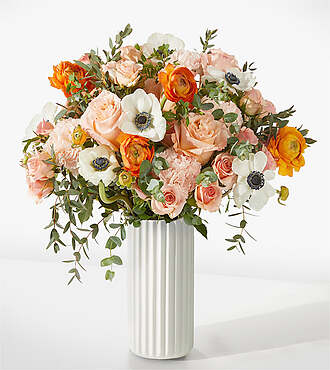
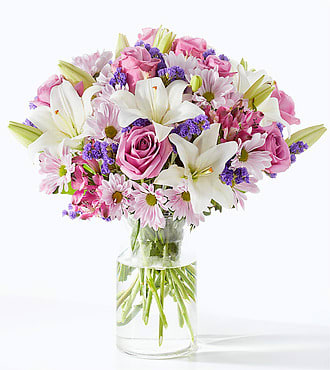
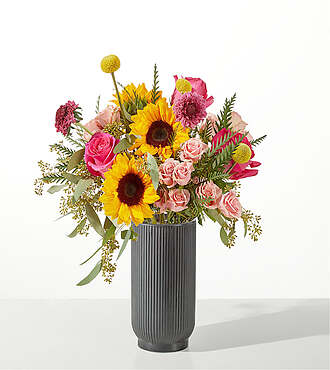
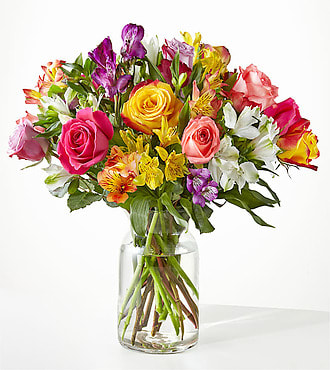
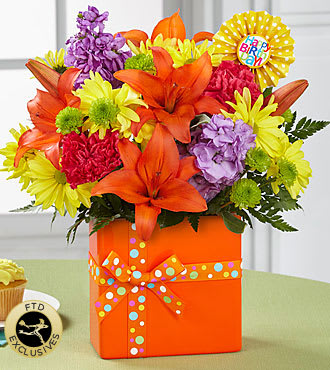
The Bloom Central flower delivery of the month for July in Arthur is the Best Day Bouquet
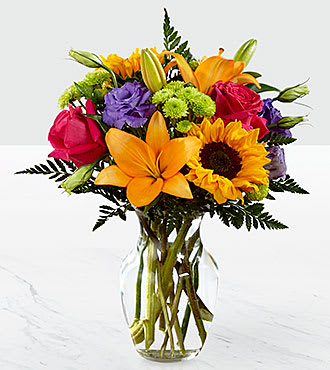
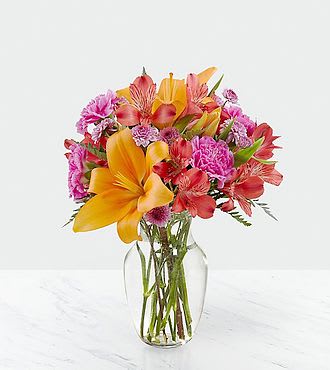
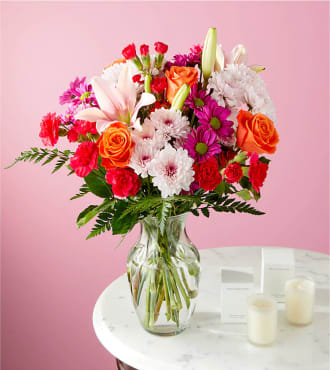
Introducing the Best Day Bouquet - a delightful floral arrangement that will instantly bring joy to any space! Bursting with vibrant colors and charming blooms, this bouquet is sure to make your day brighter. Bloom Central has truly outdone themselves with this perfectly curated collection of flowers. You can't help but smile when you see the Best Day Bouquet.
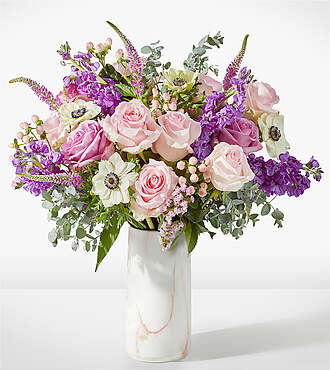
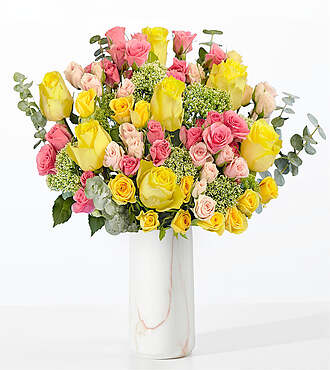
The first thing that catches your eye are the stunning roses. Soft petals in various shades of pink create an air of elegance and grace. They're complemented beautifully by cheerful sunflowers in bright yellow hues.
But wait, there's more! Sprinkled throughout are delicate purple lisianthus flowers adding depth and texture to the arrangement. Their intricate clusters provide an unexpected touch that takes this bouquet from ordinary to extraordinary.
And let's not forget about those captivating orange lilies! Standing tall amongst their counterparts, they demand attention with their bold color and striking beauty. Their presence brings warmth and enthusiasm into every room they grace.
As if it couldn't get any better, lush greenery frames this masterpiece flawlessly. The carefully selected foliage adds natural charm while highlighting each individual bloom within the bouquet.
Whether it's adorning your kitchen counter or brightening up an office desk, this arrangement simply radiates positivity wherever it goes - making every day feel like the best day. When someone receives these flowers as a gift, they know that someone truly cares about brightening their world.
What sets apart the Best Day Bouquet is its ability to evoke feelings of pure happiness without saying a word. It speaks volumes through its choice selection of blossoms carefully arranged by skilled florists at Bloom Central who have poured their love into creating such a breathtaking display.
So go ahead and treat yourself or surprise a loved one with the Best Day Bouquet. It's a little slice of floral perfection that brings sunshine and smiles in abundance. You deserve to have the best day ever, and this bouquet is here to ensure just that.
Arthur Florist
Arthur Flower Delivery - Frequently Asked Questions
- Does Bloom Central offer same-day flower delivery in Arthur?
- Yes. Place your order online before 1:00 PM and a local Arthur florist will hand-deliver your arrangement the same day. Orders can also be scheduled up to one month in advance.
- Is it safe to order flowers online?
- Absolutely! We utilize a secure, encrypted checkout to protect your personal and payment information. Visa, Mastercard, American Express, Discover, PayPal and Klarna are all accepted.
- What funeral homes does Bloom Central deliver sympathy flowers to in Arthur?
- We hand-deliver sympathy and memorial floral arrangements to all funeral homes near Arthur, including: Dares Funeral & Cremation Service, Mattson Funeral Home.
- What nearby cities does Bloom Central also deliver flowers to?
- In addition to Arthur, we deliver fresh flowers to many nearby cities including: Mora, Knife Lake, Comfort, Brunswick, Grass Lake, Peace, Braham, Pokegama
- What are the most popular flower arrangements at the Arthur florist?
- Three of our most popular arrangements at our Arthur florist are: Yellow Brick Road Bouquet ($54.90), Birthday Surprise Bouquet ($54.90), Special Request 150 ($150.00). All are available for same-day delivery.
More About Arthur
Are looking for a Arthur florist because you are not local to the area? If so, here is a brief travelogue of what Arthur has to offer. Who knows, perhaps you'll be intrigued enough to come visit soon, partake in some of the fun activities Arthur has to offer and deliver flowers to your loved one in person!
Arthur, Minnesota, population 293, sits in the Red River Valley like a button sewn to the hem of the prairie. The town announces itself with a water tower, two grain elevators, and a single stop sign that no one stops at but everyone acknowledges with a polite tap of the brakes. To drive through Arthur is to witness a paradox: a place so small it feels both transient and eternal, a speck that insists on its own significance. The sky here does not loom, it collaborates. It stretches itself thin above the fields, turning the horizon into a 360-degree theater where dawns arrive as slow epics and storms roll in like arguments between gods.
Residents move through their days with the deliberate pace of people who know the value of a minute but refuse to be enslaved by it. Farmers check soybeans under a sun that blanches the gravel roads to the color of old bones. Retired teachers tend peonies in yards where the grass submits to meticulous edging. At the post office, a hand-painted sign reads “If it doesn’t fit, don’t force it,” which could double as the town motto. Conversations here are built from questions about the weather, the crops, and whether the high school’s six-man football team might finally beat Stephen-Argyle this fall. The answers are usually a shrug, a smile, and an invitation to the next potluck.

Same day service available. Order your Arthur floral delivery and surprise someone today!
What Arthur lacks in infrastructure it compensates for in texture. The air smells of topsoil and cut alfalfa. Summer weekends hum with the sound of lawnmowers and the distant yip of a dog chasing tractors. In winter, snow muffles the streets into something like a lullaby, and front windows glow with the blue light of televisions tuned to weather reports. The town’s lone diner, a converted railcar, serves pie so flawless it momentarily convinces you that all human conflict stems from a global shortfall of butter and lattice crusts.
Every August, Arthur doubles in size during the Arthur Fair, a three-day festival that transforms the county fairgrounds into a carnival of contradictions. Children pedal tricycles in races where everyone gets a ribbon. Teenagers flirt shyly by the Ferris wheel, which creaks like a rocking chair. Elderly couples two-step to a cover band’s rendition of “Blue Skirt Waltz” while the midway lights flicker like fireflies trapped in wire cages. The fair’s climax is the demolition derby, a ritual of twisted metal and primal laughter that ends with drivers emerging from their cars, unharmed, to shake hands as the crowd cheers not for victory but for spectacle.
To outsiders, Arthur might register as a nowhere. A pass-through. But to linger here is to notice the invisible filaments that bind the place: the way the postmaster knows which widow needs extra stamps, the way neighbors plow each other’s driveways without being asked, the way the entire town shows up when someone’s barn needs raising or a baby needs babysitting. In an age of algorithms and ambient dread, Arthur operates on a different operating system. It is a town that still believes in the covenant of eye contact, in the wisdom of rotating tires before winter, in the idea that a shared meal can mend most fractures.
The prairie, of course, is the silent protagonist. It insists on humility. It reminds you that roots matter, that seasons are both cycles and sentences, that resilience is a form of love. Stand at the edge of a field at dusk, and you’ll feel it, the strange comfort of knowing you are small, that the land and sky will continue their conversation long after you’ve left. Arthur, in its unassuming way, offers a rebuttal to the cult of more. It suggests that a life can be built not on the fever of accumulation but on the art of tending, to crops, to community, to the fragile, vital truth that we are all someone’s neighbor.