




- New Baby
- Best Sellers
- Vased









 $49.90
- $79.90
- $74.90
- $69.90
July 1, 2026
Chengwatana July Floral Selection
The Bloom Central flower delivery of the month for July in Chengwatana is the Alluring Elegance Bouquet
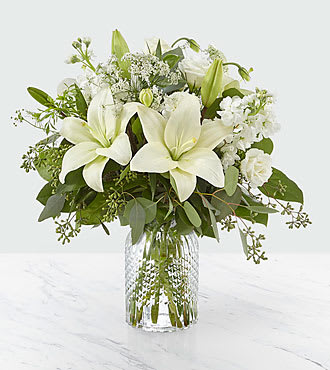
The Alluring Elegance Bouquet from Bloom Central is sure to captivate and delight. The arrangement's graceful blooms and exquisite design bring a touch of elegance to any space.
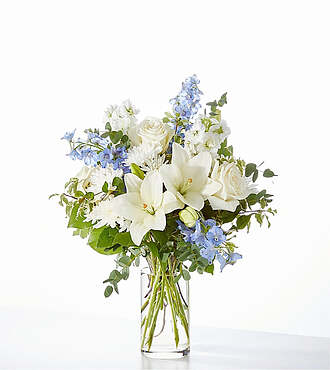
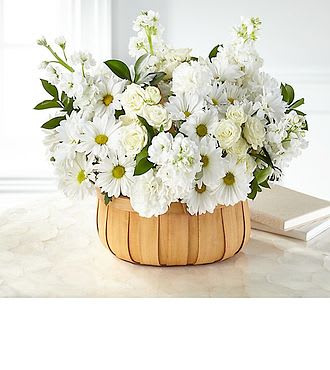
The Alluring Elegance Bouquet is a striking array of ivory and green. Handcrafted using Asiatic lilies interwoven with white Veronica, white stock, Queen Anne's lace, silver dollar eucalyptus and seeded eucalyptus.
One thing that sets this bouquet apart is its versatility. This arrangement has timeless appeal which makes it suitable for birthdays, anniversaries, as a house warming gift or even just because moments.
Not only does the Alluring Elegance Bouquet look amazing but it also smells divine! The combination of the lilies and eucalyptus create an irresistible aroma that fills the room with freshness and joy.
Overall, if you're searching for something elegant yet simple; sophisticated yet approachable look no further than the Alluring Elegance Bouquet from Bloom Central. Its captivating beauty will leave everyone breathless while bringing warmth into their hearts.
Local Flower Delivery in Chengwatana
Chengwatana Flower Delivery - Frequently Asked Questions
- Does Bloom Central offer same-day flower delivery in Chengwatana?
- Yes. Place your order online before 1:00 PM and a local Chengwatana florist will hand-deliver your arrangement the same day. Orders can also be scheduled up to one month in advance.
- Is it safe to order flowers online?
- Absolutely! We utilize a secure, encrypted checkout to protect your personal and payment information. Visa, Mastercard, American Express, Discover, PayPal and Klarna are all accepted.
- What funeral homes does Bloom Central deliver sympathy flowers to in Chengwatana?
- We hand-deliver sympathy and memorial floral arrangements to all funeral homes near Chengwatana, including: Dares Funeral & Cremation Service, Mattson Funeral Home.
- What nearby cities does Bloom Central also deliver flowers to?
- In addition to Chengwatana, we deliver fresh flowers to many nearby cities including: Pine City, Rock Creek, Pokegama, Hinckley, Rush City, Nessel, Sandstone, Comfort
- What are the most popular flower arrangements at the Chengwatana florist?
- Three of our most popular arrangements at our Chengwatana florist are: Gentle Blossoms Basket ($117.90), Contemporary Dish Garden ($59.90), Wondrous Nature Bouquet ($59.90). All are available for same-day delivery.
More About Chengwatana
Are looking for a Chengwatana florist because you are not local to the area? If so, here is a brief travelogue of what Chengwatana has to offer. Who knows, perhaps you'll be intrigued enough to come visit soon, partake in some of the fun activities Chengwatana has to offer and deliver flowers to your loved one in person!
Chengwatana, Minnesota, sits where the Snake River elbows into the St. Croix, a confluence less dramatic than the name suggests but charged with the quiet magnetism of places time has chosen to sidestep. To drive into Chengwatana is to pass through a tunnel of hardwood canopies that part abruptly, revealing a town so small its existence feels almost speculative, a cluster of weathered buildings, a single-lane bridge, a cemetery where the dates on the stones stop around 1910. The air here smells like pine resin and wet stone. The river carves its path with a sound like pages turning. You half-expect to find a sign that reads, “If you lived here, you’d be home by now,” except there are no signs, only the sense that you’ve stumbled into a diorama of rural America preserved under glass.
The town’s name derives from the Ojibwe, meaning “where the waters meet,” a phrase that evokes the collision of histories as much as geography. In the mid-1800s, Chengwatana briefly flared into relevance as a trading post and county seat, its streets thrumming with loggers, settlers, and Dakota and Ojibwe communities navigating the tremors of displacement. A wooden fort once stood here, erected by the U.S. government to “keep the peace,” which is to say, to enforce new borders. Today, the fort exists only as a plaque and a faint grid of depressions in the earth, as if the land itself remembers what we’ve agreed to forget. Kids from the handful of remaining families ride bikes over those same depressions, weaving through history without noticing the weight of it.

Same day service available. Order your Chengwatana floral delivery and surprise someone today!
What’s left now is a kind of radiant stillness. The old general store, shuttered since the Eisenhower administration, still wears its hand-painted sign like a crown. The post office operates out of a converted shed, its hours dictated less by the clock than by the postmaster’s basset hound, who naps in a sunbeam by the door. Visitors come for the Chengwatana State Forest, 30,000 acres of birch and maple that ignite in autumn, drawing hikers and birders who move through the trails with the reverent air of pilgrims. They pause at the fire tower, climb its skeletal frame, and squint at the horizon where Minnesota blurs into Wisconsin, the view a mosaic of green and blue that seems to pulse.
Locals, a term used loosely for the 30-odd souls who call this place home, speak of Chengwatana not as a relic but as a living thing. They point to the community hall, where potlucks materialize like clockwork every third Saturday, tables groaning under rhubarb pies and casseroles that defy entropy. They mention the volunteer fire department, a brigade of four who once saved the bridge from a lightning strike using little more than grit and a garden hose. There’s pride here, the kind that doesn’t need to announce itself, the kind that thrives in the absence of spectators.
To spend a day in Chengwatana is to confront a paradox: the urge to romanticize its solitude clashing with the reality of its unselfconsciousness. The town doesn’t care if you find it charming. It doesn’t need you to. The rivers keep moving. The trees keep growing. The past here isn’t buried; it’s folded into the present, soft as old flannel. You leave wondering if places like this aren’t a kind of antidote, not escapes from modernity but reminders of the rhythms that endure beneath the noise. The road out of town curves past a field where wild turkeys peck at the soil, their feathers catching the light like polished metal. In the rearview mirror, Chengwatana shrinks until it’s just a smudge, then a feeling, then gone.