





- Birthday
- Best Sellers
- Under $100










July 1, 2026
Cuba July Floral Selection
The Bloom Central flower delivery of the month for July in Cuba is the Blooming Bounty Bouquet
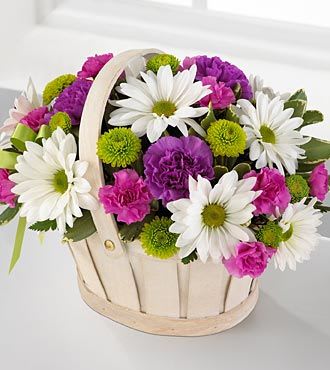
The Blooming Bounty Bouquet from Bloom Central is a delightful floral arrangement that brings joy and beauty into any home. This charming bouquet is perfect for adding a pop of color and natural elegance to your living space.
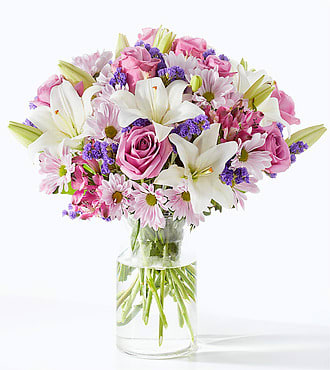
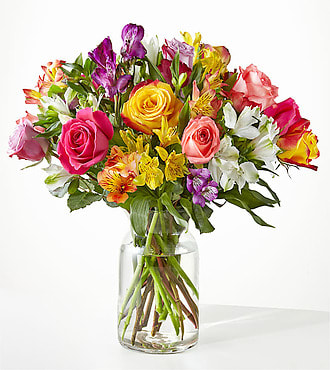
With its vibrant blend of blooms, the Blooming Bounty Bouquet exudes an air of freshness and vitality. The assortment includes an array of stunning flowers such as green button pompons, white daisy pompons, hot pink mini carnations and purple carnations. Each bloom has been carefully selected to create a harmonious balance of colors that will instantly brighten up any room.
One can't help but feel uplifted by the sight of this lovely bouquet. Its cheerful hues evoke feelings of happiness and warmth. Whether placed on a dining table or displayed in the entryway, this arrangement becomes an instant focal point that radiates positivity throughout your home.
Not only does the Blooming Bounty Bouquet bring visual delight; it also fills the air with a gentle aroma that soothes both mind and soul. As you pass by these beautiful blossoms, their delicate scent envelops you like nature's embrace.
What makes this bouquet even more special is how long-lasting it is. With proper care these flowers will continue to enchant your surroundings for days on end - providing ongoing beauty without fuss or hassle.
Bloom Central takes great pride in delivering bouquets directly from local flower shops ensuring freshness upon arrival - an added convenience for busy folks who appreciate quality service!
In conclusion, if you're looking to add cheerfulness and natural charm to your home or surprise another fantastic momma with some much-deserved love-in-a-vase gift - then look no further than the Blooming Bounty Bouquet from Bloom Central! It's simple yet stylish design combined with its fresh fragrance make it impossible not to smile when beholding its loveliness because we all know, happy mommies make for a happy home!
Cuba Florist
Cuba Flower Delivery - Frequently Asked Questions
- Does Bloom Central offer same-day flower delivery in Cuba?
- Yes. Place your order online before 1:00 PM and a local Cuba florist will hand-deliver your arrangement the same day. Orders can also be scheduled up to one month in advance.
- Is it safe to order flowers online?
- Absolutely! We utilize a secure, encrypted checkout to protect your personal and payment information. Visa, Mastercard, American Express, Discover, PayPal and Klarna are all accepted.
- What hospitals and care facilities does Bloom Central deliver to in Cuba?
- We deliver fresh flower arrangements to all hospitals, nursing homes and care facilities in Cuba Missouri, including: Arbors At Victorian Place Of Cuba, Memory Care Assisted Living By Americare , Cuba Manor, Inc.
- What funeral homes does Bloom Central deliver sympathy flowers to in Cuba?
- We hand-deliver sympathy and memorial floral arrangements to all funeral homes near Cuba, including: Chapel Hill Mortuary & Memorial Gardens, Debo Funeral Home & Summit Memorial Park, Freeman Mortuary, James & Gahr Mortuary, Jefferson City National Cemetery, Memorial Chapel And Crematory of Waynesvilee / St Robert, Oltmann Funeral Home, St Louis Doves Release Company, Tyler M Woods Funeral Director.
- What churches does Bloom Central deliver flowers to in Cuba?
- We deliver fresh floral arrangements to all churches and places of worship in Cuba, including: Bible Baptist Church.
- What nearby cities does Bloom Central also deliver flowers to?
- In addition to Cuba, we deliver fresh flowers to many nearby cities including: Steelville, Bourbon, St. James, Sullivan, Owensville, Rolla, Belle, Gerald
- What are the most popular flower arrangements at the Cuba florist?
- Three of our most popular arrangements at our Cuba florist are: Backyard Party Bouquet ($69.90), Bright Spark Rose Bouquet ($84.90), Simply Enchanting Rose Bouquet ($49.90). All are available for same-day delivery.
More About Cuba
Are looking for a Cuba florist because you are not local to the area? If so, here is a brief travelogue of what Cuba has to offer. Who knows, perhaps you'll be intrigued enough to come visit soon, partake in some of the fun activities Cuba has to offer and deliver flowers to your loved one in person!
Cuba, Missouri, sits along the stretch of Route 66 that unfurls like a sun-bleached ribbon past gas stations repurposed into time capsules and fields where the corn seems to wave with a kind of Midwestern semaphore. The town’s population hovers just north of 3,000, a number that feels both intimate and deceptive, because what Cuba lacks in sprawl it repays in a density of stories. You notice this first in the murals. Twelve of them, to be exact, sprawling across downtown buildings like a graphic novel about the town’s psyche. Painted by artists who came here precisely because Cuba decided, in the late ’90s, to turn its walls into canvases, these murals are not mere decoration. They are arguments, with history, with anonymity, with the idea that a town this small could ever be forgotten.
The Viva Cuba organization, a civic group whose members possess the quiet zeal of people who’ve seen what neglect can do, spearheaded the mural project. Their logic was both practical and sly: if you give people something to look at, they might just stay awhile. It worked. Visitors now amble down the sidewalks, necks craned, as if the town itself were a gallery curated by some cosmic docent. The murals depict steam locomotives, barn dances, a young Lyndon B. Johnson teaching at the Welhausen School in 1930. Each image feels like a thread pulled from the fabric of the collective memory, insisting that the past isn’t dead here. It’s having a conversation with the present over pie at the Missouri Hick BBQ, where the smoked brisket arrives in portions that defy physics.

Same day service available. Order your Cuba floral delivery and surprise someone today!
The Crawford County Historical Museum, housed in a former railroad depot, doubles as a temple to the region’s persistence. Inside, artifacts hum with the residue of labor: handmade quilts, rusted farm tools, a ledger from the 1800s where someone’s careful script records the price of eggs. The volunteer docent, a woman whose smile suggests she’s heard every joke about small-town museums, will tell you about the 1940s USO club that once drew big-band acts to Cuba. Her voice carries a pride that’s neither boastful nor defensive. It’s the tone of someone who knows that history isn’t just what happened. It’s what we keep alive.
On the corner of Franklin and Smith, a diner called Shelly’s Café serves pancakes the size of hubcaps. Shelly herself might be your waitress, refilling your coffee with the kind of efficiency that suggests she’s been doing this since the Truman administration. The regulars, farmers, teachers, teenagers sneaking fries before school, cluster in booths, their chatter layering into a soundtrack of town gossip and weather predictions. The café’s walls are plastered with faded photos of Cuba’s annual Christmas parade, a event where tractors double as floats and Santa arrives on a fire truck. The parade is less a spectacle than a shared promise: we’re still here.
Outside, the breeze carries the scent of freshly cut grass from the city park, where kids cannonball into the pool and old men play checkers under the pavilion. The park’s walking trail loops past a playground donated by the local Lions Club, its sign etched with names of families who’ve donated $100 apiece to keep the swings oiled. This is the thing about Cuba: it runs on a economy of care. When the community center needed a new roof, the fundraising bake sale lasted three days. When the high school’s volleyball team made state finals, the streets temporarily went neon with hand-painted signs.
To call Cuba quaint would miss the point. Quaintness implies a kind of passivity, a relic waiting to be discovered. Cuba is not waiting. It’s busy, tending its flower beds, repainting its murals, arguing over the proper way to make sloppy Joes at the fall festival. There’s a defiance in this, a refusal to concede that small towns are doomed to fade. What you sense here isn’t nostalgia. It’s a stubborn, joyful insistence that a place can be both ordinary and extraordinary, that the real magic isn’t in surviving but in choosing, every day, to thrive.