





- New Baby
- Best Sellers
- Carnations








July 1, 2026
Seneca July Floral Selection
The Bloom Central flower delivery of the month for July in Seneca is the Light and Lovely Bouquet
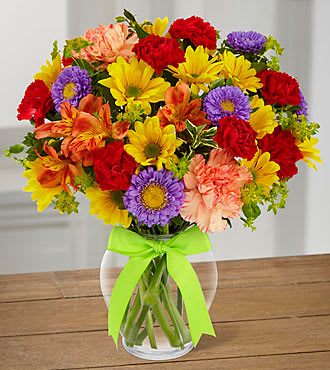
Introducing the Light and Lovely Bouquet, a floral arrangement that will brighten up any space with its delicate beauty. This charming bouquet, available at Bloom Central, exudes a sense of freshness and joy that will make you smile from ear to ear.
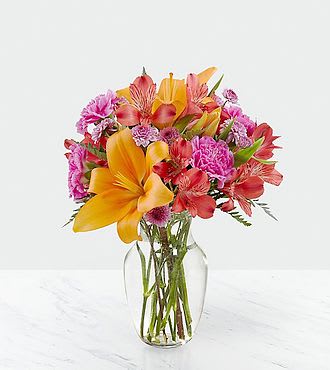
The Light and Lovely Bouquet features an enchanting combination of yellow daisies, orange Peruvian Lilies, lavender matsumoto asters, orange carnations and red mini carnations. These lovely blooms are carefully arranged in a clear glass vase with a touch of greenery for added elegance.
This delightful floral bouquet is perfect for all occasions be it welcoming a new baby into the world or expressing heartfelt gratitude to someone special. The simplicity and pops of color make this arrangement suitable for anyone who appreciates beauty in its purest form.
What is truly remarkable about the Light and Lovely Bouquet is how effortlessly it brings warmth into any room. It adds just the right amount of charm without overwhelming the senses.
The Light and Lovely Bouquet also comes arranged beautifully in a clear glass vase tied with a lime green ribbon at the neck - making it an ideal gift option when you want to convey your love or appreciation.
Another wonderful aspect worth mentioning is how long-lasting these blooms can be if properly cared for. With regular watering and trimming stems every few days along with fresh water changes every other day; this bouquet can continue bringing cheerfulness for up to two weeks.
There is simply no denying the sheer loveliness radiating from within this exquisite floral arrangement offered by the Light and Lovely Bouquet. The gentle colors combined with thoughtful design make it an absolute must-have addition to any home or a delightful gift to brighten someone's day. Order yours today and experience the joy it brings firsthand.
Seneca Missouri Flower Delivery
Seneca Flower Delivery - Frequently Asked Questions
- Does Bloom Central offer same-day flower delivery in Seneca?
- Yes. Place your order online before 1:00 PM and a local Seneca florist will hand-deliver your arrangement the same day. Orders can also be scheduled up to one month in advance.
- Is it safe to order flowers online?
- Absolutely! We utilize a secure, encrypted checkout to protect your personal and payment information. Visa, Mastercard, American Express, Discover, PayPal and Klarna are all accepted.
- What hospitals and care facilities does Bloom Central deliver to in Seneca?
- We deliver fresh flower arrangements to all hospitals, nursing homes and care facilities in Seneca Missouri, including: Seneca House.
- What funeral homes does Bloom Central deliver sympathy flowers to in Seneca?
- We hand-deliver sympathy and memorial floral arrangements to all funeral homes near Seneca, including: Benton County Funeral Home, Benton County Memorial Park, Burckhalter Funeral Home, Campbell-Biddlecome Funeral Home, Clark Funeral Homes, Epting Funeral Home, Housh Funeral Home, Knell Mortuary, Mason-Woodard Mortuary & Crematory, Ozark Funeral Homes, Ozark Funeral Homes, Ozark Memorial Park Cemetery, Park Cemetery & Monument Shop, Pinnacle Memorial Gardens, Premier Memorials, Thornhill-Dillon Mortuary, West Chestnut Monument, Yates Trackside Furniture.
- What churches does Bloom Central deliver flowers to in Seneca?
- We deliver fresh floral arrangements to all churches and places of worship in Seneca, including: First Baptist Church.
- What nearby cities does Bloom Central also deliver flowers to?
- In addition to Seneca, we deliver fresh flowers to many nearby cities including: Neosho, Goodman, Anderson, Joplin, Duquesne, Diamond, Duenweg, Granby
- What are the most popular flower arrangements at the Seneca florist?
- Three of our most popular arrangements at our Seneca florist are: Radiant Citrus Bouquet ($64.90), Darling Bouquet ($59.90), Sunshine Daydream Bouquet ($49.90). All are available for same-day delivery.
More About Seneca
Are looking for a Seneca florist because you are not local to the area? If so, here is a brief travelogue of what Seneca has to offer. Who knows, perhaps you'll be intrigued enough to come visit soon, partake in some of the fun activities Seneca has to offer and deliver flowers to your loved one in person!
Consider Seneca at dawn. The town exhales a mist that clings to the hollows between its hills, softening the edges of grain silos and clapboard houses. A single train whistle splits the air, a sound so familiar it registers less as noise than as a kind of pulse, steady and ancient, threading through the Ozark foothills. This is a place where the land insists on being felt, not in the dramatic way of mountains or oceans, but through the quiet persistence of red clay under sneakers, the scratch of cornstalks against denim, the way the Spring River licks at limestone until both seem to hum the same tune.
Seneca began as a railroad town in the 1870s, a fact etched into its DNA. The tracks still cut through its center like a spine, connecting past to present. Freight cars rumble past the old depot, now a museum where locals donate rotary phones and sepia-toned photos of men in overalls posing beside steam engines. The curator, a retired teacher named Marjorie, will tell you about the Cherokee families who walked these hills before the trains came, about the dust bowl survivors who stayed because leaving felt like abandoning a friend. History here isn’t something studied. It’s leaned against, like the sun-warmed bricks of the hardware store where farmers buy nails and gossip about the weather.

Same day service available. Order your Seneca floral delivery and surprise someone today!
What you notice first about the people is how they inhabit time. They move with the deliberateness of folks who’ve learned the cost of haste. At the diner on Main Street, the waitress knows your coffee order before you do, and the fry cook quotes Twain between flipping pancakes. Conversations linger. A mechanic might pause mid-sentence to watch a hawk circle a field, as though the bird’s flight were the punchline to a joke everyone gets. This isn’t nostalgia. It’s a practiced kind of presence, a refusal to let the world’s frenzy drown out the sound of wind in the oaks.
Six miles southeast, Grand Falls churns out its low, perpetual thunder. At 163 feet wide, it’s the widest continuously flowing waterfall in Missouri, a crescent of froth and roar that pulls kayakers and daydreamers alike. Kids dare each other to skim stones near its base, while elders picnic on blankets, remembering when their knees didn’t crease. The falls have a way of resetting scale. You stand there, mist pricking your face, and the argument you had with your sister, the deadlines clotting your inbox, they blur into the background, trivial as dandelion fluff.
Friday nights in autumn belong to the high school football team, the Indians, whose games draw half the town to a field ringed by portable lights. The cheerleaders’ chants sync with the crunch of tackles, and when the quarterback, a lanky kid who fixes tractors with his dad, lofts a wobbly pass into the end zone, the crowd’s roar could convince you that joy is a shared language. Afterward, families linger in the parking lot, swapping casseroles and conspiring about next week’s parade.
It would be easy to frame Seneca as an anachronism, a relic of “simpler times.” But that’s a lie towns like this tell to outsiders. Simplicity isn’t the point. What exists here is something sturdier: a recognition that certain things, neighbors, seasons, the smell of rain on hot asphalt, are worth building a life around. The world beyond the county line spins itself into knots trying to sell answers. Seneca, in its unassuming way, suggests we might’ve had the questions wrong all along.
You leave thinking about the trains. How they still come, day and night, carrying lumber and steel and God knows what else. How they speed past the town without stopping, how Seneca watches them go without envy. There’s a lesson there, maybe, about motion and stillness, about the grace of staying put while the world races by. Or maybe it’s just a train. Either way, the mist rises. The coffee stays warm. The falls keep singing.