





- New Baby
- Best Sellers
- Lilies












 $49.90



July 1, 2026
Claremont July Floral Selection
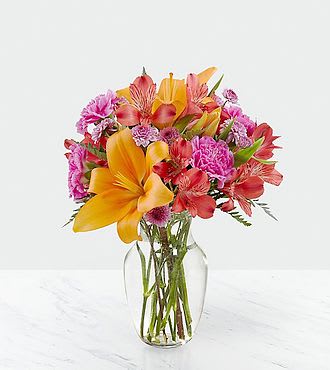
The Bloom Central flower delivery of the month for July in Claremont is the Light and Lovely Bouquet
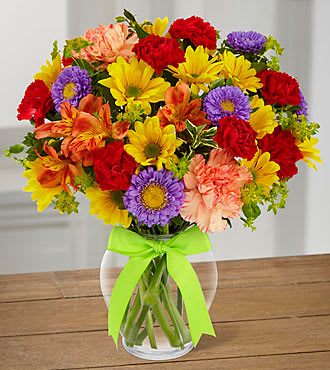
Introducing the Light and Lovely Bouquet, a floral arrangement that will brighten up any space with its delicate beauty. This charming bouquet, available at Bloom Central, exudes a sense of freshness and joy that will make you smile from ear to ear.
The Light and Lovely Bouquet features an enchanting combination of yellow daisies, orange Peruvian Lilies, lavender matsumoto asters, orange carnations and red mini carnations. These lovely blooms are carefully arranged in a clear glass vase with a touch of greenery for added elegance.
This delightful floral bouquet is perfect for all occasions be it welcoming a new baby into the world or expressing heartfelt gratitude to someone special. The simplicity and pops of color make this arrangement suitable for anyone who appreciates beauty in its purest form.
What is truly remarkable about the Light and Lovely Bouquet is how effortlessly it brings warmth into any room. It adds just the right amount of charm without overwhelming the senses.
The Light and Lovely Bouquet also comes arranged beautifully in a clear glass vase tied with a lime green ribbon at the neck - making it an ideal gift option when you want to convey your love or appreciation.
Another wonderful aspect worth mentioning is how long-lasting these blooms can be if properly cared for. With regular watering and trimming stems every few days along with fresh water changes every other day; this bouquet can continue bringing cheerfulness for up to two weeks.
There is simply no denying the sheer loveliness radiating from within this exquisite floral arrangement offered by the Light and Lovely Bouquet. The gentle colors combined with thoughtful design make it an absolute must-have addition to any home or a delightful gift to brighten someone's day. Order yours today and experience the joy it brings firsthand.
Claremont New Hampshire Flower Delivery
Claremont Flower Delivery - Frequently Asked Questions
- Does Bloom Central offer same-day flower delivery in Claremont?
- Yes. Place your order online before 1:00 PM and a local Claremont florist will hand-deliver your arrangement the same day. Orders can also be scheduled up to one month in advance.
- Is it safe to order flowers online?
- Absolutely! We utilize a secure, encrypted checkout to protect your personal and payment information. Visa, Mastercard, American Express, Discover, PayPal and Klarna are all accepted.
- What hospitals and care facilities does Bloom Central deliver to in Claremont?
- We deliver fresh flower arrangements to all hospitals, nursing homes and care facilities in Claremont New Hampshire, including: Elm Wood Center At Claremont, Valley Regional Hospital.
- What funeral homes does Bloom Central deliver sympathy flowers to in Claremont?
- We hand-deliver sympathy and memorial floral arrangements to all funeral homes near Claremont, including: Blossom Hill Cemetery, Cheshire Family Funeral Chapel, Diluzio Foley And Fletcher Funeral Homes, Emmons Funeral Home, Holden Memorials, Knight Funeral Homes & Crematory, NH State Veterans Cemetery, Old North Cemetery, Peterborough Marble & Granite Works, Phaneuf Funeral Homes & Crematorium, Ricker Funeral Home & Crematory, Roy Funeral Home, Still Oaks Funeral & Memorial Home, Stringer Funeral Home, Twin State Monuments, VT Veterans Memorial Cemetery, Woodbury & Son Funeral Service.
- What churches does Bloom Central deliver flowers to in Claremont?
- We deliver fresh floral arrangements to all churches and places of worship in Claremont, including: First Baptist Church Of Claremont.
- What nearby cities does Bloom Central also deliver flowers to?
- In addition to Claremont, we deliver fresh flowers to many nearby cities including: Unity, Cornish, Newport, Charlestown, Plainfield, Lempster, Sunapee, Grantham
- What are the most popular flower arrangements at the Claremont florist?
- Three of our most popular arrangements at our Claremont florist are: Spirit of Spring Basket ($49.90), Happy Times Bouquet ($49.90), Schefflera Arboricola ($97.90). All are available for same-day delivery.
More About Claremont
Are looking for a Claremont florist because you are not local to the area? If so, here is a brief travelogue of what Claremont has to offer. Who knows, perhaps you'll be intrigued enough to come visit soon, partake in some of the fun activities Claremont has to offer and deliver flowers to your loved one in person!
Claremont, New Hampshire, sits like a quiet argument against the idea that small cities must choose between history and motion. Drive into town past the kind of dense New England woods that make you understand why “thicket” is both a noun and a verb, and the first thing you notice is the clock tower. It rises from the downtown’s redbrick spine, a four-faced sentinel whose hands have moved for over a century in their patient, circular proof that time here is both kept and gently ignored. The streets fan out beneath it, a grid of low-roofed buildings where family-owned pharmacies share walls with espresso bars, and the sidewalks host a rhythm of shuffling boots and brisk sneakers that suggests a community content to move at the speed of conversation.
The Sugar River cuts through the city’s eastern edge, its name a sweet irony given the muscular way it churns around old mill foundations. Those mills once turned water into cloth and paychecks, their brick husks now repurposed as galleries, workshops, a library. Stand on the pedestrian bridge at dusk and you’ll see runners tracing the river trail, their breath visible in cold months, their shirtsleeves rolled up when the air turns humid. Kids dare each other to skip stones near the rapids. Retirees fish for trout with the focus of surgeons. The water’s sound is a constant, not a roar but a white-noise hum, the auditory equivalent of a place breathing.

Same day service available. Order your Claremont floral delivery and surprise someone today!
Downtown’s storefronts tell stories in their glass. A café displays oil paintings by a local artist whose landscapes make the Connecticut Valley look both hyperreal and dreamlike. A bookstore stacks memoirs beside field guides to fungi. At the diner, regulars orbit the counter in a ballet of creamers and laminated menus, swapping jokes about the weather or the high school football team’s prospects. The waitstaff know orders by heart: coffee black, rye toast, eggs over easy with home fries that crunch like autumn leaves. You get the sense that if you sat here long enough, you’d learn everything worth knowing about Claremont without asking a single question.
Parks stitch the city together. Broad sidewalks curve through Arrowhead Recreation Area, where pine trees shed needles onto tennis courts and the laughter of pickup soccer games blends with the creak of swingsets. In winter, the hillside becomes a mosaic of sled tracks; in summer, the community pool glows turquoise under sunlight. At the Common, a gazebo hosts brass bands on holidays, their horns sending show tunes into the twilight while families sprawl on blankets, sharing peach pie and comparing mosquito bites. There’s an absence of pretense here, a sense that leisure needs no justification beyond itself.
What’s most striking about Claremont isn’t its postcard angles, the covered bridges, the steeples, the maples that erupt in October like fireworks, but the way it resists caricature. Yes, the past looms large, but it doesn’t suffocate. A tech startup operates out of a Victorian house, its founders coding in rooms where mill foremen once smoked cigars. The high school’s robotics team trophies gleam in the same display case as its 1982 state basketball championship plaque. History here feels less like a shackle than a foundation, something alive enough to build on.
Leave during the golden hour, when the sun slants through the valley, and you’ll see the light gild the clock tower, the river, the faces of people lugging groceries or walking dogs. It’s easy to mistake the scene for nostalgia, but that’s not quite right. Nostalgia implies something lost. Claremont, in its unshowy persistence, suggests instead that certain things endure, not frozen, but adapting, a town that knows the difference between existing and merely staying alive. You drive away wondering if the rest of us could learn to keep time like that: patient, precise, but always with room for the unexpected chord.