




- New Baby
- Best Sellers
- Sympathy
 $297.90
- $64.90

July 1, 2026
Dunbarton July Floral Selection
The Bloom Central flower delivery of the month for July in Dunbarton is the Be Bold Bouquet by Better Homes and Gardens
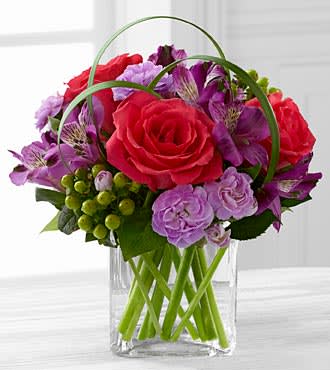
Introducing the Be Bold Bouquet by Better Homes and Gardens floral arrangement! Blooming with bright colors to boldly express your every emotion, this exquisite flower bouquet is set to celebrate. Hot pink roses, purple Peruvian Lilies, lavender mini carnations, green hypericum berries, lily grass blades, and lush greens are brought together to create an incredible flower arrangement.
The flowers are artfully arranged in a clear glass cube vase, allowing their natural beauty to shine through. The lucky recipient will feel like you have just picked the flowers yourself from a beautiful garden!
Whether you're celebrating an anniversary, sending get well wishes or simply saying 'I love you', the Be Bold Bouquet is always appropriate. This floral selection has timeless appeal and will be cherished by anyone who is lucky enough to receive it.
Better Homes and Gardens has truly outdone themselves with this incredible creation. Their attention to detail shines through in every petal and leaf - creating an arrangement that not only looks stunning but also feels incredibly luxurious.
If you're looking for a captivating floral arrangement that brings joy wherever it goes, the Be Bold Bouquet by Better Homes and Gardens is the perfect choice. The stunning colors, long-lasting blooms, delightful fragrance and affordable price make it a true winner in every way. Get ready to add a touch of boldness and beauty to someone's life - you won't regret it!
Local Flower Delivery in Dunbarton
Dunbarton Flower Delivery - Frequently Asked Questions
- Does Bloom Central offer same-day flower delivery in Dunbarton?
- Yes. Place your order online before 1:00 PM and a local Dunbarton florist will hand-deliver your arrangement the same day. Orders can also be scheduled up to one month in advance.
- Is it safe to order flowers online?
- Absolutely! We utilize a secure, encrypted checkout to protect your personal and payment information. Visa, Mastercard, American Express, Discover, PayPal and Klarna are all accepted.
- What funeral homes does Bloom Central deliver sympathy flowers to in Dunbarton?
- We hand-deliver sympathy and memorial floral arrangements to all funeral homes near Dunbarton, including: Blossom Hill Cemetery, Goodwin Funeral Home & Cremation Services, Old North Cemetery, Peterborough Marble & Granite Works, Phaneuf Funeral Homes & Crematorium, Still Oaks Funeral & Memorial Home.
- What nearby cities does Bloom Central also deliver flowers to?
- In addition to Dunbarton, we deliver fresh flowers to many nearby cities including: Bow, Weare, Concord, Goffstown, Suncook, Hopkinton, Hooksett, Pembroke
- What are the most popular flower arrangements at the Dunbarton florist?
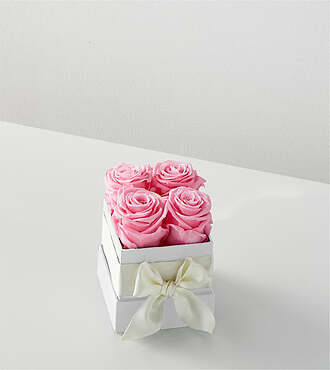
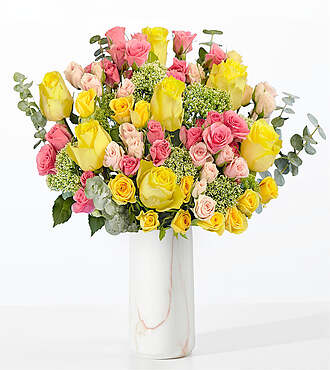
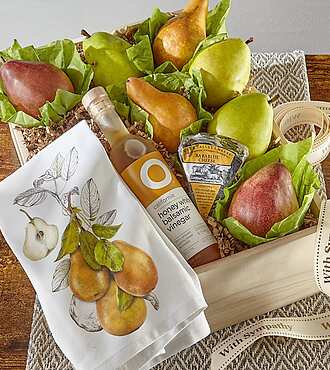
- Three of our most popular arrangements at our Dunbarton florist are: Yellow Rose Bouquet ($84.90), Sweetberry Box A Florist Original ($64.90), Mother Nature Bouquet ($64.90). All are available for same-day delivery.
More About Dunbarton
Are looking for a Dunbarton florist because you are not local to the area? If so, here is a brief travelogue of what Dunbarton has to offer. Who knows, perhaps you'll be intrigued enough to come visit soon, partake in some of the fun activities Dunbarton has to offer and deliver flowers to your loved one in person!
Dunbarton, New Hampshire, is the sort of place that makes you wonder whether the word “town” even applies anymore, or if it does, whether we’ve been using it wrong all along. You arrive via a two-lane road that curves like a question mark through stands of pine and maple, past stone walls that look less built than extruded by the land itself. The air smells of cut grass and distant rain. The first thing you notice is the quiet, which isn’t an absence of sound so much as a presence: the creak of a porch swing, the scuffle of a squirrel in dry leaves, the faint metallic ring of a hammer striking something purposeful over on Beard Road. The second thing you notice is that no one seems to be in a hurry to make you notice anything else.
The town common sits at the center, a green so lush it feels almost accusatory in its vitality. Here, on a Tuesday afternoon, a woman in a sunhat deadheads marigolds while a Labrador retriever named Max circles her in slow, panting orbits. A boy on a bicycle delivers newspapers to the library, the post office, the fire station, all housed in buildings that predate the concept of zoning laws. The library’s interior smells of wood polish and the faint, reassuring musk of aging paper. The librarian knows every patron’s reading habits but would never presume to mention them. Outside, a signboard announces a potluck supper to benefit the historical society, which is embroiled in a friendly but fervent debate over whether to restore a 19th-century cider press or let it “return to the earth with dignity.”

Same day service available. Order your Dunbarton floral delivery and surprise someone today!
Dunbarton’s history is the kind that New England towns wear like a well-loved flannel shirt. The Stark family, yes, those Starks, the ones who gave the region generals and granite-jawed resolve, once planted roots here, and their homestead still stands as a museum that’s open three weekends a month, weather permitting. The docent, a retired teacher with a encyclopedic knowledge of local stone walls, will tell you about how the house’s beams were hand-hewn by men who argued about the Revolutionary War over lunch pails. The past here isn’t preserved so much as kept in gentle circulation, like a library book everyone agrees is too good to discard.
What’s startling, though, is how the present insists on unfolding with equal sincerity. At the general store, a teenager rings up a customer’s coffee and gas while texting her friend about the upcoming high school soccer game. The cash register is older than she is. Down the road, a farmer trains sunflowers to face the highway, a gesture so uncynical it could make you blush. In the evenings, residents gather at the transfer station, not a dump, they’ll remind you, but a “waste management facility”, to trade gossip and tomato seedlings. The line between utility and ritual blurs until it disappears.
The woods here are not wilderness but something better: cared for. Trails wind through parcels of land conserved by families who wrote stewardship into their wills. You can walk for miles under a canopy of oak, listening to the rustle of something that might be wind or might be a deer deciding not to bolt. At the top of Page Hill, the view stretches across ridges that fade from green to blue, a gradient that defies your phone’s camera. A handmade bench offers a place to sit. The carving on its arm reads, “Rest Here,” but the “Here” feels redundant.
Leaving Dunbarton requires a conscious act of will. You pass the Baptist church, its steeple clock stuck perpetually at 8:45, a quirk the congregation embraces as a metaphor for eternity or municipal budgeting, depending on whom you ask. A pickup truck towing a canoe waves you ahead at the four-way stop. As the road straightens and the pines thin, you check your mirror and see the town receding like a mirage, which is maybe the point. It persists not by resisting the 21st century but by quietly, insistently reminding you that a place can choose what to hold onto. The choice, like the town itself, feels both ancient and alive.