





- Get Well
- Best Sellers
- Vased
 $54.90
- $54.90
- $79.90
- $54.90
- $49.90
- $49.90
- $49.90
- $79.90
- $74.90
- $69.90
July 1, 2026
Bethel July Floral Selection
The Bloom Central flower delivery of the month for July in Bethel is the Birthday Brights Bouquet
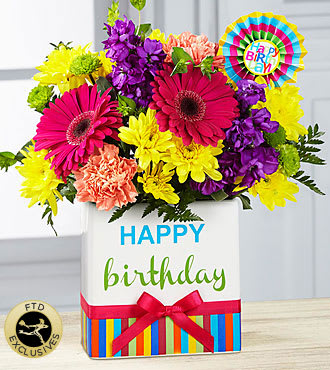
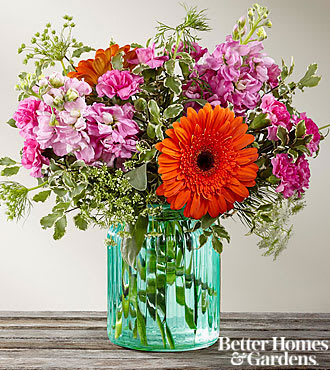
The Birthday Brights Bouquet from Bloom Central is a delightful floral arrangement that anyone would adore. With its vibrant colors and cheerful blooms, it's sure to bring a smile to the face of that special someone.
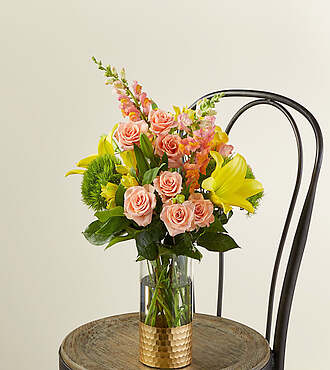
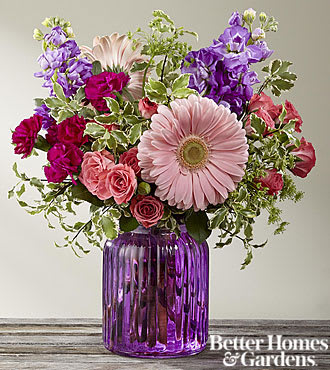
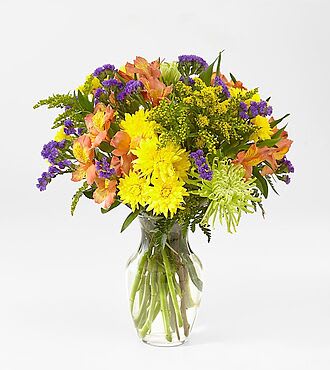
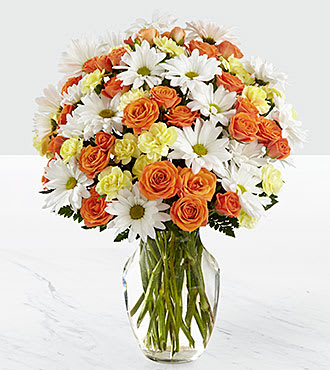
This bouquet features an assortment of beautiful flowers in shades of pink, orange, yellow, and purple. The combination of these bright hues creates a lively display that will add warmth and happiness to any room.
Specifically the Birthday Brights Bouquet is composed of hot pink gerbera daisies and orange roses taking center stage surrounded by purple statice, yellow cushion poms, green button poms, and lush greens to create party perfect birthday display.
To enhance the overall aesthetic appeal, delicate greenery has been added around the blooms. These greens provide texture while giving depth to each individual flower within the bouquet.
With Bloom Central's expert florists crafting every detail with care and precision, you can be confident knowing that your gift will arrive fresh and beautifully arranged at the lucky recipient's doorstep when they least expect it.
If you're looking for something special to help someone celebrate - look no further than Bloom Central's Birthday Brights Bouquet!
Bethel New York Flower Delivery
Bethel Flower Delivery - Frequently Asked Questions
- Does Bloom Central offer same-day flower delivery in Bethel?
- Yes. Place your order online before 1:00 PM and a local Bethel florist will hand-deliver your arrangement the same day. Orders can also be scheduled up to one month in advance.
- Is it safe to order flowers online?
- Absolutely! We utilize a secure, encrypted checkout to protect your personal and payment information. Visa, Mastercard, American Express, Discover, PayPal and Klarna are all accepted.
- What funeral homes does Bloom Central deliver sympathy flowers to in Bethel?
- We hand-deliver sympathy and memorial floral arrangements to all funeral homes near Bethel, including: Applebee-McPhillips Funeral Home, Bolock Funeral Home, Chipak Funeral Home, Chomko Nicholas Funeral Home, Copeland Funeral Home, DeWitt-Martinez Funeral and Cremation Services, Flynn Funeral & Cremation Memorial Centers, Flynn Funeral & Cremation Memorial Centers, Harris Funeral Home, Hessling Funeral Home, Knight-Auchmoody Funeral Home, Old Ellenville Cemetery, Savino Carl J Jr Funeral Home, Scarr Leonard A Funrl Dir, Stroyan Funeral Home, T S Purta Funeral Home, Wanamaker & Carlough Funeral Home, Yanac Funeral & Cremation Service.
- What nearby cities does Bloom Central also deliver flowers to?
- In addition to Bethel, we deliver fresh flowers to many nearby cities including: Cochecton, Monticello, Delaware, Liberty, Thompson, Callicoon, Tusten, South Fallsburg
- What are the most popular flower arrangements at the Bethel florist?
- Three of our most popular arrangements at our Bethel florist are: Pick of the Patch Pumpkin Bouquet ($59.90), Elegant Impressions Luxury Orchid ($157.90), Yellow Brick Road Bouquet ($74.90). All are available for same-day delivery.
More About Bethel
Are looking for a Bethel florist because you are not local to the area? If so, here is a brief travelogue of what Bethel has to offer. Who knows, perhaps you'll be intrigued enough to come visit soon, partake in some of the fun activities Bethel has to offer and deliver flowers to your loved one in person!
Bethel, New York, exists in the kind of rural silence that feels both ancient and urgently present, a place where the past doesn’t so much linger as hum beneath the soil like a live wire. The hills here roll with a drowsy, undulating grace, their contours softened by time and weather, fields dotted with cattle that regard passing cars with a bovine indifference so total it borders on wisdom. To drive these roads in late summer is to move through a latticework of shadows cast by oaks whose branches twist like arteries, sunlight filtering down in fragments, each mile marked by the occasional farmhouse, its porch cluttered with the artifacts of generations, rusted tools, faded lawn chairs, firewood stacked in loose, asymmetrical towers.
The town’s name rings with a quiet irony. Bethel: “house of God.” And there is something quietly devotional in the way light falls here, golden and diffuse, as if the air itself were stained with reverence. But the divinity here is earthy, unpretentious, rooted in the rhythms of tractors groaning through fields, of farmers mending fences under skies so vast they seem to swallow sound. This is a landscape that demands you notice how the mist clings to the hollows at dawn, how the frost etches delicate patterns on pumpkins left in patches come October. It is easy, in such moments, to forget that this quiet corner of Sullivan County once briefly became the center of the universe.

Same day service available. Order your Bethel floral delivery and surprise someone today!
In August 1969, half a million people converged on Max Yasgur’s farm, a patch of land now preserved as both artifact and altar. The event’s mythology has long since calcified into legend, but Bethel itself refuses to be fossilized. Visit the site today and you’ll find not a shrine to chaos but a meadow that still bends under the wind, flanked by the Bethel Woods Center for the Arts, a venue whose sleek pavilion seems to hover above the grass like some benign spacecraft. The contrast is jarring, at first, this marriage of pastoral stillness and modern ambition, until you watch a crowd spread across the lawn for a summer concert, faces tilted toward the stage as fireflies blink lazily in the encroaching dusk. The past isn’t dead here. It’s in dialogue.
Locals, when asked about the tension between memory and progress, tend to shrug. A woman at the general store, her hands busy restocking jars of local honey, will tell you that the real Bethel isn’t in the history books or the headlines. It’s in the way the community gathers every fall for the agricultural fair, children clutching blue ribbons for prize zucchini, teenagers flirting by the Ferris wheel. It’s in the volunteer firefighters’ pancake breakfasts, the way the librarian knows every kid’s reading level by heart. At the Museum at Bethel Woods, exhibits chronicle the ’60s with a curator’s precision, but the real story is outside, where visitors walk the field, some barefoot, as if testing the grass for residual magic.
What persists, beyond the myths, is a town that has mastered the art of balance. The same roads that once choked with traffic now wind past vineyards and U-pick orchards, kayaks stacked by lakes where loons call across the water. New arrivals, artists, retirees, entrepreneurs, fold into the community like ingredients in a stubborn stew, their presence altering the flavor but not the essence. There’s a humility here, a recognition that no single narrative can contain a place that has been both witness and participant, sanctuary and stage.
To leave Bethel is to carry the sense that you’ve touched something irreducible, a paradox of permanence and flux. The fields endure. The music fades. The people remain, tending their gardens, their histories, their quiet corner of a world that still, against all odds, believes in the possibility of harmony.