





- Best Value
- Best Sellers
- Under $100
 $49.90










July 1, 2026
Gilboa July Floral Selection
The Bloom Central flower delivery of the month for July in Gilboa is the Comfort and Grace Bouquet
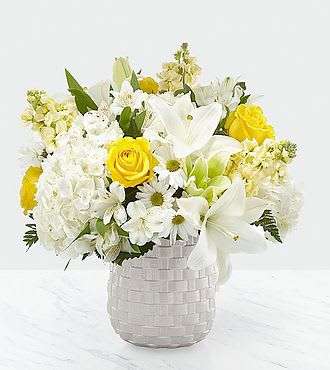
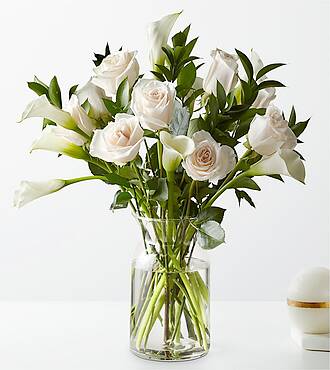
The Comfort and Grace Bouquet from Bloom Central is simply delightful. This gorgeous floral arrangement exudes an aura of pure elegance and charm making it the perfect gift for any occasion.
The combination of roses, stock, hydrangea and lilies is a timeless gift to share during times of celebrations or sensitivity and creates a harmonious blend that will surely bring joy to anyone who receives it. Each flower in this arrangement is fresh-cut at peak perfection - allowing your loved one to enjoy their beauty for days on end.
The lucky recipient can't help but be captivated by the sheer beauty and depth of this arrangement. Each bloom has been thoughtfully placed to create a balanced composition that is both visually pleasing and soothing to the soul.
What makes this bouquet truly special is its ability to evoke feelings of comfort and tranquility. The gentle hues combined with the fragrant blooms create an atmosphere that promotes relaxation and peace in any space.
Whether you're looking to brighten up someone's day or send your heartfelt condolences during difficult times, the Comfort and Grace Bouquet does not disappoint. Its understated elegance makes it suitable for any occasion.
The thoughtful selection of flowers also means there's something for everyone's taste! From classic roses symbolizing love and passion, elegant lilies representing purity and devotion; all expertly combined into one breathtaking display.
To top it off, Bloom Central provides impeccable customer service ensuring nationwide delivery right on time no matter where you are located!
If you're searching for an exquisite floral arrangement brimming with comfort and grace then look no further than the Comfort and Grace Bouquet! This arrangement is a surefire way to delight those dear to you, leaving them feeling loved and cherished.
Local Flower Delivery in Gilboa
Gilboa Flower Delivery - Frequently Asked Questions
- Does Bloom Central offer same-day flower delivery in Gilboa?
- Yes. Place your order online before 1:00 PM and a local Gilboa florist will hand-deliver your arrangement the same day. Orders can also be scheduled up to one month in advance.
- Is it safe to order flowers online?
- Absolutely! We utilize a secure, encrypted checkout to protect your personal and payment information. Visa, Mastercard, American Express, Discover, PayPal and Klarna are all accepted.
- What funeral homes does Bloom Central deliver sympathy flowers to in Gilboa?
- We hand-deliver sympathy and memorial floral arrangements to all funeral homes near Gilboa, including: Applebee Funeral Home, Betz Funeral Home, Burnett & White Funeral Homes, Catricala Funeral Home, De Marco-Stone Funeral Home, Delker and Terry Funeral Home, Dufresne Funeral Home, Emerick Gordon C Funeral Home, Glenville Funeral Home, Keyser Funeral & Cremation Services, Konicek & Collett Funeral Home LLC, Lester R. Grummons Funeral Home, New Comer Funerals & Cremations, Ray Funeral Svce, Riverview Funeral Home, Simpson-Gaus Funeral Home, Sweets Funeral Home, Yadack-Fox Funeral Home.
- What nearby cities does Bloom Central also deliver flowers to?
- In addition to Gilboa, we deliver fresh flowers to many nearby cities including: Jefferson, Roxbury, Broome, Summit, Stamford, Harpersfield, Windham, Rensselaerville
- What are the most popular flower arrangements at the Gilboa florist?
- Three of our most popular arrangements at our Gilboa florist are: Always Smile Luxury Bouquet ($99.90), Blooming Visions Bouquet ($69.90), Pure Beauty Mixed Roses ($84.90). All are available for same-day delivery.
More About Gilboa
Are looking for a Gilboa florist because you are not local to the area? If so, here is a brief travelogue of what Gilboa has to offer. Who knows, perhaps you'll be intrigued enough to come visit soon, partake in some of the fun activities Gilboa has to offer and deliver flowers to your loved one in person!
In the upstate folds where the Catskills shrug into valleys quilted with farms, Gilboa, New York, sits as if half-buried by time, a town that has, twice now, been asked to vanish for the sake of something larger. The first vanishing happened a century ago, when the original Gilboa dissolved into the reservoir behind the Schoharie Dam, its bones submerged to quench New York City’s thirst. The second vanishing is quieter, geologic, written in shale: 380 million years ago, this patch of earth was a swamp forest, and the oldest trees on the planet, Eospermatopteris, their stumps fossilized into stone, stood here, then fell, then became the reason school buses full of children now idle outside the Gilboa Museum, their passengers pressing small hands to glass cases that hold primordial bark. This is a place where disappearances accumulate meaning, where what’s absent insists on being seen.
Drive through today’s Gilboa, reconstituted a few miles uphill from its drowned ancestor, and you’ll pass a post office, a church, a library no bigger than a living room. The houses wear vinyl siding in shades of eggshell and dusk, their yards studded with wind chimes and bird feeders. It’s easy to mistake the quiet for inertia. But talk to the woman at the farmers’ market selling rhubarb jam, or the retiree who volunteers as the town historian, and you’ll hear a civic pulse that thrives on paradox: this is a community knit together by displacement, by the understanding that survival sometimes demands starting over. When the old Gilboa was evacuated in the 1920s, some families used horses to drag their homes uphill, inch by inch, until the new settlement coalesced. That same pragmatism lingers. Residents still meet in the fire hall to plan fundraisers for a new playground or debate the merits of solar panels on the school roof.

Same day service available. Order your Gilboa floral delivery and surprise someone today!
The dam itself looms a mile north, a concrete trapezoid that holds back 17.6 billion gallons. Its spillway cascades like a liquid staircase, and on misty mornings, rainbows hover above the plunge pool. You might catch a local fisherman casting for trout in the Schoharie Creek below, or a hiker pausing on the trail that ribbons the reservoir’s edge. What’s striking is how unremarkable the infrastructure feels to those who live beside it, not because they take it for granted, but because they’ve made peace with its duality. The dam is both tamer of floods and agent of erasure, a colossus that reshaped their world. Yet it’s also why the tap water here tastes like snowmelt, why the valley stays green even in drought.
Gilboa’s genius lies in its refusal to be any one thing. Walk the fossil trail behind the museum, where replicas of Devonian-era trees rise like skeletal umbrellas, and you’re standing in a palimpsest. Layers of history press upward: fern imprints in rock, the faint outlines of root systems, the whisper of a town that exists now only in photographs. Kids clamber over the models, pretending to be archaeologists, while their parents picnic under sugar maples. It’s a scene that collapses epochs, inviting the past to coexist with soccer practice and TikTok.
There’s a tendency to romanticize small towns as holdouts against modernity, but Gilboa resists that. Its identity is fluid, shaped by the same forces that erased it. People here tend gardens and plow driveways and gather for potlucks where the talk revolves around propane prices and the upcoming high school musical. They know their trees fed the first forests, their reservoir fuels a metropolis, their home is a way station between deep time and the next rainfall. What looks like ordinary life, here, is a kind of vigilance, a choice to keep building something that can endure the next vanishing.