





- Anniversary
- Best Sellers
- Under $60
 $69.90








- $49.90



July 1, 2026
Morris July Floral Selection
The Bloom Central flower delivery of the month for July in Morris is the Be Bold Bouquet by Better Homes and Gardens

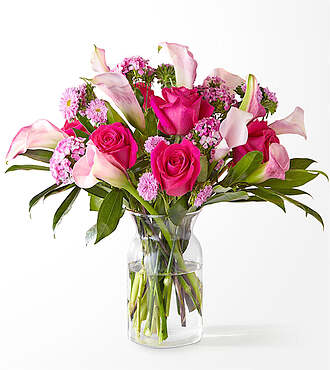
Introducing the Be Bold Bouquet by Better Homes and Gardens floral arrangement! Blooming with bright colors to boldly express your every emotion, this exquisite flower bouquet is set to celebrate. Hot pink roses, purple Peruvian Lilies, lavender mini carnations, green hypericum berries, lily grass blades, and lush greens are brought together to create an incredible flower arrangement.
The flowers are artfully arranged in a clear glass cube vase, allowing their natural beauty to shine through. The lucky recipient will feel like you have just picked the flowers yourself from a beautiful garden!
Whether you're celebrating an anniversary, sending get well wishes or simply saying 'I love you', the Be Bold Bouquet is always appropriate. This floral selection has timeless appeal and will be cherished by anyone who is lucky enough to receive it.
Better Homes and Gardens has truly outdone themselves with this incredible creation. Their attention to detail shines through in every petal and leaf - creating an arrangement that not only looks stunning but also feels incredibly luxurious.
If you're looking for a captivating floral arrangement that brings joy wherever it goes, the Be Bold Bouquet by Better Homes and Gardens is the perfect choice. The stunning colors, long-lasting blooms, delightful fragrance and affordable price make it a true winner in every way. Get ready to add a touch of boldness and beauty to someone's life - you won't regret it!
Local Flower Delivery in Morris
Morris Flower Delivery - Frequently Asked Questions
- Does Bloom Central offer same-day flower delivery in Morris?
- Yes. Place your order online before 1:00 PM and a local Morris florist will hand-deliver your arrangement the same day. Orders can also be scheduled up to one month in advance.
- Is it safe to order flowers online?
- Absolutely! We utilize a secure, encrypted checkout to protect your personal and payment information. Visa, Mastercard, American Express, Discover, PayPal and Klarna are all accepted.
- What funeral homes does Bloom Central deliver sympathy flowers to in Morris?
- We hand-deliver sympathy and memorial floral arrangements to all funeral homes near Morris, including: Canajoharie Falls Cemetery, Chopyak-Scheider Funeral Home, Coleman & Daniels Funeral Home, Crown Hill Memorial Park, DeMunn Funeral Home, Delker and Terry Funeral Home, Eannace Funeral Home, Fiore Funeral Home, Hopler & Eschbach Funeral Home, Lester R. Grummons Funeral Home, McFee Memorials, Mohawk Valley Funerals & Cremations, Peaceful Pets by Schepp Family Funeral Homes, Rice J F Funeral Home, Savage-DeMarco Funeral Service, Savage-DeMarco Funeral Service, St Joseph Cemetery, Sullivan Walter D & Son Funeral Home.
- What nearby cities does Bloom Central also deliver flowers to?
- In addition to Morris, we deliver fresh flowers to many nearby cities including: Pittsfield, Butternuts, Otego, New Berlin, Laurens, New Lisbon, West End, Columbus
- What are the most popular flower arrangements at the Morris florist?
- Three of our most popular arrangements at our Morris florist are: Everyday Love Bouquet with Chocolates ($72.90), Radiance in Bloom Basket ($89.90), Shades of Purple Bouquet ($59.90). All are available for same-day delivery.
More About Morris
Are looking for a Morris florist because you are not local to the area? If so, here is a brief travelogue of what Morris has to offer. Who knows, perhaps you'll be intrigued enough to come visit soon, partake in some of the fun activities Morris has to offer and deliver flowers to your loved one in person!
Morris, New York, sits in the Butternut Valley like a comma in a long, rural sentence, a pause that invites you to linger but never overstays. To drive through on Route 51 is to glimpse a town that seems both stubbornly present and quietly dissolving into the surrounding hills, a place where the past isn’t preserved so much as perpetually unearthed by the rhythms of daily life. The sun rises over fields striped with corn and alfalfa, their rows so precise they could be stitching the earth together. Tractors hum at dawn, their operators waving with the solemnity of men performing liturgy. Here, the air smells of cut grass and diesel, a combination that feels less like contradiction than covenant.
The town’s center is a blink of red brick and clapboard: a post office where the clerk knows your name before you speak, a library with creaking floors that protest under the weight of centuries, a diner where coffee costs a dollar and the eggs arrive with yolks so bright they seem to mock the very concept of city food. At the counter, farmers dissect the weather with the intensity of philosophers, their forecasts less predictions than oral histories. You get the sense that in Morris, time isn’t linear but layered, a palimpsest of harvests and hard winters, of high school football games and firehouse pancake breakfasts, of the way the light slants through the valley in October, turning the maples into torches.

Same day service available. Order your Morris floral delivery and surprise someone today!
Walk down Main Street on a Tuesday and you’ll pass the kind of small businesses that elsewhere have been replaced by algorithms. There’s a hardware store where the owner will loan you a wrench and ask about your mother. A tailor whose hands move like he’s unraveling time itself. A gallery where local artists display landscapes that somehow make the familiar feel sacred. The school, a red-and-white monument to community, buzzes with a cross-country meet, kids sprinting past apple orchards, their breath visible in the autumn chill, their sneakers kicking up dust that hangs in the air like a blessing.
What’s easy to miss, if you’re just passing through, is the way Morris resists the binary of quaintness and decay. Yes, the population hovers near 600, and yes, the train no longer stops here. But the absence of certain things, traffic, neon, the low-grade panic of urban life, creates a space for other textures. Neighbors still gather at the town hall to argue over zoning laws with the fervor of revolutionaries. The annual Oxen Days festival draws crowds for tractor pulls and pie contests, events that are less nostalgia than proof that some traditions can still bind a people together. Even the cemetery on the hill feels alive in its way, names on the stones echoing in the children who race past them.
There’s a particular magic to standing on the bridge over the Butternut Creek at dusk, watching the water carve its slow path south. The creek isn’t majestic, but it’s persistent, a mirror for the sky, a home for herons, a thing that persists without spectacle. You start to wonder if the value of a place isn’t measured in what it produces but in what it refuses to discard. In Morris, that means the smell of woodsmoke on a frosty morning, the way the church bell tolls for both weddings and funerals, the unspoken rule that you wave to every car you pass, even if you don’t know who’s inside.
To call it idyllic would miss the point. Life here isn’t easy, just intentional. The same hands that plant seeds in spring also shovel snow in January. The same voices that sing hymns on Sunday gather in the school gym to vote on Tuesday. What looks like stasis is really a kind of vigilance, a collective agreement to keep tending something fragile, something worth passing on. You leave wondering if the rest of us have forgotten something essential, something Morris never learned to let go.