





- Birthday
- Best Sellers
- Sympathy



 $297.90
- $64.90



July 1, 2026
Princeton July Floral Selection
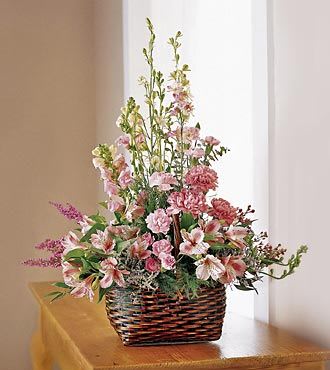
The Bloom Central flower delivery of the month for July in Princeton is the Be Bold Bouquet by Better Homes and Gardens
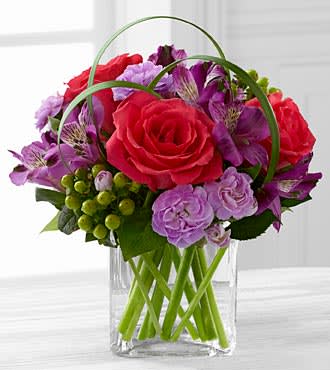
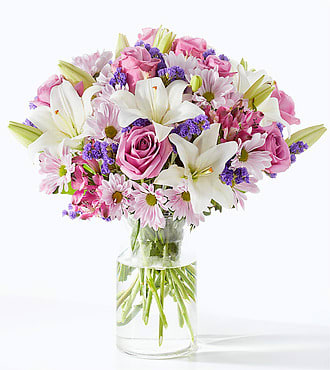
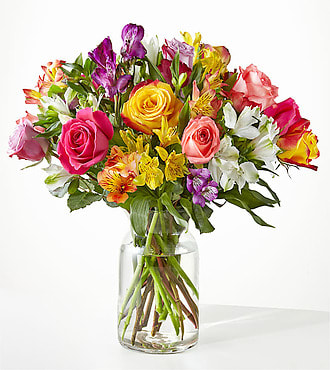
Introducing the Be Bold Bouquet by Better Homes and Gardens floral arrangement! Blooming with bright colors to boldly express your every emotion, this exquisite flower bouquet is set to celebrate. Hot pink roses, purple Peruvian Lilies, lavender mini carnations, green hypericum berries, lily grass blades, and lush greens are brought together to create an incredible flower arrangement.
The flowers are artfully arranged in a clear glass cube vase, allowing their natural beauty to shine through. The lucky recipient will feel like you have just picked the flowers yourself from a beautiful garden!
Whether you're celebrating an anniversary, sending get well wishes or simply saying 'I love you', the Be Bold Bouquet is always appropriate. This floral selection has timeless appeal and will be cherished by anyone who is lucky enough to receive it.
Better Homes and Gardens has truly outdone themselves with this incredible creation. Their attention to detail shines through in every petal and leaf - creating an arrangement that not only looks stunning but also feels incredibly luxurious.
If you're looking for a captivating floral arrangement that brings joy wherever it goes, the Be Bold Bouquet by Better Homes and Gardens is the perfect choice. The stunning colors, long-lasting blooms, delightful fragrance and affordable price make it a true winner in every way. Get ready to add a touch of boldness and beauty to someone's life - you won't regret it!
Local Flower Delivery in Princeton
Princeton Flower Delivery - Frequently Asked Questions
- Does Bloom Central offer same-day flower delivery in Princeton?
- Yes. Place your order online before 1:00 PM and a local Princeton florist will hand-deliver your arrangement the same day. Orders can also be scheduled up to one month in advance.
- Is it safe to order flowers online?
- Absolutely! We utilize a secure, encrypted checkout to protect your personal and payment information. Visa, Mastercard, American Express, Discover, PayPal and Klarna are all accepted.
- What funeral homes does Bloom Central deliver sympathy flowers to in Princeton?
- We hand-deliver sympathy and memorial floral arrangements to all funeral homes near Princeton, including: Carrons Funeral Home, Hood Funeral Home, Joyners Funeral Home, Parkside Florist, Rose & Graham Funeral Home, Sanders Funeral Home, Shackleford-Howell Funeral Home, Stevens Funeral Home, Strickland Funeral Home, Thomas-Yelverton Funeral Svc.
- What nearby cities does Bloom Central also deliver flowers to?
- In addition to Princeton, we deliver fresh flowers to many nearby cities including: Pine Level, Selma, Kenly, Smithfield, Mar-Mac, Goldsboro, Fremont, Brogden
- What are the most popular flower arrangements at the Princeton florist?
- Three of our most popular arrangements at our Princeton florist are: Pick of the Patch Pumpkin Bouquet ($59.90), Elegant Impressions Luxury Orchid ($157.90), Yellow Brick Road Bouquet ($74.90). All are available for same-day delivery.
More About Princeton
Are looking for a Princeton florist because you are not local to the area? If so, here is a brief travelogue of what Princeton has to offer. Who knows, perhaps you'll be intrigued enough to come visit soon, partake in some of the fun activities Princeton has to offer and deliver flowers to your loved one in person!
Princeton, North Carolina, does not announce itself. It appears instead as a kind of quiet exhale between Raleigh and the coast, a pause in the static, a place where the air itself seems to soften. Drive into town on a Tuesday morning, past the soybean fields and tobacco barns, past the roadside stands offering peaches in summer, collards in fall, and you’ll notice something strange: your shoulders drop. Your breath slows. The world here moves at the speed of a bicycle pedaled by a kid with no particular place to be. The town’s single traffic light blinks yellow, as if winking at the idea of urgency.
Main Street stretches four blocks, lined with low-slung buildings that wear their history like a favorite flannel shirt, frayed at the edges but deeply loved. At Howell’s Hardware, founded when Eisenhower was president, a man in a John Deere cap might explain the merits of galvanized nails over common ones, not because you asked, but because he cares. The diner next door serves sweet tea in Mason jars, and the waitress knows your order before you slide into the vinyl booth. Down the block, a barber pole spins red and white, and inside, under the buzz of clippers, someone is always debating the merits of this year’s tomato crop.

Same day service available. Order your Princeton floral delivery and surprise someone today!
What defines Princeton, though, isn’t its geography or its architecture but its people, who treat neighborliness as both a verb and a sacrament. Every spring, the town hosts the Potato Festival, a celebration of the humble spud that draws thousands to Main Street. There are tractor parades and pie contests and children racing with potatoes balanced on spoons, their faces flushed with concentration. Farmers in seed-company hats stand beside tables heaped with Covingtons and Beauregards, explaining the difference between dry-flesh and moist-flesh varieties to anyone who lingers. The festival isn’t just about agriculture; it’s a ritual of continuity, a way of saying, This is who we are, and we’re still here.
The land itself seems to collaborate in this act of persistence. Fields stretch in every direction, their rows precise as scripture, dotted with workers who bend and rise in the same rhythms their grandparents did. At dawn, mist hangs over the crops like a held breath, and by midday, the sun turns the soil into something that smells like possibility. You can see the pride in the way a farmer runs a hand over a sweet potato’s russet skin, or in the way a gardener arranges zinnias at the farmers’ market, stem by stem, each bloom a bright fist of color.
Schools here are small enough that the principal knows every student’s name, and Friday nights in autumn belong to high school football, where the stands erupt in cheers not just for touchdowns but for effort, for grit, for the kid who gets up muddy and keeps running. The park downtown has a gazebo where old men play checkers and teenagers take prom photos, their dresses rustling like fallen leaves. On Sundays, the churches fill with harmonies from hymnals older than the pews.
It would be easy to mistake Princeton for a relic, a town preserved in amber. But look closer: the new community center hosts coding workshops for kids. Solar panels glint on barn roofs. The library, housed in a former train depot, loans out fishing poles alongside novels. Progress here doesn’t roar; it unfolds gently, like a porch conversation that starts with the weather and ends with a plan to repaint the crosswalks.
Leave Princeton by a back road at dusk, and you’ll pass a hundred front yards where families rock on porches, waving as you go. Fireflies rise like sparks from the fields, and the sky turns the color of a ripe plum. You’ll wonder, as you merge onto the highway, why the air feels different now. Then it hits you: you’ve been breathing in hope, the quiet, stubborn kind that grows in places where people still believe in tomorrow because they’ve built today, together, one potato, one nail, one hello at a time.