





- New Baby
- Best Sellers
- Under $60









 $49.90

June 1, 2026
Beech Mountain Lakes June Floral Selection
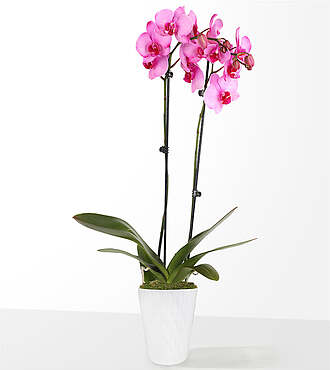
The Bloom Central flower delivery of the month for June in Beech Mountain Lakes is the Fuchsia Phalaenopsis Orchid
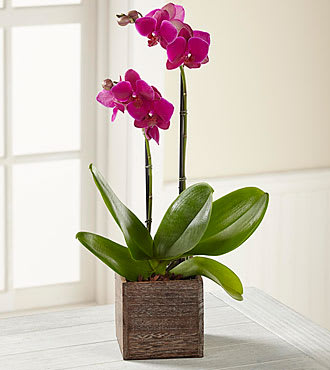
The Fuchsia Phalaenopsis Orchid floral arrangement from Bloom Central is a stunning addition to any home decor. This beautiful orchid arrangement features vibrant violet blooms that are sure to catch the eye of anyone who enters the room.
This stunning double phalaenopsis orchid displays vibrant violet blooms along each stem with gorgeous green tropical foliage at the base. The lively color adds a pop of boldness and liveliness, making it perfect for brightening up a living room or adding some flair to an entryway.
One of the best things about this floral arrangement is its longevity. Unlike other flowers that wither away after just a few days, these phalaenopsis orchids can last for many seasons if properly cared for.
Not only are these flowers long-lasting, but they also require minimal maintenance. With just a little bit of water every week and proper lighting conditions your Fuchsia Phalaenopsis Orchids will thrive and continue to bloom beautifully.
Another great feature is that this arrangement comes in an attractive, modern square wooden planter. This planter adds an extra element of style and charm to the overall look.
Whether you're looking for something to add life to your kitchen counter or wanting to surprise someone special with a unique gift, this Fuchsia Phalaenopsis Orchid floral arrangement from Bloom Central is sure not disappoint. The simplicity combined with its striking color makes it stand out among other flower arrangements.
The Fuchsia Phalaenopsis Orchid floral arrangement brings joy wherever it goes. Its vibrant blooms capture attention while its low-maintenance nature ensures continuous enjoyment without much effort required on the part of the recipient. So go ahead and treat yourself or someone you love today - you won't regret adding such elegance into your life!
Beech Mountain Lakes Pennsylvania Flower Delivery
Beech Mountain Lakes Flower Delivery - Frequently Asked Questions
- Does Bloom Central offer same-day flower delivery in Beech Mountain Lakes?
- Yes. Place your order online before 1:00 PM and a local Beech Mountain Lakes florist will hand-deliver your arrangement the same day. Orders can also be scheduled up to one month in advance.
- Is it safe to order flowers online?
- Absolutely! We utilize a secure, encrypted checkout to protect your personal and payment information. Visa, Mastercard, American Express, Discover, PayPal and Klarna are all accepted.
- What funeral homes does Bloom Central deliver sympathy flowers to in Beech Mountain Lakes?
- We hand-deliver sympathy and memorial floral arrangements to all funeral homes near Beech Mountain Lakes, including: Cremation Specialist of Pennsylvania, Denison Cemetery & Mausoleum, Disque Richard H Funeral Home, Harman Funeral Home & Crematory, Hollenback Cemetery, Kniffen OMalley Leffler Funeral and Cremation Services, Kopicki Funeral Home, McHugh-Wilczek Funeral Home, Metcalfe & Shaver Funeral Home, Ovsak Andrew P Funeral Home, Recupero Funeral Home, Reliable Limousine Service, St Marys Cemetery, Thomas M Sullivan Funeral Home, Vine Street Cemetery, Walukiewicz-Oravitz Fell Funeral Home, Wroblewski Joseph L Funeral Home, Yeosock Funeral Home.
- What nearby cities does Bloom Central also deliver flowers to?
- In addition to Beech Mountain Lakes, we deliver fresh flowers to many nearby cities including: Freeland, Dorrance, Wright, Hazleton, Dennison, West Hazleton, Hazle, Conyngham
- What are the most popular flower arrangements at the Beech Mountain Lakes florist?
- Three of our most popular arrangements at our Beech Mountain Lakes florist are: Special Request 60 ($60.00), September Sunset Bouquet ($54.90), Special Request 250 ($250.00). All are available for same-day delivery.
More About Beech Mountain Lakes
Are looking for a Beech Mountain Lakes florist because you are not local to the area? If so, here is a brief travelogue of what Beech Mountain Lakes has to offer. Who knows, perhaps you'll be intrigued enough to come visit soon, partake in some of the fun activities Beech Mountain Lakes has to offer and deliver flowers to your loved one in person!
Approaching Beech Mountain Lakes, Pennsylvania, requires a certain recalibration of expectation, not because the place defies expectation, but because it quietly insists you meet it where it lives, which is somewhere between the Pocono Mountains’ deep-green shrug and the sort of human settlement that seems less built than discovered, like a fern uncurling in a sunlit patch of forest. The community announces itself not with billboards or gas stations but with a gradual thickening of pines, a sudden flash of lake through trees, the road narrowing as if ushering you into a secret. Residents here move with the deliberateness of people who’ve chosen not just a house but a habitat: kayakers slice across glassy water at dawn, gardeners kneel in raised beds with the focus of monks, children pedal bikes along trails that vanish into woods so dense they swallow sound. There’s a sense of collective inhalation.
The lakes, there are several, each a liquid comma in the landscape, serve as both anchor and compass. In summer, they’re kinetic with life: teenagers cannonball off docks, retirees cast lines for bass, couples paddleboard as herons stalk the shallows. By October, the water turns reflective, holding the fire of maple trees along its edges like a cupped match. Winter transforms the shorelines into frosted etchings, ice fishermen huddling over holes as smoke wisps from chimneys in the distance. Spring arrives as a slow melt, a loosening, the lakes shrugging off their icy skins as the first kayaks reappear. The rhythm here feels less imposed by clocks than by the tilt of the planet, the sun’s arc, the way shadows lengthen across docks.

Same day service available. Order your Beech Mountain Lakes floral delivery and surprise someone today!
Houses cling to hillsides or nestle in valleys, their designs deferring to the land rather than dominating it. Front porches face stands of birch; back decks overlook ravines where deer flicker through ferns. It’s common to see someone stop mid-chore, say, hauling groceries, to watch a red-tailed hawk circle a thermal or listen to the thrum of cicadas. The architecture of daily life incorporates pauses. Neighbors greet each other not with small talk but with observations: Saw the otters back in the cove or The blackberries are coming in thick by the trailhead. Conversations orbit around shared coordinates, a certain bend in a path, a particular overlook, as if the landscape itself is a lingua franca.
At the community center, bulletin boards bristle with flyers for yoga classes, birding walks, stargazing nights. The activities aren’t the frenetic sort engineered to combat boredom but rather offerings that extend an invitation to notice. A guided hike might focus on lichen patterns; a workshop could teach the difference between chickadee calls. Even the golf course, which ribbons through the woods, feels less like a concession to suburban habit than a way to move meditatively through the terrain, cart paths winding past granite outcroppings and stands of hemlock.
What’s easy to miss, initially, is how intentional all this is. Beech Mountain Lakes doesn’t happen by accident. Trails are meticulously maintained but never widened. Wildlife corridors remain uninterrupted. Regulations exist, but they’re less about restriction than preservation, a pact to keep the place’s essence intact. This requires vigilance, a communal understanding that beauty isn’t a static asset but a verb, something you do. When a storm topples oaks, residents chainsaw the trunks into benches. When invasive plants threaten the understory, they organize pulling parties. There’s an ethos of stewardship that feels less like duty than gratitude.
To spend time here is to witness a kind of equilibrium, not the absence of change but a harmony with it. The light shifts. The lakes breathe. Children grow up knowing the names of trees. Visitors often leave with a vague ache, a sense of having brushed against a different way to be. It’s the ache of recognizing that some places, rare ones, manage to hold both wildness and home in the same hand.