




- Love & Romance
- Best Sellers
- Vased
 $69.90


- $49.90
- $79.90
- $74.90
- $69.90
July 1, 2026
Jones July Floral Selection
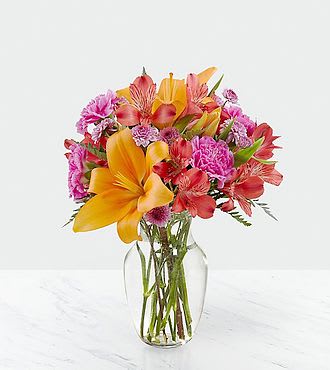
The Bloom Central flower delivery of the month for July in Jones is the Blushing Bouquet
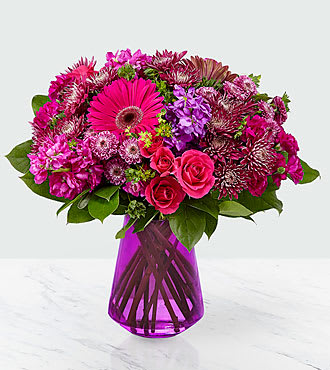
The Blushing Bouquet floral arrangement from Bloom Central is simply delightful. It exudes a sense of elegance and grace that anyone would appreciate. The pink hues and delicate blooms make it the perfect gift for any occasion.
With its stunning array of gerberas, mini carnations, spray roses and button poms, this bouquet captures the essence of beauty in every petal. Each flower is carefully hand-picked to create a harmonious blend of colors that will surely brighten up any room.
The recipient will swoon over the lovely fragrance that fills the air when they receive this stunning arrangement. Its gentle scent brings back memories of blooming gardens on warm summer days, creating an atmosphere of tranquility and serenity.
The Blushing Bouquet's design is both modern and classic at once. The expert florists at Bloom Central have skillfully arranged each stem to create a balanced composition that is pleasing to the eye. Every detail has been meticulously considered, resulting in a masterpiece fit for display in any home or office.
Not only does this elegant bouquet bring joy through its visual appeal, but it also serves as a reminder of love and appreciation whenever seen or admired throughout the day - bringing smiles even during those hectic moments.
Furthermore, ordering from Bloom Central guarantees top-notch quality - ensuring every stem remains fresh upon arrival! What better way to spoil someone than with flowers that are guaranteed to stay vibrant for days?
The Blushing Bouquet from Bloom Central encompasses everything one could desire - beauty, elegance and simplicity.
Jones Florist
Jones Flower Delivery - Frequently Asked Questions
- Does Bloom Central offer same-day flower delivery in Jones?
- Yes. Place your order online before 1:00 PM and a local Jones florist will hand-deliver your arrangement the same day. Orders can also be scheduled up to one month in advance.
- Is it safe to order flowers online?
- Absolutely! We utilize a secure, encrypted checkout to protect your personal and payment information. Visa, Mastercard, American Express, Discover, PayPal and Klarna are all accepted.
- What funeral homes does Bloom Central deliver sympathy flowers to in Jones?
- We hand-deliver sympathy and memorial floral arrangements to all funeral homes near Jones, including: Daughenbaugh Funeral Home, Furlong Funeral Home, Hollenbeck-Cahill Funeral Homes, Hubert Funeral Home, Lake View Cemetery Association, Lynch-Green Funeral Home, Oakland Cemetary Office.
- What nearby cities does Bloom Central also deliver flowers to?
- In addition to Jones, we deliver fresh flowers to many nearby cities including: Johnsonburg, St. Marys, Kane, Ridgway, Wetmore, Kersey, Shippen, Lafayette
- What are the most popular flower arrangements at the Jones florist?
- Three of our most popular arrangements at our Jones florist are: Happily Ever After Bouquet and Bear Set ($79.90), Radiant Citrus Box Bouquet ($79.90), Pink Picnic Basket ($94.90). All are available for same-day delivery.
More About Jones
Are looking for a Jones florist because you are not local to the area? If so, here is a brief travelogue of what Jones has to offer. Who knows, perhaps you'll be intrigued enough to come visit soon, partake in some of the fun activities Jones has to offer and deliver flowers to your loved one in person!
The town of Jones sits in a valley where the Appalachian ridges slump like tired shoulders, a place where the sky presses close enough to touch if you stand on the right hill at dawn. Morning here arrives as a slow negotiation between mist and sunlight, the kind of light that turns brick facades into something soft, almost alive. Residents move through the streets with a rhythm that suggests they know things the rest of us have forgotten, how to wait without impatience, how to listen to the hum of power lines in August, how to recognize a neighbor’s wave as both greeting and sacrament. It’s a town built not for tourists but for the steady accretion of days, each one layering over the last like sediment.
Drive past the single traffic light, a relic whose slow blink has timed the first steps of toddlers, the last sighs of the elderly, and you’ll find the sort of diner where the coffee tastes like it’s been brewing since the Truman administration. The waitress knows your name before you sit down. She knows your uncle’s cholesterol numbers. She asks about your sister in Scranton. The eggs arrive crisp at the edges, yolks like liquid gold, and you realize this isn’t just breakfast. It’s a communion. At the counter, retired miners and high school cross-country runners share space without speaking, bound by the unspoken agreement that everyone deserves a place to be silent together.

Same day service available. Order your Jones floral delivery and surprise someone today!
Jones has a way of folding history into its sidewalks. The old textile mill, now a community center, hosts quilting circles where women stitch patterns passed down through generations, their fingers moving as if guided by ancestral muscle memory. Teenagers skateboard in the parking lot, their laughter bouncing off walls that still hum with the ghosts of looms. The library, a Carnegie relic with stained glass windows depicting scenes from Moby-Dick, lets children check out fossils alongside books. The librarian, a woman with a voice like a pencil sketching velvet, insists stories and trilobites are equally vital to survival.
Autumn here is a fever dream of color. Maple trees ignite in reds so vivid they hurt your eyes. School buses rumble down backroads, their windows crammed with faces pressed to glass, kids marveling at the world’s refusal to stay green. Football games on Friday nights draw the whole town, not because anyone cares about touchdowns, but because the bleachers creak under the weight of collective breath, the shared hope that maybe this week, the quarterback will stop staring at his crush long enough to catch the ball. Afterward, everyone gathers at the ice cream stand, its neon sign flickering like a heartbeat, and no one mentions how the vanilla tastes better when the air smells of woodsmoke.
Winter strips the landscape to its bones. Snow muffles the streets, and porch lights glow like tiny suns against the blue-dark. Neighbors shovel each other’s driveways without being asked. They drop casseroles on doorsteps with notes that say Eat something hot. The cold sharpens the air into something holy, a reminder that survival is collaborative. By March, when the thaw turns the river into a roaring thing, kids dare each other to skim stones across ice floes, their voices carrying across water that knows the weight of glaciers.
Spring is mud and miracle. Daffodils punch through frost. The community garden, a patchwork of plots tended by nuns, mechanics, and third graders, becomes a symposium of dirt and dreams. Tomatoes are grown with the same care some reserve for prayer. At the farmers’ market, a man sells honey in jars labeled with the GPS coordinates of his hives. He’ll tell you the bees prefer dandelions to roses. You’ll believe him.
There’s a bench in the town square dedicated to someone named Esther, whose dates of birth and death are worn smooth by weather. No one remembers who she was, but the plaque says She Loved Well, which might be the only epitaph that matters. Sit there long enough and you’ll notice how the wind carries the scent of bread from the bakery, how the old men playing chess nearby argue about Eisenhower like it’s 1957, how the light falls in a way that makes every shadow seem intentional. Jones doesn’t dazzle. It doesn’t have to. It persists, gentle and stubborn, a rebuttal to the lie that bigger is better. You leave wondering if the world’s most essential truths are written not in headlines but in the quiet spaces between people who’ve decided to keep going, together.