





- Birthday
- Best Sellers
- Under $60


 $49.90

July 1, 2026
Oakland July Floral Selection
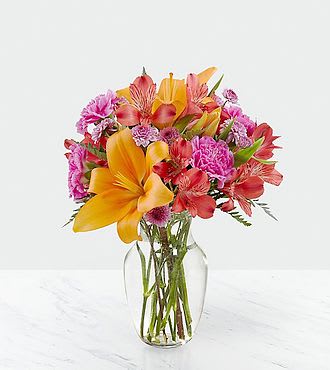
The Bloom Central flower delivery of the month for July in Oakland is the Light and Lovely Bouquet
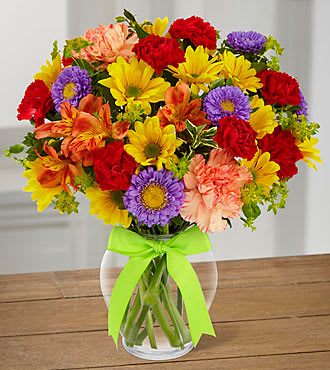
Introducing the Light and Lovely Bouquet, a floral arrangement that will brighten up any space with its delicate beauty. This charming bouquet, available at Bloom Central, exudes a sense of freshness and joy that will make you smile from ear to ear.
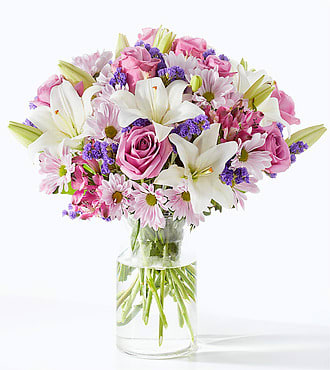
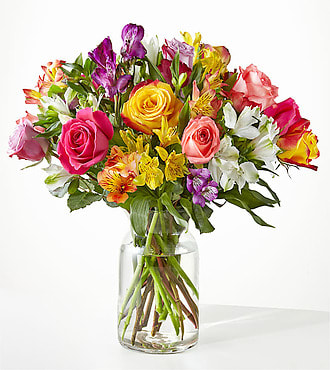
The Light and Lovely Bouquet features an enchanting combination of yellow daisies, orange Peruvian Lilies, lavender matsumoto asters, orange carnations and red mini carnations. These lovely blooms are carefully arranged in a clear glass vase with a touch of greenery for added elegance.
This delightful floral bouquet is perfect for all occasions be it welcoming a new baby into the world or expressing heartfelt gratitude to someone special. The simplicity and pops of color make this arrangement suitable for anyone who appreciates beauty in its purest form.
What is truly remarkable about the Light and Lovely Bouquet is how effortlessly it brings warmth into any room. It adds just the right amount of charm without overwhelming the senses.
The Light and Lovely Bouquet also comes arranged beautifully in a clear glass vase tied with a lime green ribbon at the neck - making it an ideal gift option when you want to convey your love or appreciation.
Another wonderful aspect worth mentioning is how long-lasting these blooms can be if properly cared for. With regular watering and trimming stems every few days along with fresh water changes every other day; this bouquet can continue bringing cheerfulness for up to two weeks.
There is simply no denying the sheer loveliness radiating from within this exquisite floral arrangement offered by the Light and Lovely Bouquet. The gentle colors combined with thoughtful design make it an absolute must-have addition to any home or a delightful gift to brighten someone's day. Order yours today and experience the joy it brings firsthand.
Local Flower Delivery in Oakland
Oakland Flower Delivery - Frequently Asked Questions
- Does Bloom Central offer same-day flower delivery in Oakland?
- Yes. Place your order online before 1:00 PM and a local Oakland florist will hand-deliver your arrangement the same day. Orders can also be scheduled up to one month in advance.
- Is it safe to order flowers online?
- Absolutely! We utilize a secure, encrypted checkout to protect your personal and payment information. Visa, Mastercard, American Express, Discover, PayPal and Klarna are all accepted.
- What funeral homes does Bloom Central deliver sympathy flowers to in Oakland?
- We hand-deliver sympathy and memorial floral arrangements to all funeral homes near Oakland, including: Allegheny Cemetery, Allegheny Cemetery, Beth Abraham Congregation, Calvary Cemetery, Coston Saml E Funeral Home, Dalessandro Funeral Home & Crematory, John N Elachko Funeral Home, McCabe Bros Inc Funeral Homes, Precious Pets Memorial Center & Crematory, Samuel J Jones Funeral Home, Schugar Ralph Inc Funeral Chapel, St Pauls Cemetery of Reserve Township, The Homewood Cemetery, Walter J. Zalewski Funeral Homes.
- What nearby cities does Bloom Central also deliver flowers to?
- In addition to Oakland, we deliver fresh flowers to many nearby cities including: Shanor-Northvue, Chicora, Homeacre-Lyndora, Meadowood, Butler, Unionville, Oak Hills, Meridian
- What are the most popular flower arrangements at the Oakland florist?
- Three of our most popular arrangements at our Oakland florist are: Eternal Affection Arrangement with Flag ($94.90), Remembrance Bouquet ($79.90), Sunny Sentiments Bouquet ($49.90). All are available for same-day delivery.
More About Oakland
Are looking for a Oakland florist because you are not local to the area? If so, here is a brief travelogue of what Oakland has to offer. Who knows, perhaps you'll be intrigued enough to come visit soon, partake in some of the fun activities Oakland has to offer and deliver flowers to your loved one in person!
Oakland, Pennsylvania, exists in a state of perpetual becoming, a neighborhood that feels less like a fixed point on a map than a sustained argument about what a city can be. To walk its streets on a crisp autumn morning, past the Gothic spires of the University of Pittsburgh, through the hum of Forbes Avenue’s coffee shops, beneath the shadow of the Cathedral of Learning, that 42-story monument to the American faith in upwardness, is to witness a collision of futures. Students lugging backpacks the size of small refrigerators weave around nurses on lunch breaks and retirees debating the merits of oat milk lattes. The air smells of fried pierogi trucks and the faint, metallic tang of ambition. Here, the past is not erased but repurposed: old trolley tracks hide under fresh asphalt; former steel magnate mansions now house think tanks where philosophers and coders argue about blockchain ethics.
The heart of Oakland beats in its public spaces, which reject the sterility of so much urban design. Schenley Plaza, a green oblong of grass and umbrellas, functions as a communal living room. On any given afternoon, undergrads sprawl with chemistry textbooks, toddlers chase pigeons into fountains, and a guy in a sandwich-board declaring “THE END IS NEAR, BUT FIRST, LET’S DISCUSS HEGEL” holds court near a crepe stand. The plaza doesn’t demand productivity or consumption. It simply exists, a rare permission to linger. Across the street, the Carnegie Museum of Natural History offers a different kind of sanctuary. Children press their palms to T. rex femur bones while their parents stare at dioramas of frozen wolves, their glass-eyed intensity a reminder that awe is ageless.

Same day service available. Order your Oakland floral delivery and surprise someone today!
What defines Oakland, though, isn’t its institutions but its collisions, the way a robotics professor might debate zoning laws with a barista while waiting for a bus, or how the Phipps Conservatory’s tropical ferns steam up the windows beside a snow-dusted parking lot in January. The conservatory itself, a labyrinth of glass and chlorophyll, feels like a metaphor for the neighborhood: fragile yet persistent, a controlled chaos of growth. Orchids curl toward skylights. Schoolkids sketch Venus flytraps, their faces inches from the soil. Outside, the Cathedral’s limestone facade glows honey-gold in the sunset, its thousand windows reflecting a thousand different skies.
Schenley Park, Oakland’s 456-acre lungs, offers a respite from the cerebral grind. Joggers pant up serpentine trails as off-leash dogs orbit them in happy loops. In the fall, the park’s trees ignite in pyrotechnic reds, drawing photographers and poets. By winter, the same slopes become a democratizing force: toddlers on sleds share the hill with physics majors testing homemade toboggans. The park refuses hierarchy. It says: Breathe. Move. Be a body. This ethos seeps into the surrounding streets, where Ethiopian restaurants share blocks with robotics startups, and a vintage clothing store’s mannequins wear both flapper beads and SpaceX t-shirts.
The neighborhood’s true currency is conversation. In Oakland, dialogue is a contact sport. At the Carnegie Library, a teenager studying for the SATs might borrow a charger from a homeless man reciting Milton. Outside the Hillman Library, clumps of students debate Kierkegaard’s teleological suspension of the ethical while eyeing the food trucks’ lunch specials. Even the squirrels seem engaged, their chittering a kind of commentary on the human spectacle.
Nightfall softens Oakland’s edges. Strings of patio lights flicker on above sidewalk cafes. The Cathedral’s upper floors glow like a lantern, a beacon for late-night scholars and insomniacs. Down below, the 61C bus sighs to a stop, exhaling passengers into the dark. There’s a sense of accumulation here, of countless small efforts stacking into something monumental. Oakland doesn’t promise answers. It offers something better: the chance to stand in the middle of a question, surrounded by others doing the same, all of you reaching.