





- New Baby
- Best Sellers
- Thank You















 $49.90
- $79.90



July 1, 2026
Swatara July Floral Selection
The Bloom Central flower delivery of the month for July in Swatara is the Hello Gorgeous Bouquet
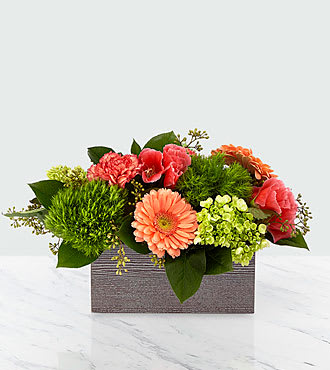
The Hello Gorgeous Bouquet from Bloom Central is a simply breathtaking floral arrangement - like a burst of sunshine and happiness all wrapped up in one beautiful bouquet. Through a unique combination of carnation's love, gerbera's happiness, hydrangea's emotion and alstroemeria's devotion, our florists have crafted a bouquet that blossoms with heartfelt sentiment.
The vibrant colors in this bouquet will surely brighten up any room. With cheerful shades of pink, orange, and peach, the arrangement radiates joy and positivity. The flowers are carefully selected to create a harmonious blend that will instantly put a smile on your face.
Imagine walking into your home and being greeted by the sight of these stunning blooms. In addition to the exciting your visual senses, one thing you'll notice about the Hello Gorgeous Bouquet is its lovely scent. Each flower emits a delightful fragrance that fills the air with pure bliss. It's as if nature itself has created a symphony of scents just for you.
This arrangement is perfect for any occasion - whether it be a birthday celebration, an anniversary surprise or simply just because the versatility of the Hello Gorgeous Bouquet knows no bounds.
Bloom Central takes great pride in delivering only the freshest flowers, so you can rest assured that each stem in this bouquet is handpicked at its peak perfection. These blooms are meant to last long after they arrive at your doorstep and bringing joy day after day.
And let's not forget about how easy it is to care for these blossoms! Simply trim the stems every few days and change out the water regularly. Your gorgeous bouquet will continue blooming beautifully before your eyes.
So why wait? Treat yourself or someone special today with Bloom Central's Hello Gorgeous Bouquet because everyone deserves some floral love in their life!
Swatara Pennsylvania Flower Delivery
Swatara Flower Delivery - Frequently Asked Questions
- Does Bloom Central offer same-day flower delivery in Swatara?
- Yes. Place your order online before 1:00 PM and a local Swatara florist will hand-deliver your arrangement the same day. Orders can also be scheduled up to one month in advance.
- Is it safe to order flowers online?
- Absolutely! We utilize a secure, encrypted checkout to protect your personal and payment information. Visa, Mastercard, American Express, Discover, PayPal and Klarna are all accepted.
- What funeral homes does Bloom Central deliver sympathy flowers to in Swatara?
- We hand-deliver sympathy and memorial floral arrangements to all funeral homes near Swatara, including: Beaver-Urich Funeral Home, Blue Ridge Memorial Gardens, Etzweiler Funeral Home, Gingrich Memorials, Hetrick-Bitner Funeral Home, Levitz Memorial Park H M, Malpezzi Funeral Home, Myers-Harner Funeral Home, Neill Funeral Home, Neill Funeral Home, Rolling Green Cemetery, Tri-County Memorial Gardens, Zimmerman-Auer Funeral Home.
- What nearby cities does Bloom Central also deliver flowers to?
- In addition to Swatara, we deliver fresh flowers to many nearby cities including: Lawnton, Bressler, Enhaut, Paxtang, Steelton, Rutherford, Highspire, Progress
- What are the most popular flower arrangements at the Swatara florist?
- Three of our most popular arrangements at our Swatara florist are: Star Spangled - A Florist Original ($59.90), Eternal Day Arrangement ($229.90), Ballet Slippers Bouquet ($49.90). All are available for same-day delivery.
More About Swatara
Are looking for a Swatara florist because you are not local to the area? If so, here is a brief travelogue of what Swatara has to offer. Who knows, perhaps you'll be intrigued enough to come visit soon, partake in some of the fun activities Swatara has to offer and deliver flowers to your loved one in person!
The sun slices through mist over Swatara Township like a blade through gauze, illuminating a place that does not so much announce itself as settle around you, soft and insistent as the Susquehanna’s breath on a July morning. This is not a town that begs for postcards. Its beauty is quieter, folded into the creases of backroads where cornfields hum with the secret lives of stalks, where the Swatara Creek carves its patient way southward, a liquid spine connecting histories. You notice first the light, how it slants through stands of sycamore, how it pools in the gravel lots of diners where men in seed caps debate the merits of John Deere over Kubota, their voices rising like steam from mugs of coffee. The air here smells of cut grass and diesel and the faint iron tang of the river, a scent that clings to your clothes like a story you can’t shake.
Drive Route 72 on a weekday afternoon and you’ll pass barns wearing their age like honor badges, their red paint bleached to the pink of a newborn’s fingers. Teenagers pedal bikes along the shoulder, backpacks slung like tortoise shells, shouting jokes that dissolve into the Doppler haze of a passing semi. At Swatara State Park, trails thread through stands of oak where deer move like rumors, there, then not there. Fishermen wade into the creek’s chill, casting lines in arcs that catch the light just so, their reflections rippling into abstraction. You get the sense that everything here is both exactly what it seems and something else entirely, a palimpsest of tract housing and colonial stonework, of Wawa parking lots and Civil War-era railroads sinking back into the earth.

Same day service available. Order your Swatara floral delivery and surprise someone today!
What binds it all isn’t geography but rhythm. Dawns arrive with the growl of school buses testing their vocal cords. Mailboxes yawn open to swallow bills and grocery circulars. At the Swatara Gap Fire Company, volunteers polish trucks until they gleam like carnival rides, ready to sprint toward someone’s worst day. In the library off Rosewood Lane, children press palms to the spines of books, their faces lit by the blue glow of computer screens and the gold of late-day sun. There’s a woman at the farmers’ market who sells honey in mason jars, each batch labeled with the month it was bottled, as if to say: This is what the summer lindens whispered. This is the autumn goldenrod’s last aria. You buy one not because you need honey but because you want to hold a season in your hands.
People speak of “community” as if it’s something you can build like a Lego set, but here it feels more like weather, a constant, gathering force. Neighbors mulch each other’s gardens unprompted. High school football games draw crowds wrapped in blankets, their cheers looping into the star-punched sky. At the rotary club, someone always remembers to ask about your sister’s knee surgery. It’s not utopia. Laundry still molds in basement hampers. Roads crater with potholes. Yet there’s a stubborn grace in the way a waitress refills your coffee three times without writing it down, in the way the old barber points out the exact spot where the trolley line once ran, his clippers tracing the air like a conductor’s baton.
Leave by the eastern backroads as evening thickens, past farmstands shuttered for the night, past a lone bicyclist pumping uphill, legs pistoning in the dying light. The valley holds the day’s warmth like a cupped palm. You think about the honey in your passenger seat, the way it will crystallize by December, how you’ll have to warm it gently to bring back its gold. It occurs to you that places like Swatara are neither escapes nor destinations but mirrors, showing us what we forget to want: a life where the small things stay luminous, where the creek keeps writing its slow, unreadable poem across the land.