





- Love & Romance
- Best Sellers
- Sympathy
 $69.90















- $297.90
- $64.90






July 1, 2026
Due West July Floral Selection
The Bloom Central flower delivery of the month for July in Due West is the Into the Woods Bouquet
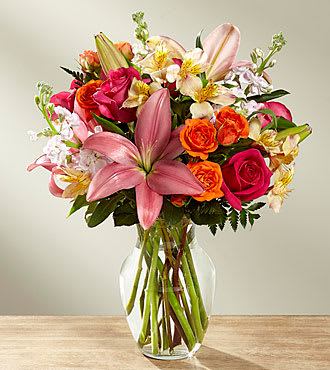
The Into the Woods Bouquet floral arrangement from Bloom Central is simply enchanting. The rustic charm and natural beauty will captivate anyone who is lucky enough to receive this bouquet.
The Into the Woods Bouquet consists of hot pink roses, orange spray roses, pink gilly flower, pink Asiatic Lilies and yellow Peruvian Lilies. The combination of vibrant colors and earthy tones create an inviting atmosphere that every can appreciate. And don't worry this dazzling bouquet requires minimal effort to maintain.
Let's also talk about how versatile this bouquet is for various occasions. Whether you're celebrating a birthday, hosting a cozy dinner party with friends or looking for a unique way to say thinking of you or thank you - rest assured that the Into the Woods Bouquet is up to the task.
One thing everyone can appreciate is longevity in flowers so fear not because this stunning arrangement has amazing staying power. It will gracefully hold its own for days on end while still maintaining its fresh-from-the-garden look.
When it comes to convenience, ordering online couldn't be easier thanks to Bloom Central's user-friendly website. In just a few clicks, you'll have your very own woodland wonderland delivered straight to your doorstep!
So treat yourself or someone special to a little piece of nature's serenity. Add a touch of woodland magic to your home with the breathtaking Into the Woods Bouquet. This fantastic selection will undoubtedly bring peace, joy, and a sense of natural beauty that everyone deserves.
Due West South Carolina Flower Delivery
Due West Flower Delivery - Frequently Asked Questions
- Does Bloom Central offer same-day flower delivery in Due West?
- Yes. Place your order online before 1:00 PM and a local Due West florist will hand-deliver your arrangement the same day. Orders can also be scheduled up to one month in advance.
- Is it safe to order flowers online?
- Absolutely! We utilize a secure, encrypted checkout to protect your personal and payment information. Visa, Mastercard, American Express, Discover, PayPal and Klarna are all accepted.
- What funeral homes does Bloom Central deliver sympathy flowers to in Due West?
- We hand-deliver sympathy and memorial floral arrangements to all funeral homes near Due West, including: Cannon Memorial Park Funerals and Cremations, Coile and Hall Funeral Directors, Cremation Society of South Carolina - Westville Funerals, Davenport Funeral Home, Duckett Robinson Funeral Home & Crematory, Dunbar Funeral Home, Fletcher Funeral & Cremation Services, Grand View Memorial Gardens, Gray Funeral Home, Hicks Funeral Home, Lord & Stephens Funeral Homes, Pruitt Funeral Home, Robinson Funeral Home & Crematory, Sosebee Mortuary and Crematory, Sprow Mortuary Services, Thomas McAfee Funeral Home- Northwest Chapel, Watkins Garrett & Wood Mortuary, Westview Memorial Park.
- What nearby cities does Bloom Central also deliver flowers to?
- In addition to Due West, we deliver fresh flowers to many nearby cities including: Honea Path, Ware Shoals, Abbeville, Lake Secession, Belton, Iva, Greenwood, Homeland Park
- What are the most popular flower arrangements at the Due West florist?
- Three of our most popular arrangements at our Due West florist are: Sangria Bouquet ($54.90), Second Chances Bouquet and Candle Set ($94.90), Special Request 200 ($200.00). All are available for same-day delivery.
More About Due West
Are looking for a Due West florist because you are not local to the area? If so, here is a brief travelogue of what Due West has to offer. Who knows, perhaps you'll be intrigued enough to come visit soon, partake in some of the fun activities Due West has to offer and deliver flowers to your loved one in person!
In the pale blue hour before dawn, Due West, South Carolina, seems less a town than a held breath. The streets lie quiet under a sky that stretches like a promise. A single traffic light blinks yellow at an intersection where two pickup trucks might, by noon, constitute a jam. The air carries the scent of dew-soaked grass and distant pine. By seven, the sun cracks the horizon, and the town stirs with a rhythm so unforced it feels almost like a counterargument to modernity. Here, time moves not in ticks but in waves, a child’s bicycle left leaning against a fence becomes a still life, a porch swing’s creak a metronome. Due West’s name, legend says, emerged from an 1850s debate among settlers about which direction to take. The story goes that one man, impatient with deliberation, pointed decisively toward the horizon. That the name endures feels less about cardinal alignment than a quiet ethos: forward, together, without equivocation.
Erskine College anchors the town, its brick buildings standing like sentinels amid oaks whose roots grip the earth with the tenacity of memory. Students crisscross the quad, backpacks slung over shoulders, faces tilted toward the possibilities of a seminar or a sunset. The college’s presence threads through daily life, a professor buys peaches at the local market, a soccer coach waves to retirees on their evening walk. Knowledge here is not an abstraction but a shared project, a hand-me-down quilt of questions and small epiphanies. The library’s windows glow amber in the dusk, offering glimpses of students hunched over books, their focus a kind of reverence.

Same day service available. Order your Due West floral delivery and surprise someone today!
Main Street unfolds in vignettes. A barber recounts high school football lore to a customer whose hair has been trimmed in the same chair since the Eisenhower administration. At the café, the clatter of dishes harmonizes with the murmur of farmers discussing rainfall and rototillers. The diner’s pie case displays slices of sweetness under glass, each a geometry of patience. Neighbors greet one another by name, their exchanges less small talk than a reaffirmation of presence. The hardware store’s owner knows which hinge fits Mrs. Lundy’s百年-old cabinet; the florist remembers that Mr. Carter prefers daisies unsullied by baby’s breath.
Autumn sharpens the air, and the town leans into ritual. Pumpkins appear on stoops, their grins carved by children who race leaves down sidewalks. At the annual harvest festival, families crowd around hayrides, their laughter rising like woodsmoke. The college’s choir performs hymns in the chapel, voices blending in a way that makes even atheists feel proximate to grace. Winter brings a hush, snowflakes settling on church steeples and the bronze statue of a Civil War soldier whose plaque urges passersby to “remember.” By spring, dogwoods erupt in blossoms so white they seem to light the streets from below.
There is a particular courage in remaining small, in resisting the pull of more. Due West does not shout. It does not strain for significance. It simply persists, a testament to the proposition that a place can be both refuge and compass, a spot where the sky feels near enough to touch, and the act of touching it requires only looking up, then stepping forward.