





- Best Value
- Best Sellers
- Under $60
 $49.90












- $49.90






July 1, 2026
Alexandria July Floral Selection
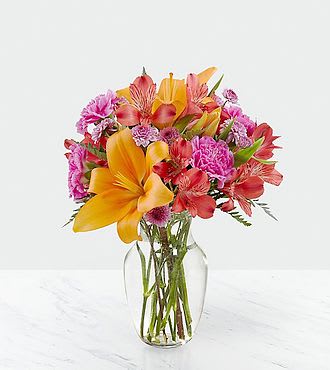
The Bloom Central flower delivery of the month for July in Alexandria is the Light and Lovely Bouquet

Introducing the Light and Lovely Bouquet, a floral arrangement that will brighten up any space with its delicate beauty. This charming bouquet, available at Bloom Central, exudes a sense of freshness and joy that will make you smile from ear to ear.
The Light and Lovely Bouquet features an enchanting combination of yellow daisies, orange Peruvian Lilies, lavender matsumoto asters, orange carnations and red mini carnations. These lovely blooms are carefully arranged in a clear glass vase with a touch of greenery for added elegance.
This delightful floral bouquet is perfect for all occasions be it welcoming a new baby into the world or expressing heartfelt gratitude to someone special. The simplicity and pops of color make this arrangement suitable for anyone who appreciates beauty in its purest form.
What is truly remarkable about the Light and Lovely Bouquet is how effortlessly it brings warmth into any room. It adds just the right amount of charm without overwhelming the senses.
The Light and Lovely Bouquet also comes arranged beautifully in a clear glass vase tied with a lime green ribbon at the neck - making it an ideal gift option when you want to convey your love or appreciation.
Another wonderful aspect worth mentioning is how long-lasting these blooms can be if properly cared for. With regular watering and trimming stems every few days along with fresh water changes every other day; this bouquet can continue bringing cheerfulness for up to two weeks.
There is simply no denying the sheer loveliness radiating from within this exquisite floral arrangement offered by the Light and Lovely Bouquet. The gentle colors combined with thoughtful design make it an absolute must-have addition to any home or a delightful gift to brighten someone's day. Order yours today and experience the joy it brings firsthand.
Alexandria Tennessee Flower Delivery
Alexandria Flower Delivery - Frequently Asked Questions
- Does Bloom Central offer same-day flower delivery in Alexandria?
- Yes. Place your order online before 1:00 PM and a local Alexandria florist will hand-deliver your arrangement the same day. Orders can also be scheduled up to one month in advance.
- Is it safe to order flowers online?
- Absolutely! We utilize a secure, encrypted checkout to protect your personal and payment information. Visa, Mastercard, American Express, Discover, PayPal and Klarna are all accepted.
- What funeral homes does Bloom Central deliver sympathy flowers to in Alexandria?
- We hand-deliver sympathy and memorial floral arrangements to all funeral homes near Alexandria, including: Austin Funeral & Cremation Services, Doak-Howell Funeral Home and Cremation Services, Forest Lawn Funeral Home & Memorial Gardens, Hendersonville Funeral Home, Hooper Huddleston & Horner Funeral Home & Cremation Services, Madison Funeral Home, Murfreesboro Funeral Home, Music City Mortuary, Nashville Funeral and Cremation, Neptune Society, Phillips-Robinson Funeral Home, Presley Funeral Home, Roselawn Memorial Gardens, Spring Hill Funeral Home and Cemetery, Stone River National Cemetery, Woodfin Funeral Chapel, Woodfin Funeral Chapel, Woodlawn-Roesch-Patton Funeral Home & Memorial Park.
- What nearby cities does Bloom Central also deliver flowers to?
- In addition to Alexandria, we deliver fresh flowers to many nearby cities including: Watertown, Gordonsville, South Carthage, Carthage, Smithville, Lebanon, Woodbury, Baxter
- What are the most popular flower arrangements at the Alexandria florist?
- Three of our most popular arrangements at our Alexandria florist are: Party Starter Bouquet ($59.90), Be Happy Bouquet ($49.90), Garden Glam Bouquet ($64.90). All are available for same-day delivery.
More About Alexandria
Are looking for a Alexandria florist because you are not local to the area? If so, here is a brief travelogue of what Alexandria has to offer. Who knows, perhaps you'll be intrigued enough to come visit soon, partake in some of the fun activities Alexandria has to offer and deliver flowers to your loved one in person!
Imagine a place where the sun rises not as an overseer but a participant, its early light filtering through stands of oak and maple to dapple the two-lane roads that ribbon across the hills. Alexandria, Tennessee, sits in the kind of quietude that hums. It is a town where the air smells of cut grass and distant rain, where the past and present share a porch swing, swaying in a rhythm so steady it feels like a form of time itself. To call it quaint would be to miss the point. Quaintness is a performance. Alexandria simply is. Drive through on a Thursday morning. Notice the way the hardware store’s screen door slaps shut behind a man in a frayed ball cap, how he pauses to wave at a woman arranging pumpkins outside the antiques shop. The wave isn’t perfunctory. It contains multitudes: How’s your mother’s knee? Did your boy win the game? Need help with those later? Here, communication happens in gestures, in the tilt of a head, the cadence of a nod. The town square, a loose constellation of brick facades and sloping sidewalks, serves as both stage and audience for a drama so ordinary it becomes profound. A teenager sweeps the floor of a family-owned diner, humming along to a jukebox playing Patsy Cline. An old farmer in mud-caked boots sips coffee at the counter, his hands around the mug like they’ve known decades of labor and still find a way to cradle something gently. Outside, a breeze carries the scent of earth from the fields that fringe the town, where soybeans and tobacco grow in rows so straight they could be geometry homework. The land itself seems conscious of its role, patient and generous, as if aware that tending it is less a chore than a kind of conversation. History here isn’t confined to plaques or museums. It’s in the weight of the limestone courthouse, built in 1846, its walls thick enough to hold a thousand secrets. It’s in the railroad tracks that stitch the town to the broader world, steel veins that once pulsed with the commerce of timber and grain. Trains still pass, their whistles echoing like ghosts with schedules to keep, but the rhythm has changed. What was once a lifeline is now a reminder, a low, resonant note in the town’s soundtrack. Ten minutes east, Center Hill Lake glitters, its waters a respite for bass fishermen and kayakers, children cannonballing off docks, couples tracing the shoreline with footprints that vanish by noon. The lake doesn’t dazzle. It doesn’t have to. It is what it is: a place where the sky dips down to touch the earth, where herons stalk the shallows with the precision of poets. Back in town, the library’s fluorescent glow spills onto the sidewalk as a girl clutches a stack of books to her chest, her face lit with the kind of hope only stories can ignite. Down the block, a barber leans in his doorway, laughing at something the florist across the street just said. You could call it a scene from another era, but that would ignore the Subaru in the pharmacy parking lot, the satellite dish on the roof of the Victorian turned law office. Alexandria isn’t resisting the future. It’s digesting it, slow and deliberate, the way a tree absorbs sunlight. There’s a particular genius to this, a recognition that progress doesn’t have to mean rupture. The annual fall festival draws crowds from neighboring counties, craft vendors, bluegrass bands, a parade featuring tractors and tumbling toddlers, but the real spectacle is the town itself, how it becomes both mirror and magnet, reflecting and attracting a certain kind of hunger. People come here, even briefly, and leave wondering what they’re missing elsewhere. Not grandiosity. Not spectacle. Just the quiet marvel of a community that knows its name, its contours, the sound of its own heartbeat. Dusk falls softly. Fireflies blink on and off above lawns where sprinklers hiss. Somewhere, a screen door creaks open, then closes. The moon climbs. Alexandria sleeps. But beneath that sleep, like roots under soil, something thrums.