





- New Baby
- Best Sellers
- Carnations










July 1, 2026
Alto July Floral Selection
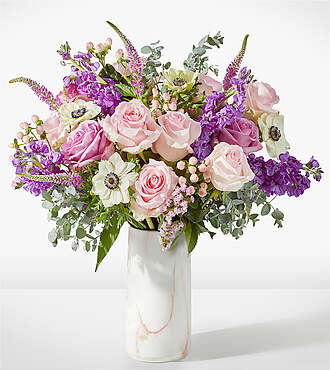
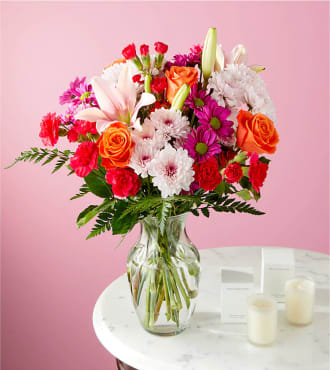
The Bloom Central flower delivery of the month for July in Alto is the Blooming Embrace Bouquet
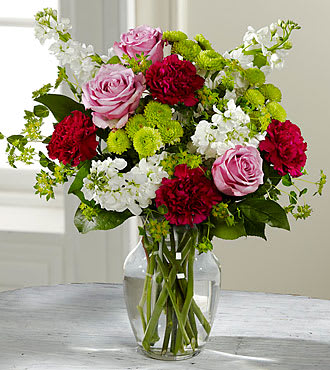
Introducing the beautiful Blooming Embrace Bouquet from Bloom Central! This floral arrangement is a delightful burst of color and charm that will instantly brighten up any room. With its vibrant blooms and exquisite design, it's truly a treat for the eyes.
The bouquet is a hug sent from across the miles wrapped in blooming beauty, this fresh flower arrangement conveys your heartfelt emotions with each astonishing bloom. Lavender roses are sweetly stylish surrounded by purple carnations, frilly and fragrant white gilly flower, and green button poms, accented with lush greens and presented in a classic clear glass vase.
One can't help but feel uplifted by the sight of this bouquet. Its joyful colors evoke feelings of happiness and positivity, making it an ideal gift for any occasion - be it birthdays, anniversaries or simply just because! Whether you're surprising someone special or treating yourself, this bouquet is sure to bring smiles all around.
What makes the Blooming Embrace Bouquet even more impressive is its long-lasting freshness. The high-quality blooms are expertly arranged to ensure maximum longevity. So you can enjoy their beauty day after day without worrying about them wilting away too soon.
Not only is this bouquet visually appealing, but it also fills any space with a delightful fragrance that lingers in the air. Imagine walking into your home and being greeted by such a sweet scent; it's like stepping into your very own garden oasis!
Ordering from Bloom Central guarantees exceptional service and reliability - they take great care in ensuring your order arrives on time and in perfect condition. Plus, their attention to detail shines through in every aspect of creating this marvelous arrangement.
Whether you're looking to surprise someone special or add some beauty to your own life, the Blooming Embrace Bouquet from Bloom Central won't disappoint! Its radiant colors, fresh fragrances and impeccable craftsmanship make it an absolute delight for anyone who receives it. So go ahead , indulge yourself or spread joy with this exquisite bouquet - you won't regret it!
Local Flower Delivery in Alto
Alto Flower Delivery - Frequently Asked Questions
- Does Bloom Central offer same-day flower delivery in Alto?
- Yes. Place your order online before 1:00 PM and a local Alto florist will hand-deliver your arrangement the same day. Orders can also be scheduled up to one month in advance.
- Is it safe to order flowers online?
- Absolutely! We utilize a secure, encrypted checkout to protect your personal and payment information. Visa, Mastercard, American Express, Discover, PayPal and Klarna are all accepted.
- What funeral homes does Bloom Central deliver sympathy flowers to in Alto?
- We hand-deliver sympathy and memorial floral arrangements to all funeral homes near Alto, including: Athens Cemetery, Autry Funeral Home, Boren-Conner Funeral Home, Cremation Of East Texas, Hannigan Smith Funeral Home, Jenkins-Garmon Funeral Home, Sensational Ceremonies, Starr Memorials, Walker & Walker Funeral Home.
- What nearby cities does Bloom Central also deliver flowers to?
- In addition to Alto, we deliver fresh flowers to many nearby cities including: Rusk, New Summerfield, Jacksonville, Nacogdoches, Grapeland, Redland, Hudson, Lufkin
- What are the most popular flower arrangements at the Alto florist?
- Three of our most popular arrangements at our Alto florist are: Backyard Party Bouquet ($69.90), Bright Spark Rose Bouquet ($84.90), Simply Enchanting Rose Bouquet ($49.90). All are available for same-day delivery.
More About Alto
Are looking for a Alto florist because you are not local to the area? If so, here is a brief travelogue of what Alto has to offer. Who knows, perhaps you'll be intrigued enough to come visit soon, partake in some of the fun activities Alto has to offer and deliver flowers to your loved one in person!
The thing about Alto, Texas, is how it doesn’t announce itself so much as unfold, a slow bloom of clapboard and red dirt and pecan trees whose branches arc over two-lane roads like cathedral buttresses. You arrive here not with the adrenal thrum of interstate exits but through a gradual negotiation, a series of turns that narrow the world from highway to farm road to gravel, until the sky itself seems closer, a blue tarp stretched taut above fields where cattle graze in diagonal lines. The town’s population, a number so modest it feels almost rude to mention, belies a density of human warmth, a sense of being held in the quiet palm of collective care. People here still wave at strangers, not the frantic windshield salute of desperation but a gentle lift of fingers from the steering wheel, a recognition that you, too, are part of the machinery of this place, even if only passing through.
What strikes you first is the sound. Or rather, the absence of sound as most Americans now understand it: the digital hum, the low-grade tinnitus of commerce, the predatory growl of traffic. Here, the auditory palette is dominated by wind in the pines, the creak of porch swings, the distant call of a rooster asserting its territory. At the Alto Family Diner, a squat brick building with neon cursive spelling “EAT” in a fever-dream pink, the clatter of dishes harmonizes with the laughter of regulars who occupy the same vinyl booths they’ve claimed since the Reagan administration. The waitress knows their orders before they speak, a telepathy born of decades-long repetition. Biscuits arrive fluffy and urgent, their steam rising in theological plumes.

Same day service available. Order your Alto floral delivery and surprise someone today!
Drive past the post office, its flag snapping in the breeze, and you’ll see the kind of small-town choreography that defies irony. A teenager on a riding mower trims the courthouse lawn with the precision of a surgeon. An elderly man in overalls rearranges tomatoes at a roadside stand, each fruit buffed to a grotesque perfection. Children pedal bikes in looping figure eights, their voices carrying across yards where laundry flaps on lines like semaphore flags. There’s a metaphysics to these rituals, a sense that every act, no matter how minor, is a thread in a fabric that holds the whole enterprise together.
The surrounding countryside insists on its own relevance. To the east, the Davy Crockett National Forest sprawls with a kind of vegetative insistence, its trails dappled with light that filters through loblolly pines. Farmers tend fields with the patient gait of men who understand soil as a living thing, a partner in dialogue. In spring, bluebonnets erupt along Highway 21, transforming the roadside into a cerulean river. You could argue that beauty this uncomplicated risks cliché, but that’s the point: Alto’s landscape refuses to perform. It simply is, a rebuttal to the curated sublime.
At the heart of it all is a paradox: the town’s apparent stillness belies a vibrant kineticism. The high school football field becomes a Friday-night vortex, drawing families who cheer not just for touchdowns but for the sheer fact of continuity. The library, housed in a converted Victorian, hosts story hours where toddlers sprawl on carpets as sunbeams spotlight dust motes above them. The annual Pecan Festival, a jubilee of pie contests and fiddle music, feels less like nostalgia than a living argument for joy as a renewable resource.
Leave Alto, and the memory that lingers isn’t any single image but a sensation, the quiet understanding that places like this persist not in spite of modernity’s churn but as a quiet counterargument. The town doesn’t shout. It doesn’t need to. It exists as a kind of proof, a reminder that community can still be a verb here, that the act of holding together remains both radical and ordinary, as sacred as the soil itself.