





- Love & Romance
- Best Sellers
- Under $60
 $69.90







- $49.90

July 1, 2026
Bronte July Floral Selection
The Bloom Central flower delivery of the month for July in Bronte is the Bountiful Garden Bouquet
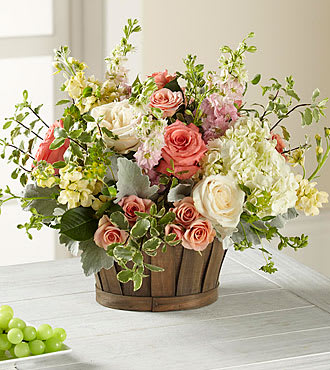
Introducing the delightful Bountiful Garden Bouquet from Bloom Central! This floral arrangement is simply perfect for adding a touch of natural beauty to any space. Bursting with vibrant colors and unique greenery, it's bound to bring smiles all around!
Inspired by French country gardens, this captivating flower bouquet has a Victorian styling your recipient will adore. White and salmon roses made the eyes dance while surrounded by pink larkspur, cream gilly flower, peach spray roses, clouds of white hydrangea, dusty miller stems, and lush greens, arranged to perfection.
Featuring hues ranging from rich peach to soft creams and delicate pinks, this bouquet embodies the warmth of nature's embrace. Whether you're looking for a centerpiece at your next family gathering or want to surprise someone special on their birthday, this arrangement is sure to make hearts skip a beat!
Not only does the Bountiful Garden Bouquet look amazing but it also smells wonderful too! As soon as you approach this beautiful arrangement you'll be greeted by its intoxicating fragrance that fills the air with pure delight.
Thanks to Bloom Central's dedication to quality craftsmanship and attention to detail, these blooms last longer than ever before. You can enjoy their beauty day after day without worrying about them wilting too soon.
This exquisite arrangement comes elegantly presented in an oval stained woodchip basket that helps to blend soft sophistication with raw, rustic appeal. It perfectly complements any decor style; whether your home boasts modern minimalism or cozy farmhouse vibes.
The simplicity in both design and care makes this bouquet ideal even for those who consider themselves less-than-green-thumbs when it comes to plants. With just a little bit of water daily and a touch of love, your Bountiful Garden Bouquet will continue to flourish for days on end.
So why not bring the beauty of nature indoors with the captivating Bountiful Garden Bouquet from Bloom Central? Its rich colors, enchanting fragrance, and effortless charm are sure to brighten up any space and put a smile on everyone's face. Treat yourself or surprise someone you care about - this bouquet is truly a gift that keeps on giving!
Bronte Florist
Bronte Flower Delivery - Frequently Asked Questions
- Does Bloom Central offer same-day flower delivery in Bronte?
- Yes. Place your order online before 1:00 PM and a local Bronte florist will hand-deliver your arrangement the same day. Orders can also be scheduled up to one month in advance.
- Is it safe to order flowers online?
- Absolutely! We utilize a secure, encrypted checkout to protect your personal and payment information. Visa, Mastercard, American Express, Discover, PayPal and Klarna are all accepted.
- What hospitals and care facilities does Bloom Central deliver to in Bronte?
- We deliver fresh flower arrangements to all hospitals, nursing homes and care facilities in Bronte Texas, including: Bronte Health And Rehab Center.
- What funeral homes does Bloom Central deliver sympathy flowers to in Bronte?
- We hand-deliver sympathy and memorial floral arrangements to all funeral homes near Bronte, including: Elliott-Hamil Funeral Home, Elmwood Funeral Home & Memorial Park, Girdner Funeral Home, Johnsons Funeral Home, McCoy Funeral Home, Norths Funeral Home, Shaffer Funeral Home, Shaffer Funeral Home, Texas State Veterans Cemetery at The Abilene.
- What nearby cities does Bloom Central also deliver flowers to?
- In addition to Bronte, we deliver fresh flowers to many nearby cities including: Robert Lee, Winters, Ballinger, Grape Creek, San Angelo, Sterling City, Sweetwater, Roscoe
- What are the most popular flower arrangements at the Bronte florist?
- Three of our most popular arrangements at our Bronte florist are: Alluring Elegance Bouquet ($89.90), Floral Confetti Bouquet Set ($124.90), Intrigue Luxury Lily and Hydrangea Bouquet - 22 Stems ($237.90). All are available for same-day delivery.
More About Bronte
Are looking for a Bronte florist because you are not local to the area? If so, here is a brief travelogue of what Bronte has to offer. Who knows, perhaps you'll be intrigued enough to come visit soon, partake in some of the fun activities Bronte has to offer and deliver flowers to your loved one in person!
The town of Bronte, Texas, does not so much announce itself as allow itself to be discovered, a quiet rebellion against the urgency of the modern world. You arrive here by accident or intention, and either way the place greets you with a sky so vast it seems to curve downward at the edges, pressing the horizon into the earth. The land here is flat but never passive, a canvas of red dirt and scrub oak that hums with a heat so thorough it feels less like weather and more like a condition of being. People move slowly here, not from lethargy but from a kind of pact with time itself, an agreement that the things worth doing, repairing a fence, watching a child chase fireflies, listening to the wind comb through wheat fields, require a patience that outlasts the clock.
Bronte’s history clings to its edges. The railroad tracks, now quiet, once thrummed with the commerce of cattle and cotton, veins that connected this speck on the map to the pulse of the nation. The town’s name, borrowed from a British novelist known for storms and passions, feels both incongruous and apt, a joke played by some long-dead surveyor who understood that the drama here is quieter, deeper, etched into the lines of ranchers’ faces and the creak of porch swings at dusk. The past is not so much preserved as inherited, carried forward in stories told at the Dairy Queen booth where farmers gather at dawn, their boots dusty, their laughter a low rumble beneath the clatter of spoons against bowls of vanilla soft-serve.

Same day service available. Order your Bronte floral delivery and surprise someone today!
What defines Bronte is not its size but its scale, the way life expands to fill the space it’s given. A single stoplight governs the main intersection, but no one hurries through it. The library, housed in a building no larger than a double-wide trailer, loans out mysteries and Westerns and picture books with the solemnity of a cathedral. At the high school football field on Friday nights, the entire town materializes under stadium lights, cheering for boys whose names they’ve known since diapers, their voices rising into the dark like a hymn. The score matters less than the ritual, the collective breath held as a kick arcs toward the goalposts, the way the crowd sways as one organism when the band strikes up the fight song.
The land itself seems to collaborate with the people. Thunderstorms barrel across the plains with biblical intensity, turning the streets into rivers, but by morning the sun bakes the earth into something usable again. Gardens flourish in unlikely patches of soil, coaxed into generosity by hands that understand the grammar of seasons. The lake south of town shimmers like a mirage, drawing fishermen and teenagers and retirees who park their folding chairs at the water’s edge, content to watch the light fracture into liquid gold.
There’s a particular alchemy to small-town life, a way of transforming isolation into intimacy. In Bronte, every transaction at the Family Dollar is also a conversation. The postmaster knows which cousins are feuding and which aunt just sent a birthday card with a $20 bill tucked inside. When someone falls ill, casseroles appear on doorsteps with the quiet efficiency of a secret society. The church bulletin board advertises potlucks and prayer chains, but the real communion happens in the parking lot, where people linger after services, squinting in the sunlight, swapping news about grandkids and the chance of rain.
To call Bronte “quaint” would miss the point. This is a place that resists nostalgia by insisting on its own present tense. The future is not an abstraction here, it’s the new calf in the pasture, the freshman quarterback practicing his spiral, the teacher who stays late to help a student parse a quadratic equation. Life in Bronte is not simple, but it is specific, a mosaic of small gestures and shared burdens. You leave wondering if the rest of the world has it backward, if the secret to surviving the 21st century isn’t more connectivity but better connections, the kind that don’t require a screen or a satellite, just a willingness to show up, to stay put, to look the world in the eye and say, without irony, This is enough.