





- New Baby
- Best Sellers
- Sympathy













 $297.90
- $64.90






July 1, 2026
Cactus July Floral Selection
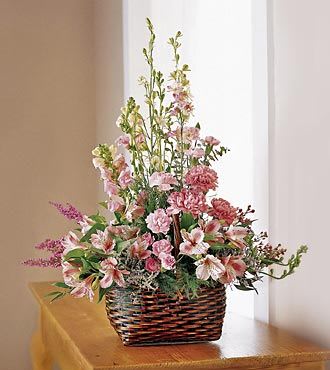
The Bloom Central flower delivery of the month for July in Cactus is the Happy Blooms Basket

The Happy Blooms Basket is a delightful floral arrangement that will bring joy to any room. Bursting with vibrant colors and enchanting scents this bouquet is perfect for brightening up any space in your home.
The Happy Blooms Basket features an exquisite combination of blossoming flowers carefully arranged by skilled florists. With its cheerful mix of orange Asiatic lilies, lavender chrysanthemums, lavender carnations, purple monte casino asters, green button poms and lush greens this bouquet truly captures the essence of beauty and birthday happiness.
One glance at this charming creation is enough to make you feel like you're strolling through a blooming garden on a sunny day. The soft pastel hues harmonize gracefully with bolder tones, creating a captivating visual feast for the eyes.
To top thing off, the Happy Blooms Basket arrives with a bright mylar balloon exclaiming, Happy Birthday!
But it's not just about looks; it's about fragrance too! The sweet aroma wafting from these blooms will fill every corner of your home with an irresistible scent almost as if nature itself has come alive indoors.
And let us not forget how easy Bloom Central makes it to order this stunning arrangement right from the comfort of your own home! With just a few clicks online you can have fresh flowers delivered straight to your doorstep within no time.
What better way to surprise someone dear than with a burst of floral bliss on their birthday? If you are looking to show someone how much you care the Happy Blooms Basket is an excellent choice. The radiant colors, captivating scents, effortless beauty and cheerful balloon make it a true joy to behold.
Cactus Texas Flower Delivery
Cactus Flower Delivery - Frequently Asked Questions
- Does Bloom Central offer same-day flower delivery in Cactus?
- Yes. Place your order online before 1:00 PM and a local Cactus florist will hand-deliver your arrangement the same day. Orders can also be scheduled up to one month in advance.
- Is it safe to order flowers online?
- Absolutely! We utilize a secure, encrypted checkout to protect your personal and payment information. Visa, Mastercard, American Express, Discover, PayPal and Klarna are all accepted.
- What nearby cities does Bloom Central also deliver flowers to?
- In addition to Cactus, we deliver fresh flowers to many nearby cities including: Sunray, Dumas, Stratford, Dalhart, Stinnett, Fritch, Gruver, Borger
- What are the most popular flower arrangements at the Cactus florist?
- Three of our most popular arrangements at our Cactus florist are: White Orchid Planter ($97.90), Easter Brunch Bouquet ($54.90), Uplifting Moments Basket ($49.90). All are available for same-day delivery.
More About Cactus
Are looking for a Cactus florist because you are not local to the area? If so, here is a brief travelogue of what Cactus has to offer. Who knows, perhaps you'll be intrigued enough to come visit soon, partake in some of the fun activities Cactus has to offer and deliver flowers to your loved one in person!
In the high plains of the Texas Panhandle, where the sky does not so much arch as devour, the town of Cactus asserts itself with the quiet tenacity of a mesquite tree. The wind here is less a breeze than a character, relentless, shaping, the kind that whittles fence posts and rearranges the earth’s dust into temporary sculptures. People move through it as if by unspoken agreement, leaning into its push, squinting against its grit, their faces etched with lines that suggest both fatigue and a peculiar kind of joy. To call Cactus “resilient” feels redundant. Resilience is the town’s syntax.
Drive down Main Street at noon, and the sun hammers the pavement into something molten. The grain elevator looms like a cathedral, its silver bulk a landmark for miles. Trucks rumble past, hauling cotton modules or cattle, their drivers waving through open windows. At the diner near the railroad tracks, regulars cluster around Formica tables, swapping stories about rain, or the lack of it, and the high school football team’s latest upset. The coffee tastes like nostalgia. The pie crusts flake in a way that implies generations of practiced hands.

Same day service available. Order your Cactus floral delivery and surprise someone today!
What outsiders might mistake for emptiness here is, in fact, a kind of negative space, an invitation to notice what thrives in the margins. Take the community garden behind the library, where sunflowers tilt their faces like curious children. Or the mural on the side of the hardware store, a splash of turquoise and gold depicting the town’s history: Comanche trails, oil derricks, a grinning mechanic holding a wrench aloft like Excalibur. The artist, a retired math teacher, shrugs when asked about symbolism. “Just wanted to make it pretty,” she says, as if beauty requires justification.
Friday nights belong to the Sandies, the high school football team whose victories and defeats bind the town in a collective heartbeat. The stadium lights draw moths and families alike, their glow a beacon against the flat, dark expanse. Teenagers in letterman jackets slouch on bleachers, trying to seem casual about their own potential. Grandparents recount plays from decades past, their voices rising over the crunch of popcorn. When the quarterback, a lanky kid who also plays trombone in the marching band, scrambles for a last-second touchdown, the crowd’s roar feels like it could levitate the goalposts.
Cactus defies the romanticism of decay. Abandoned storefronts? They become quilting studios or yoga spaces, their windows plastered with flyers for charity auctions and summer reading programs. The old movie theater, shuttered in the ’80s, now hosts a monthly storytelling night where ranchers and nurses share tales of rogue goats and first loves. Even the landscape collaborates. After a rare rain, the scrubland erupts in bluebonnets and Indian paintbrush, a fleeting carpet of color that seems to whisper: Look closer.
The people here measure time in seasons, planting, harvest, football, Christmas, and in the rhythm of mutual aid. When a hailstorm flattens a wheat crop, neighbors arrive with casseroles and skid steers. When a newborn spends weeks in an Amarillo NICU, the community fund-raiser fills a ledger with donations. There’s a phrase locals use: “making do.” It sounds like modesty but functions as a manifesto. Making do means planting trees where none should grow. It means repurposing heartache into humor. It means knowing the difference between solitude and loneliness.
At dusk, the horizon swallows the sun whole, and the sky ignites in pinks and oranges so vivid they feel like a private joke between the land and whoever bothers to look up. Porch lights flicker on. Crickets tune their instruments. Somewhere, a man on a riding mower circles his yard, trimming grass that will inevitably grow back. He waves to a passing pickup, its bed full of feed sacks, and for a moment, the gesture contains everything: recognition, solidarity, the faintest hint of a salute. This is Cactus. It does not dazzle. It endures. And in that endurance, it becomes something like grace.