





- Best Value
- Best Sellers
- Under $100
 $49.90

June 1, 2026
Corinth June Floral Selection
The Bloom Central flower delivery of the month for June in Corinth is the Blushing Bouquet
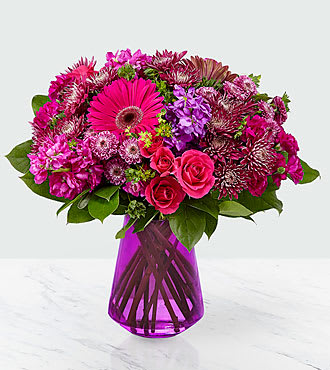
The Blushing Bouquet floral arrangement from Bloom Central is simply delightful. It exudes a sense of elegance and grace that anyone would appreciate. The pink hues and delicate blooms make it the perfect gift for any occasion.
With its stunning array of gerberas, mini carnations, spray roses and button poms, this bouquet captures the essence of beauty in every petal. Each flower is carefully hand-picked to create a harmonious blend of colors that will surely brighten up any room.
The recipient will swoon over the lovely fragrance that fills the air when they receive this stunning arrangement. Its gentle scent brings back memories of blooming gardens on warm summer days, creating an atmosphere of tranquility and serenity.
The Blushing Bouquet's design is both modern and classic at once. The expert florists at Bloom Central have skillfully arranged each stem to create a balanced composition that is pleasing to the eye. Every detail has been meticulously considered, resulting in a masterpiece fit for display in any home or office.
Not only does this elegant bouquet bring joy through its visual appeal, but it also serves as a reminder of love and appreciation whenever seen or admired throughout the day - bringing smiles even during those hectic moments.
Furthermore, ordering from Bloom Central guarantees top-notch quality - ensuring every stem remains fresh upon arrival! What better way to spoil someone than with flowers that are guaranteed to stay vibrant for days?
The Blushing Bouquet from Bloom Central encompasses everything one could desire - beauty, elegance and simplicity.
Corinth Vermont Flower Delivery
Corinth Flower Delivery - Frequently Asked Questions
- Does Bloom Central offer same-day flower delivery in Corinth?
- Yes. Place your order online before 1:00 PM and a local Corinth florist will hand-deliver your arrangement the same day. Orders can also be scheduled up to one month in advance.
- Is it safe to order flowers online?
- Absolutely! We utilize a secure, encrypted checkout to protect your personal and payment information. Visa, Mastercard, American Express, Discover, PayPal and Klarna are all accepted.
- What funeral homes does Bloom Central deliver sympathy flowers to in Corinth?
- We hand-deliver sympathy and memorial floral arrangements to all funeral homes near Corinth, including: Calvary Cemetery, Cleggs Memorial, Emmons Funeral Home, Holden Memorials, Hope Cemetery, Knight Funeral Homes & Crematory, Pruneau-Polli Funeral Home, Ricker Funeral Home & Crematory, Rock of Ages, Ross Funeral Home, Sayles Funeral Home, Twin State Monuments, VT Veterans Memorial Cemetery, Wilkinson-Beane Funeral Home & Cremation Services.
- What nearby cities does Bloom Central also deliver flowers to?
- In addition to Corinth, we deliver fresh flowers to many nearby cities including: Bradford, Washington, Topsham, Orange, Chelsea, Newbury, Fairlee, Strafford
- What are the most popular flower arrangements at the Corinth florist?
- Three of our most popular arrangements at our Corinth florist are: Pure Ivory Basket ($69.90), Heartstrings Bouquet ($69.90), Raspberry Rush Bouquet ($54.90). All are available for same-day delivery.
More About Corinth
Are looking for a Corinth florist because you are not local to the area? If so, here is a brief travelogue of what Corinth has to offer. Who knows, perhaps you'll be intrigued enough to come visit soon, partake in some of the fun activities Corinth has to offer and deliver flowers to your loved one in person!
Corinth, Vermont, sits in a valley where the land seems to fold itself around the town like a patient hand. The roads here don’t so much cut through the hills as they do negotiate with them, bending where the granite says bend, rising where the soil permits. To drive into Corinth on an October morning is to witness a negotiation between human presence and the ancient shrug of geography. The air carries the scent of turned earth and woodsmoke, and the light slants in a way that makes even the gravel sparkle. You notice first the silence, not an absence of sound but a composition of it: the creak of a weathervane, the distant churn of a tractor, the rustle of maple leaves holding fast before their final fall.
The town’s heart is a single intersection where a red clapboard general store sells gallon jugs of local syrup and galvanized buckets and copies of The Farmer’s Almanac dog-eared at the frost dates. Inside, the floorboards groan underfoot, and the proprietor knows every customer by the sound of their boots. A child buys a popsicle with coins counted twice; a farmer discusses hay yields in a tone that suggests he’s reciting poetry. The cash register rings with a clarity that feels like a minor sacrament.

Same day service available. Order your Corinth floral delivery and surprise someone today!
East of the store, a one-room library hosts a weekly story hour where toddlers sit cross-legged under a quilt stitched by a woman who remembers when the mill still spun wool. The librarian reads with her whole body, arms sweeping like branches in a storm, and the children’s laughter spills out the open windows. Down the road, the elementary school’s playground teems with motion, kids playing four square with a fervor that suggests the fate of nations hinges on each bounce. A teacher leans against the fence, nodding as a girl explains, with grave urgency, why dandelions are superior to roses.
Farms here operate less like businesses than like conversations with the soil. A dairy farmer pauses mid-chore to watch a heron stalk the edge of his pond. His cows amble across pastures so green they seem to vibrate, their bells clanking in a rhythm that syncs with the creek’s murmur. At dusk, a vegetable grower hunches over rows of kale, her hands moving with the efficiency of someone who understands that growth is both a gift and a negotiation.
In July, the town hall hosts a potluck that doubles as a dialectic on community. Casseroles and pies crowd folding tables while teenagers volunteer to bus dishes without being asked. An octogenarian fiddler plays reels that pull even the shyest onto the floor. Someone tells a joke about a moose and a mailbox; the punchline dissolves into collective laughter before it’s delivered. The room thrums with a warmth that has little to do with the woodstove in the corner.
What lingers, though, isn’t the postcard vistas or the charm of the archaic. It’s the way Corinth resists the binary of idyll and reality. Life here isn’t simpler, it’s dense with the labor of upkeep, the math of frost and harvest, the unspoken pact to pay attention. A man splitting firewood pauses to watch a hawk carve circles in the sky. A woman planting tulip bulbs waves to the mail carrier, who stops to share a rumor about an early spring. The act of noticing becomes its own discipline, a kind of covenant.
You leave wondering if the beauty of such a place lies in its refusal to be anything but itself. The hills don’t care if you admire them. The river continues its long argument with the rocks. But for a moment, driving back through the valley, you feel the faint echo of a possibility: that the art of living might simply be the art of staying present, here, in the one place that insists you look.