





- Love & Romance
- Best Sellers
- Carnations
 $69.90





July 1, 2026
Plainfield July Floral Selection
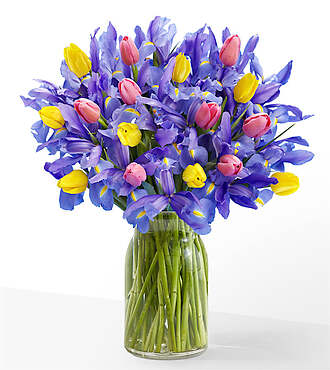
The Bloom Central flower delivery of the month for July in Plainfield is the Circling the Sun Luxury Bouquet
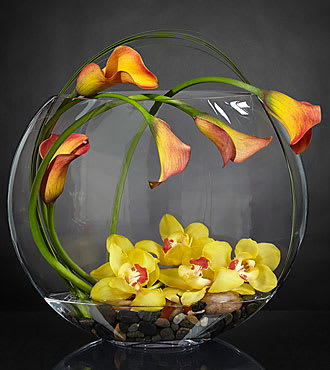
The Circling the Sun Luxury Bouquet is a floral arrangement that simply takes your breath away! Bursting with vibrant colors and delicate blooms, this bouquet is as much a work of art as it is a floral arrangement.
As you gaze upon this stunning arrangement, you'll be captivated by its sheer beauty. Arranged within a clear glass pillow vase that makes it look as if this bouquet has been captured in time, this design starts with river rocks at the base topped with yellow Cymbidium Orchid blooms and culminates with Captain Safari Mini Calla Lilies and variegated steel grass blades circling overhead. A unique arrangement that was meant to impress.
What sets this luxury bouquet apart is its impeccable presentation - expertly arranged by Bloom Central's skilled florists who pour heart into every petal placement. Each flower stands gracefully at just right height creating balance within itself as well as among others in its vicinity-making it look absolutely drool-worthy!
Whether gracing your dining table during family gatherings or adding charm to an office space filled with deadlines the Circling The Sun Luxury Bouquet brings nature's splendor indoors effortlessly. This beautiful gift will brighten the day and remind you that life is filled with beauty and moments to be cherished.
With its stunning blend of colors, fine craftsmanship, and sheer elegance the Circling the Sun Luxury Bouquet from Bloom Central truly deserves a standing ovation. Treat yourself or surprise someone special because everyone deserves a little bit of sunshine in their lives!"
Plainfield Vermont Flower Delivery
Plainfield Flower Delivery - Frequently Asked Questions
- Does Bloom Central offer same-day flower delivery in Plainfield?
- Yes. Place your order online before 1:00 PM and a local Plainfield florist will hand-deliver your arrangement the same day. Orders can also be scheduled up to one month in advance.
- Is it safe to order flowers online?
- Absolutely! We utilize a secure, encrypted checkout to protect your personal and payment information. Visa, Mastercard, American Express, Discover, PayPal and Klarna are all accepted.
- What funeral homes does Bloom Central deliver sympathy flowers to in Plainfield?
- We hand-deliver sympathy and memorial floral arrangements to all funeral homes near Plainfield, including: Boucher & Pritchard Funeral Home, Cleggs Memorial, Corbin & Palmer Funeral Home And Cremation Services, Hope Cemetery, Pruneau-Polli Funeral Home, Rock of Ages, Ross Funeral Home, Sayles Funeral Home, Stephen C Gregory And Son Cremation Service, Twin State Monuments, VT Veterans Memorial Cemetery.
- What nearby cities does Bloom Central also deliver flowers to?
- In addition to Plainfield, we deliver fresh flowers to many nearby cities including: Marshfield, Orange, Barre, East Montpelier, Groton, South Barre, Topsham, Calais
- What are the most popular flower arrangements at the Plainfield florist?
- Three of our most popular arrangements at our Plainfield florist are: Sweet and Pretty Bouquet ($49.90), I'm Sorry Bouquet ($39.90), Classic Beauty Bouquet ($69.90). All are available for same-day delivery.
More About Plainfield
Are looking for a Plainfield florist because you are not local to the area? If so, here is a brief travelogue of what Plainfield has to offer. Who knows, perhaps you'll be intrigued enough to come visit soon, partake in some of the fun activities Plainfield has to offer and deliver flowers to your loved one in person!
Imagine a town that seems to vibrate at a frequency just below the threshold of human notice, a place where the air smells like pine resin and turned earth, where the sky hangs so close in winter it feels like a held breath. This is Plainfield, Vermont, population hovering near 1,200, a speck on the map that somehow refuses to dissolve into the clichés of rural New England. To drive into Plainfield is to pass through a seam in the atmosphere. The road curves, the Green Mountains rise like the shoulders of giants shrugging off the last century, and suddenly there it is: a cluster of clapboard houses, a general store with a hand-painted sign, a single traffic light that blinks yellow as if winking at the idea of urgency.
The people here move with the deliberateness of those who understand time as a renewable resource. They tend gardens bursting with kale and sunflowers, split firewood with a rhythm that could be scored for percussion, and pause mid-task to watch bald eagles carve arcs over the Winooski River. Conversations at the post office linger. Neighbors trade zucchini and sourdough starters like currency. The librarian knows your reading habits before you do. There’s a sense of quiet collaboration here, an unspoken agreement that community is less a noun than a verb, something you do, daily, with shovels and casseroles and snow shovels.

Same day service available. Order your Plainfield floral delivery and surprise someone today!
Goddard College sits on the town’s edge, its progressive ethos seeping into the soil like mycelium. Students with backpacks and bright ideas wander into the Plainfield Co-op, debating permaculture and post-structuralism over cups of fair-trade coffee. The college’s legacy, a roster of alumni that includes poets, activists, and at least one MacArthur genius, feels both present and beside the point. What matters more is the way the campus and town lean into each other, sharing potlucks and Wi-Fi signals, turning isolation into something like intimacy.
In autumn, the hills ignite with color. Maple trees burn crimson, birches shimmer gold, and the back roads become tunnels of light. School buses trundle past farmstands piled with pumpkins, their orange so vivid it seems to hum. Winter arrives early, draping everything in a silence so thick you can hear the creak of frost tightening its grip on the fields. By March, the snowbanks slump like exhausted sentries, and the first crocuses punch through mud, defiant as fists. Spring here isn’t a season; it’s a dare.
What’s extraordinary about Plainfield is how relentlessly ordinary it insists on being. There are no neon signs, no viral landmarks, no queues of tourists clutching selfie sticks. Instead, there’s a woman on Main Street who leaves jars of wildflower honey on her porch with a honesty box. There’s a retired carpenter who builds cedar birdhouses shaped like tiny churches and gives them to kids for free. There’s the Thursday farmers’ market where the tomatoes taste like tomatoes, and the man who sells them wears a hat patched with duct tape and grins like he’s privy to a joke the rest of the world hasn’t heard yet.
To call Plainfield “quaint” would miss the point. Quaintness is a performance, a nostalgia act. This town is alive. It breathes. It argues about zoning laws and worries about broadband access and still somehow manages to gather every July for a parade where kids ride bicycles draped in streamers and the fire truck rolls by spraying rainbows from its hose. The magic here isn’t manufactured; it’s accreted, layered like sediment from a million small gestures, holding the door, plowing a driveway, remembering the name of someone’s dog.
You could drive through and see only a blur of trees and clapboard. Or you could stop, walk the dirt roads, let the place seep into you. Notice how the evening light turns the hills the color of honey. Listen to the way the river talks to itself under the ice. Feel the texture of a handshake that lasts a beat too long. Plainfield doesn’t dazzle. It persists. And in its persistence, it becomes a kind of mirror, reflecting back whatever you bring to it, cynicism, wonder, fatigue, hope. The question it asks, quietly, is the same one all great small towns ask: What if you stayed?