





- New Baby
- Best Sellers
- Under $100










July 1, 2026
West Point July Floral Selection
The Bloom Central flower delivery of the month for July in West Point is the High Style Bouquet
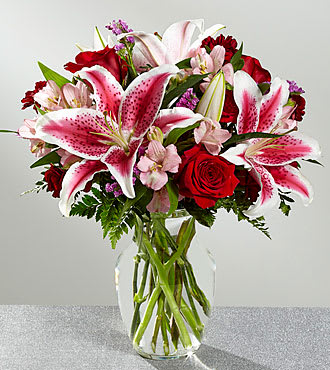
Introducing the High Style Bouquet from Bloom Central. This bouquet is simply stunning, combining an array of vibrant blooms that will surely brighten up any room.
The High Style Bouquet contains rich red roses, Stargazer Lilies, pink Peruvian Lilies, burgundy mini carnations, pink statice, and lush greens. All of these beautiful components are arranged in such a way that they create a sense of movement and energy, adding life to your surroundings.
What makes the High Style Bouquet stand out from other arrangements is its impeccable attention to detail. Each flower is carefully selected for its beauty and freshness before being expertly placed into the bouquet by skilled florists. It's like having your own personal stylist hand-pick every bloom just for you.
The rich hues found within this arrangement are enough to make anyone swoon with joy. From velvety reds to soft pinks and creamy whites there is something here for everyone's visual senses. The colors blend together seamlessly, creating a harmonious symphony of beauty that can't be ignored.
Not only does the High Style Bouquet look amazing as a centerpiece on your dining table or kitchen counter but it also radiates pure bliss throughout your entire home. Its fresh fragrance fills every nook and cranny with sweet scents reminiscent of springtime meadows. Talk about aromatherapy at its finest.
Whether you're treating yourself or surprising someone special in your life with this breathtaking bouquet from Bloom Central, one thing remains certain: happiness will blossom wherever it is placed. So go ahead, embrace the beauty and elegance of the High Style Bouquet because everyone deserves a little luxury in their life!
West Point Virginia Flower Delivery
West Point Flower Delivery - Frequently Asked Questions
- Does Bloom Central offer same-day flower delivery in West Point?
- Yes. Place your order online before 1:00 PM and a local West Point florist will hand-deliver your arrangement the same day. Orders can also be scheduled up to one month in advance.
- Is it safe to order flowers online?
- Absolutely! We utilize a secure, encrypted checkout to protect your personal and payment information. Visa, Mastercard, American Express, Discover, PayPal and Klarna are all accepted.
- What funeral homes does Bloom Central deliver sympathy flowers to in West Point?
- We hand-deliver sympathy and memorial floral arrangements to all funeral homes near West Point, including: Affinity Funeral Service, Altmeyer Funeral Home, Bennett Funeral Homes, Bliley Funeral Homes, Cold Harbor National Cemetery, Currie Funeral Home and Crematory, E. Alvin Small Funeral Homes & Crematory, F.E. Dabney Funeral Home, Glendale National Cemetery, Historische Stadt, J M Wilkerson Funeral Establishment, Mimms Funeral Service, Monaghan Funeral Home & Cremation Services, R Hayden Smith Funeral Home, Weymouth Funeral Home, Whitings Funeral Home, Woody Funeral Home Huguenot Chapel, Woody Funeral Home-Parham.
- What churches does Bloom Central deliver flowers to in West Point?
- We deliver fresh floral arrangements to all churches and places of worship in West Point, including: First Baptist Church.
- What nearby cities does Bloom Central also deliver flowers to?
- In addition to West Point, we deliver fresh flowers to many nearby cities including: Gloucester Courthouse, Williamsburg, Central Garage, Deltaville, Gloucester Point, Kilmarnock, Tappahannock, Sandston
- What are the most popular flower arrangements at the West Point florist?
- Three of our most popular arrangements at our West Point florist are: Long Stem White Rose Bouquet ($69.90), Country Basket Garden ($49.90), Garden Party Bouquet ($104.90). All are available for same-day delivery.
More About West Point
Are looking for a West Point florist because you are not local to the area? If so, here is a brief travelogue of what West Point has to offer. Who knows, perhaps you'll be intrigued enough to come visit soon, partake in some of the fun activities West Point has to offer and deliver flowers to your loved one in person!
West Point, Virginia, sits where the Mattaponi and Pamunkey Rivers marry to form the York, a geographic handshake so unassuming you might miss it if you blink while driving Route 33. The town’s name suggests a rigidity, a martial crispness, but the place itself is soft at the edges, a community folded into marshland, all tidewater sighs and pine needles rustling in humid air. To call it sleepy would miss the point. Sleep implies a stasis, a pause. Here, life hums in the low register of herons stalking the shallows, of tugboats nudging freighters toward the Chesapeake, of sunlight fracturing into a million glints on the river’s skin.
The paper mill dominates the skyline, its stacks puffing plumes that blend with clouds. It’s easy, as a visitor, to fixate on the industrial: the mill’s vastness, the railroad tracks stitching through town, the way the air carries a tang of pulp and salt. But the mill isn’t some alien monolith. Workers clock in at dawn, their trucks lining the gravel lots, their boots crunching gravel in rhythms as old as shift work itself. The mill breathes with the town. When the wind shifts, the scent of fresh-cut lumber drifts over little league fields where kids swing at fastballs, their parents cheering from bleachers that have faded to the gray of old barns.

Same day service available. Order your West Point floral delivery and surprise someone today!
Downtown stretches barely three blocks, a constellation of family-owned storefronts. At the diner, regulars nurse coffee mugs and swap stories about the one that got away, fish, yes, but also jobs, loves, the 1997 tornado that skipped over Main Street like a stone. The waitress knows everyone’s order. She calls you “hon” without irony. You could, if you wanted, map the town’s history in the cracks of the sidewalk, the flyers taped to windows advertising yard sales and lost dogs, the way the barber has hung the same signed photo of a ’70s Redskins linebacker above his chair since the Carter administration.
The rivers are the town’s pulse. At dawn, fishermen ease their skiffs into the current, nets unfurling like silver scarves. Kayakers glide past cypress knees, their paddles dipping in time to some primal metronome. Kids dare each other to leap from the railroad trestle, their shouts echoing off the water. The marshes teem with life you feel more than see: the slurp of a crab scuttling into pluff mud, the sudden splash of a bass breaking the surface, the whisper of reeds bending under the weight of a red-winged blackbird. It’s a landscape that resists grand narratives, preferring instead the quiet drama of growth and decay, tide after tide.
Trains still rumble through twice a day, their horns Doppler-shifting as they pass. The tracks divide town from river, but no one minds. The rhythm is comforting, a reminder that West Point connects to something larger, a thread in the national fabric. Yet the place feels complete unto itself. Neighbors wave from porches. Fireflies rise like sparks from lawns at dusk. The library hosts readings where locals share tales of Revolutionary skirmishes and the time a circus elephant got loose in 1912.
What lingers, though, isn’t the folklore or the scenery. It’s the sense of a community that bends but doesn’t break. Hurricanes come. The economy shifts. Through it all, West Pointers adapt with a grit that feels less like stubbornness than a kind of faith, in the rivers that sustain them, the land that holds them, the unspoken promise that tomorrow’s sunrise will gild the water just as today’s did. It’s a town that knows its identity, not as a relic or a rebrand, but as a living thing, rooted and reaching, always becoming.