





- Anniversary
- Best Sellers
- Under $80
 $69.90












- $69.90




July 1, 2026
Aztalan July Floral Selection
The Bloom Central flower delivery of the month for July in Aztalan is the Color Crush Dishgarden
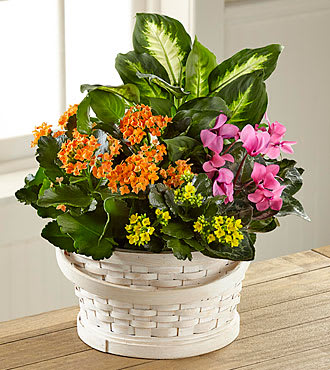
Introducing the delightful Color Crush Dishgarden floral arrangement! This charming creation from Bloom Central will captivate your heart with its vibrant colors and unqiue blooms. Picture a lush garden brought indoors, bursting with life and radiance.
Featuring an array of blooming plants, this dishgarden blossoms with orange kalanchoe, hot pink cyclamen, and yellow kalanchoe to create an impressive display.
The simplicity of this arrangement is its true beauty. It effortlessly combines elegance and playfulness in perfect harmony, making it ideal for any occasion - be it a birthday celebration, thank you or congratulations gift. The versatility of this arrangement knows no bounds!
One cannot help but admire the expert craftsmanship behind this stunning piece. Thoughtfully arranged in a large white woodchip woven handled basket, each plant and bloom has been carefully selected to complement one another flawlessly while maintaining their individual allure.
Looking closely at each element reveals intricate textures that add depth and character to the overall display. Delicate foliage elegantly drapes over sturdy green plants like nature's own masterpiece - blending gracefully together as if choreographed by Mother Earth herself.
But what truly sets the Color Crush Dishgarden apart is its ability to bring nature inside without compromising convenience or maintenance requirements. This hassle-free arrangement requires minimal effort yet delivers maximum impact; even busy moms can enjoy such natural beauty effortlessly!
Imagine waking up every morning greeted by this breathtaking sight - feeling rejuvenated as you inhale its refreshing fragrance filling your living space with pure bliss. Not only does it invigorate your senses but studies have shown that having plants around can improve mood and reduce stress levels too.
With Bloom Central's impeccable reputation for quality flowers, you can rest assured knowing that the Color Crush Dishgarden will exceed all expectations when it comes to longevity as well. These resilient plants are carefully nurtured, ensuring they will continue to bloom and thrive for weeks on end.
So why wait? Bring the joy of a flourishing garden into your life today with the Color Crush Dishgarden! It's an enchanting masterpiece that effortlessly infuses any room with warmth, cheerfulness, and tranquility. Let it be a constant reminder to embrace life's beauty and cherish every moment.
Aztalan Wisconsin Flower Delivery
Aztalan Flower Delivery - Frequently Asked Questions
- Does Bloom Central offer same-day flower delivery in Aztalan?
- Yes. Place your order online before 1:00 PM and a local Aztalan florist will hand-deliver your arrangement the same day. Orders can also be scheduled up to one month in advance.
- Is it safe to order flowers online?
- Absolutely! We utilize a secure, encrypted checkout to protect your personal and payment information. Visa, Mastercard, American Express, Discover, PayPal and Klarna are all accepted.
- What funeral homes does Bloom Central deliver sympathy flowers to in Aztalan?
- We hand-deliver sympathy and memorial floral arrangements to all funeral homes near Aztalan, including: All Faiths Funeral and Cremation Services, Becker Ritter Funeral Home & Cremation Services, Compassion Cremation Service, Cress Funeral & Cremation Service, Daley Murphy Wisch & Associates Funeral Home and Crematorium, Derrick Funeral Home & Cremation Services, Foster Funeral & Cremation Service, Gunderson Funeral & Cremation Care, Haase-Lockwood and Associates, Koepsell-Murray Funeral Home, Nitardy Funeral Home, Nitardy Funeral Home, Olsen Funeral Home, Phillip Funeral Homes, Ryan Funeral Home, Schneider Funeral Directors, St Josephs Catholic Church, Whitcomb Lynch Overton Funeral Home.
- What nearby cities does Bloom Central also deliver flowers to?
- In addition to Aztalan, we deliver fresh flowers to many nearby cities including: Johnson Creek, Jefferson, Lake Mills, Milford, Oakland, Lake Ripley, Fort Atkinson, Hebron
- What are the most popular flower arrangements at the Aztalan florist?
- Three of our most popular arrangements at our Aztalan florist are: April Showers Bouquet ($49.90), Sun Salutation Bouquet ($69.90), At First Sight Bouquet and Candle Set ($114.90). All are available for same-day delivery.
More About Aztalan
Are looking for a Aztalan florist because you are not local to the area? If so, here is a brief travelogue of what Aztalan has to offer. Who knows, perhaps you'll be intrigued enough to come visit soon, partake in some of the fun activities Aztalan has to offer and deliver flowers to your loved one in person!
The sun hangs low over Aztalan, Wisconsin, a place where the past does not whisper but hums, a steady, almost electrical thrum beneath the soles of your shoes as you walk the grass between ancient mounds. You are here, now, in this quiet corner of Jefferson County, but “here” is tricky. The limestone-strewn hillocks underfoot are not hills. They are deliberate. They are the work of hands that shaped earth a millennium ago, part of a settlement that mirrored Cahokia’s grandeur 500 miles south, a northern ripple of the Mississippian culture. Imagine it: people. Actual human beings hauling soil in baskets, piling logic into geometry, building a palisaded city where the Crawfish River offered fish and fertile silt. They lived, traded, celebrated, grieved. You can feel it if you stand very still, the eerie weight of time not as a line but as layers, like strata.
Modern Aztalan is a paradox: hushed but insistent. The reconstructed stockade towers, sharpened posts like teeth, enclose empty space, yet the air feels crowded with ghosts who refuse the passive voice. This is not a ruin. Ruins are for places abandoned by meaning. Here, the past asserts itself through absence. The mounds, their flat tops once hosting ceremonies or the homes of elites, now host picnics. Children scramble up their sides, sneakers slipping on dew-damp grass, parents squinting against the sun. You watch a toddler pause at the summit, arms out, spinning in a pure, wordless joy that transcends epochs. This, too, is ritual.

Same day service available. Order your Aztalan floral delivery and surprise someone today!
Archaeologists call Aztalan a “ceremonial center,” a term that flattens the human into the anthropological. Better to say: This was a place where people tried to solve the problem of being people. They aligned structures with solar events, buried their dead with shell beads from the Gulf, shaped clay into potsherds now displayed under glass in the visitor center. Their stories are gaps in the soil, postholes, the carbonized remains of maize. But the gaps are alive. Follow the trail to the Princess Mound, where a young woman was interred with copper jewelry, and you’ll sense the question that haunts all such sites: What do we keep? What do we carry forward?
Today, Aztalan answers by holding space for wonder. The park’s volunteers, retired teachers, local historians, teens earning community service hours, greet visitors with a zeal that feels sacred. They recite dates but also linger on the humanity: how the original inhabitants might have laughed, how they painted their faces, how they adapted when winters bit harder than expected. You notice the way sunlight glints off the river, the same light that once glinted off tools carving wood into fortifications. Aztalan does not let you romanticize the past. It demands you recognize it as real.
Drive five minutes east and you’ll hit a cornfield, then a dairy farm, then a small subdivision where bikes clutter driveways. Contemporary life pulses on, oblivious, yet the people here seem to hold Aztalan in their peripheral vision like a conscience. Local festivals echo ancestral harvest celebrations. Schoolkids build dioramas of the stockade. The past is neither kitsch nor curriculum but a kind of kin. You think of the old story about the nearby Rock Lake, where Native canoes allegedly still glide beneath the surface on foggy mornings. Legends like this aren’t escapism. They’re a way of saying: We are not the first.
By dusk, the mounds cast long shadows. A turkey vulture circles. You sit on a bench donated by the Lions Club in 1998, next to a plaque explaining the Woodland Period, and let the chronology blur. Aztalan’s genius is in its refusal to separate then from now. The people who built this place were engineers, artists, survivors. The people who walk its paths today are looking for something they can’t name. Connection, maybe. Proof that a society can vanish but leave a fingerprint. You stand to leave, brushing grass from your jeans, and realize the thrumming hasn’t stopped. It’s in you. The act of noticing, of caring, becomes its own kind of mound.