





- Best Value
- Best Sellers
- Under $100
 $49.90









July 1, 2026
Centuria July Floral Selection
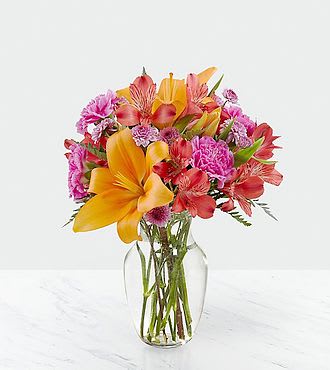
The Bloom Central flower delivery of the month for July in Centuria is the Light and Lovely Bouquet

Introducing the Light and Lovely Bouquet, a floral arrangement that will brighten up any space with its delicate beauty. This charming bouquet, available at Bloom Central, exudes a sense of freshness and joy that will make you smile from ear to ear.
The Light and Lovely Bouquet features an enchanting combination of yellow daisies, orange Peruvian Lilies, lavender matsumoto asters, orange carnations and red mini carnations. These lovely blooms are carefully arranged in a clear glass vase with a touch of greenery for added elegance.
This delightful floral bouquet is perfect for all occasions be it welcoming a new baby into the world or expressing heartfelt gratitude to someone special. The simplicity and pops of color make this arrangement suitable for anyone who appreciates beauty in its purest form.
What is truly remarkable about the Light and Lovely Bouquet is how effortlessly it brings warmth into any room. It adds just the right amount of charm without overwhelming the senses.
The Light and Lovely Bouquet also comes arranged beautifully in a clear glass vase tied with a lime green ribbon at the neck - making it an ideal gift option when you want to convey your love or appreciation.
Another wonderful aspect worth mentioning is how long-lasting these blooms can be if properly cared for. With regular watering and trimming stems every few days along with fresh water changes every other day; this bouquet can continue bringing cheerfulness for up to two weeks.
There is simply no denying the sheer loveliness radiating from within this exquisite floral arrangement offered by the Light and Lovely Bouquet. The gentle colors combined with thoughtful design make it an absolute must-have addition to any home or a delightful gift to brighten someone's day. Order yours today and experience the joy it brings firsthand.
Local Flower Delivery in Centuria
Centuria Flower Delivery - Frequently Asked Questions
- Does Bloom Central offer same-day flower delivery in Centuria?
- Yes. Place your order online before 1:00 PM and a local Centuria florist will hand-deliver your arrangement the same day. Orders can also be scheduled up to one month in advance.
- Is it safe to order flowers online?
- Absolutely! We utilize a secure, encrypted checkout to protect your personal and payment information. Visa, Mastercard, American Express, Discover, PayPal and Klarna are all accepted.
- What hospitals and care facilities does Bloom Central deliver to in Centuria?
- We deliver fresh flower arrangements to all hospitals, nursing homes and care facilities in Centuria Wisconsin, including: Sophies Manor Assisted Living II Inc.
- What funeral homes does Bloom Central deliver sympathy flowers to in Centuria?
- We hand-deliver sympathy and memorial floral arrangements to all funeral homes near Centuria, including: Brooks Funeral Home, Cremation Society Of Minnesota, Crescent Tide Funeral and Cremation, Crystal Lake Cemetary & Funeral Home, Gearhart Funeral Home, Hodroff-Epstein Memorial Chapel, Holcomb-Henry-Boom Funeral Homes & Cremation Srvcs, Johnson-Peterson Funeral Homes & Cremation, Kandt Tetrick Funeral & Cremation Services, Maple Oaks Funeral Home, Mattson Funeral Home, Methven-Taylor Funeral Home, Mueller Memorial - St. Paul, Mueller Memorial - White Bear Lake, Mueller-Bies, OHalloran & Murphy Funeral & Cremation Services, Washburn McReavy Northeast Chapel, Willwerscheid Funeral Home & Cremation Service.
- What nearby cities does Bloom Central also deliver flowers to?
- In addition to Centuria, we deliver fresh flowers to many nearby cities including: Balsam Lake, St. Croix Falls, Eureka, Milltown, Garfield, Osceola, Luck, Laketown
- What are the most popular flower arrangements at the Centuria florist?
- Three of our most popular arrangements at our Centuria florist are: Smooth Sailing Bouquet ($49.90), Serendipitous Blossoms Bouquet ($49.90), Azalea Basket ($49.90). All are available for same-day delivery.
More About Centuria
Are looking for a Centuria florist because you are not local to the area? If so, here is a brief travelogue of what Centuria has to offer. Who knows, perhaps you'll be intrigued enough to come visit soon, partake in some of the fun activities Centuria has to offer and deliver flowers to your loved one in person!
Centuria, Wisconsin, sits in the kind of quiet that feels less like an absence of sound than a presence you can hold. The town’s single traffic light blinks yellow at all hours, a metronome for the rhythm of pickup trucks and bicycles. Mornings here begin with the hiss of sprinklers and the creak of screen doors, screen doors that slam shut with a sound so familiar it might as well be the town’s heartbeat. The air smells of cut grass and diesel fuel and, on certain days, the faint tang of Lake Cynthia, which glitters just beyond the railroad tracks like a secret everyone politely agrees not to mention. People wave at strangers here. Not the performative half-lift of urban acknowledgment, but full-palmed sweeps from steering wheels or garden beds, as if to say: I see you, and you are welcome.
The downtown, a term used generously, consists of a hardware store, a diner with vinyl booths the color of ripe tomatoes, and a library housed in a former church. The library’s stained-glass windows cast prisms over copies of Little House on the Prairie and dog-eared Clive Cussler paperbacks. On Tuesdays, children gather beneath those windows for story hour, their sneakers squeaking on hardwood floors as a librarian named Marjorie reads tales of dragons and detectives, her voice bending to fit each character. Outside, old men play chess on a concrete table, their moves deliberate, their banter peppered with references to weather forecasts and the Green Bay Packers’ offensive line.

Same day service available. Order your Centuria floral delivery and surprise someone today!
What’s striking about Centuria isn’t its scale but its density, not of bodies or buildings, but of care. The high school football field doubles as a community garden in summer, rows of zucchini and sunflowers sprouting where goalposts stand sentinel. Teenagers water the plants before practice, their hands dusty, their laughter carrying across the field like birdsong. At the annual Harvest Fest, the entire population, all 893 souls, gathers to race wheelbarrows, bake pies with lattice crusts so precise they could be museum exhibits, and applaud third graders reciting patriotic poems. The fest’s highlight is a parade featuring tractors draped in crepe paper, their engines purring as kids dart between wheels to collect tossed candy.
The surrounding landscape feels like a collaborator in all this. Forests thick with white pine and oak hug the town’s edges, trails weaving through them like loose thread. In autumn, those woods ignite in reds and yellows, day hikers returning with pockets full of acorns and stories of deer frozen in golden light. Winter brings a different kind of magic: frozen lakes become skating rinks, bonfires crackling on their shores as figure eights and hockey stops etch the ice. Spring is mud and promise, the thawing earth yielding morel mushrooms and the first crocuses, which locals point to with the pride of parents at a graduation.
Yet Centuria’s true marvel is its people’s relationship with time. Clocks here seem to tick slower, not out of laziness but reverence. A mechanic might spend an hour discussing carburetors with a customer, not because he’s avoiding work, but because the conversation matters. A woman at the post office will hand your mail across the counter with both hands, a gesture that transforms routine into ritual. Even the teenagers loitering outside the gas station exhibit a patience uncommon to their species, their gazes lingering on sunsets as if they’ve been entrusted to memorize the colors.
This is not nostalgia. It’s something sturdier. Centurians know their town is imperfect, the potholes on Maple Street, the debate over whether to repair the middle school’s leaky roof, but they engage these flaws with a pragmatism edged in hope. When the river floods, as it does every few years, neighbors arrive with sandbags and coffee thermoses, their boots caked in mud, their jokes warm. When someone falls ill, casseroles materialize on doorsteps, each dish a silent vow: You are not alone.
To visit Centuria is to witness a paradox: a place that feels both lost in time and urgently present. It resists the frenetic chase for more that defines so much of modern life, opting instead to dig deep, to tend what’s already there. You leave wondering if progress might sometimes mean staying still, if the future could be built not by erasing the past but by holding it gently, like a handshake that lingers, becoming something else entirely.